Thermodynamics in Practice
First Law Applications
Energy Balances in Flowing Systems
You're already familiar with the First Law of Thermodynamics for a closed system: the change in internal energy equals the heat added minus the work done (). This works perfectly when the amount of matter inside our system boundary is fixed. But what happens when mass flows in and out, like steam through a turbine or air through a jet engine? For this, we need to analyse an open system, which we often call a control volume.
A control volume is a specific region in space that we choose for analysis. Mass and energy can cross its boundary, called the control surface.
When mass enters a control volume, it carries its own energy with it: internal, kinetic, and potential. But there's another crucial energy term we must consider. The surrounding fluid has to do work to push this mass into the control volume against the pressure inside. Likewise, the system must do work to push mass out against the surroundings. This is called flow work or flow energy.
Dealing with internal energy () and flow work () separately is cumbersome. Engineers combined them into a single, incredibly useful property: enthalpy.
Enthalpy
noun
A thermodynamic property of a system, defined as the sum of the system's internal energy and the product of its pressure and volume.
Think of enthalpy as the total energy packet carried by a unit of mass as it flows across a boundary. It conveniently bundles the internal energy and the 'entry fee' of flow work together.
The Steady-Flow Energy Equation
Most engineering devices, like turbines, pumps, and heat exchangers, operate under steady-flow conditions. This means that the mass flow rate and the properties of the fluid at any point within the control volume don't change over time. For these common scenarios, we can write a powerful energy balance called the Steady-Flow Energy Equation (SFEE).
The SFEE is a statement of the conservation of energy for a control volume under steady-flow conditions. It says that the total rate of energy entering the volume must equal the total rate of energy leaving it.
By convention, we often group the heat and work terms. Work done by the system (like a turbine's output) is positive, and heat added to the system is positive. This rearranges the equation into its most common form:
Applying the Equation
The power of the SFEE lies in its simplification for specific devices. By making reasonable assumptions, we can isolate the terms that matter most.
Nozzles and Diffusers A nozzle is a device that increases a fluid's velocity by decreasing its pressure. A diffuser does the opposite. Their primary function is to change kinetic energy.
For a nozzle:
- No work is done ().
- The process is usually very fast, so heat transfer is negligible ().
- The change in elevation is typically zero ().
The SFEE simplifies to show that the increase in kinetic energy comes from a decrease in enthalpy.
Turbines and Compressors A turbine extracts work from a high-pressure, high-temperature fluid. A compressor does the opposite, using work to increase the fluid's pressure.
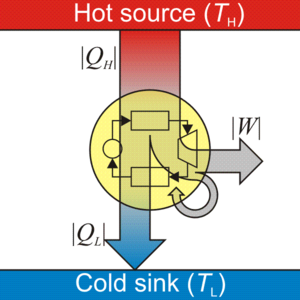
For a turbine:
- The main purpose is to produce work ( is large and positive).
- Heat transfer is often small compared to the work output and can be ignored ().
- Changes in kinetic and potential energy are usually negligible compared to the large change in enthalpy.
The SFEE shows that the work produced is equal to the drop in enthalpy across the turbine.
For a compressor, the logic is reversed. Work is put in to increase the fluid's enthalpy, resulting in . The work term would be negative, indicating work input.
What is the key distinction between a closed system and an open system (often called a control volume) in thermodynamics?
In the context of open systems, enthalpy () is a convenient property because it combines which two quantities into a single term?
The Steady-Flow Energy Equation is a cornerstone of thermal engineering, allowing us to analyse and design the machinery that powers our world by carefully tracking energy as it flows and transforms.