Thermodynamics Fundamentals
Introduction to Thermodynamics
The Study of Energy
At its heart, thermodynamics is the science of energy. It explores how energy, in the form of heat and work, moves and transforms. This might sound abstract, but it's happening all around you. It explains how a car engine converts the chemical energy in fuel into motion, how a refrigerator keeps your food cold, and even how your own body uses the energy from food to function.
Thermodynamics is the study of the relationships between heat, work, temperature, and energy, and their effect on the physical properties of matter.
To study these energy changes, we need a consistent way to talk about what we're observing. Scientists do this by breaking the universe down into two simple parts: the part they're interested in, and everything else.
System and Surroundings
Imagine you're holding a hot cup of coffee. In thermodynamics, that cup of coffee is our system—the specific part of the universe we want to study. Everything outside of that cup—the air in the room, the table it's sitting on, you—is the surroundings. The physical barrier that separates the two, the ceramic of the cup itself, is called the boundary.
The boundary is crucial because it controls how the system interacts with its surroundings. Can heat escape? Can water vapor rise from the coffee? By defining the system, surroundings, and boundary, we can track the flow of energy and matter precisely.
Types of Systems
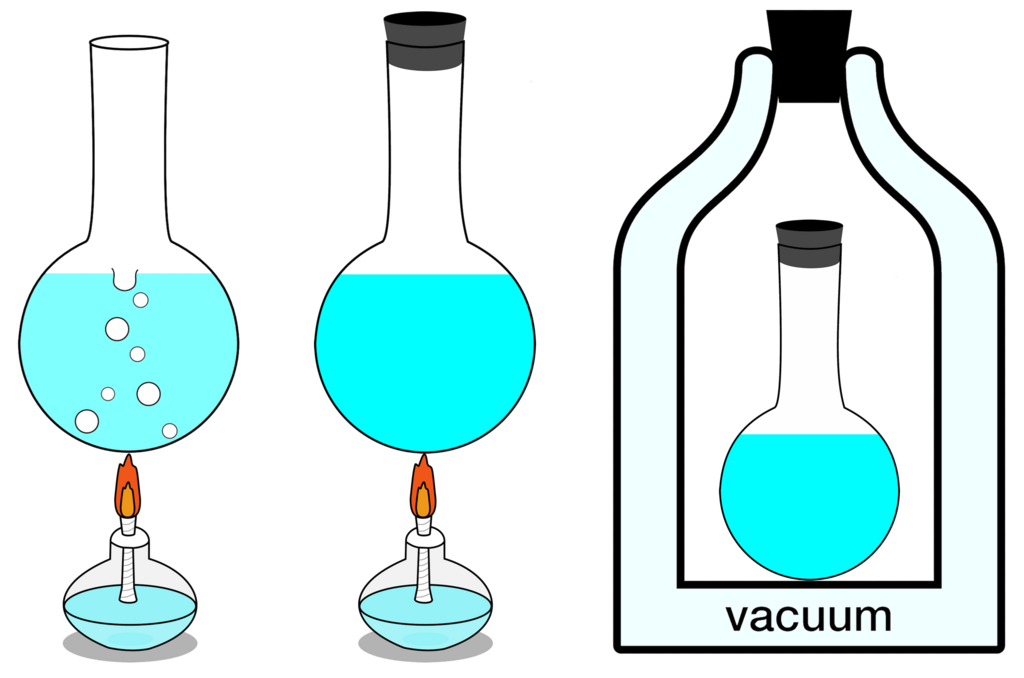
Depending on what can cross the boundary, we classify systems into three types. Understanding this distinction is key to applying thermodynamic principles.
-
Open System: Both energy (like heat) and matter (like steam) can cross the boundary. A pot of boiling water on the stove without a lid is a perfect example. It loses heat to the air and loses matter as steam escapes.
-
Closed System: Only energy can cross the boundary, not matter. Think of a tightly sealed bottle of water. You can heat it up or cool it down, but the amount of water inside remains the same.
-
Isolated System: Neither energy nor matter can cross the boundary. This is an ideal concept, but a well-insulated, sealed thermos is a close approximation. Your coffee stays hot for hours because it exchanges very little heat with the outside world, and no matter escapes.
| System Type | Energy Exchange? | Matter Exchange? |
|---|---|---|
| Open | Yes | Yes |
| Closed | Yes | No |
| Isolated | No | No |
Describing a System
To describe a system, we use measurable properties. The most common ones are temperature, pressure, volume, and energy. These properties define the system's state.
When these properties are stable and no longer changing, the system is said to be in equilibrium. A cup of coffee that has cooled to room temperature is in thermal equilibrium with its surroundings. Its temperature is constant and matches the room's temperature.
A key idea in thermodynamics is the concept of a state function. This is a property that depends only on the current state of the system, not the path it took to get there.
Think about climbing a hill. Your final altitude is a state function. It doesn't matter if you took a long, winding path or a short, steep one—your altitude is the same once you're at the top. Temperature, pressure, volume, and internal energy are all state functions. They describe the system as it is right now.
By defining systems and their properties, we create a framework for studying the fundamental laws that govern energy. These concepts are the building blocks for understanding everything from steam engines to chemical reactions.
In thermodynamics, what do we call the specific part of the universe we are studying?
A sealed can of soup being heated on a stove is an example of what kind of system?