Thermodynamics Fundamentals
Introduction to Thermodynamics
The Science of Energy
Thermodynamics is the study of energy, heat, and work. At its core, it's about how energy moves and changes form. To study these changes, scientists focus on a specific part of the universe they call a system. The system could be anything: a single-cell organism, the engine of a car, or the entire Earth's atmosphere. Everything outside the system is called the surroundings.
The boundary between a system and its surroundings is crucial. It controls what can pass between them, which leads us to three main types of systems.
Open, Closed, and Isolated
Imagine a pot of boiling water on a stove. Without a lid, it's an open system. It can exchange both energy (heat from the stove) and matter (steam escaping into the air) with its surroundings.
Now, put a tight lid on the pot. It's now a closed system. Energy can still be transferred—the pot gets hot and can warm the air around it—but matter cannot. The steam is trapped inside.
Finally, imagine pouring that hot water into a perfectly sealed and insulated thermos. This is an isolated system. In theory, it exchanges neither energy nor matter with its surroundings. The water stays hot, and no steam escapes.
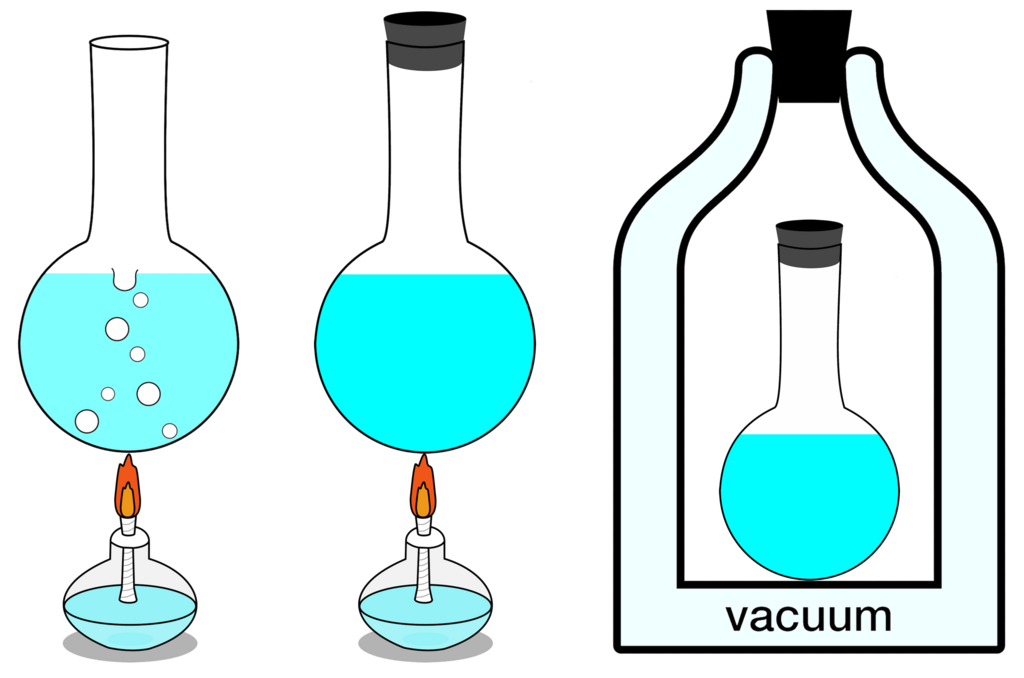
While a truly perfect isolated system doesn't exist, the concept is a useful ideal for understanding thermodynamic principles. Most systems we encounter are either open or closed.
| System Type | Exchanges Matter? | Exchanges Energy? | Example |
|---|---|---|---|
| Open | Yes | Yes | An open pot of soup |
| Closed | No | Yes | A sealed can of soda |
| Isolated | No | No | An ideal thermos |
Defining a System's State
To understand a system, we need to describe its condition, or state. We do this using measurable properties called state variables. The most fundamental of these are pressure, volume, and temperature.
Pressure () is the force the system applies on the walls of its container, spread out over the area of those walls.
Volume () is the amount of space the system takes up.
Temperature () is a measure of the average kinetic energy of the particles within the system. Hotter systems have particles that are moving more vigorously.
Knowing these values gives us a snapshot of the system at a particular moment. If any of these properties change, the system's state has changed.
Processes and Paths
A process is any transformation that takes a system from one state to another. For example, heating a gas in a cylinder is a process because it changes the system's temperature and pressure.
An important idea in thermodynamics is the state function. A state function is a property that depends only on the current state of the system, not on the path taken to get there.
Think of it like climbing a mountain. Your final elevation is a state function. It doesn't matter if you took the steep, direct path or the long, winding trail; your elevation at the summit is the same. Temperature, pressure, and volume are all state functions. The temperature of the water in our thermos is 80°C, regardless of how it was heated.
However, the work you did to climb the mountain or the heat you lost along the way depends entirely on the path you took. These are not state functions. We'll explore these path-dependent quantities, like work and heat, more as we delve deeper into the laws of thermodynamics.
Let's review these foundational concepts.
In thermodynamics, what is the term for the specific part of the universe that is being studied?
A sealed bottle of water is placed in a refrigerator. Which type of thermodynamic system does the bottle of water best represent?
These building blocks—systems, states, and processes—are the foundation for understanding how energy behaves in the world around us.