Thermodynamics and Entropy Explained
Introduction to Thermodynamics
Defining the Playing Field
Thermodynamics is the study of energy, but to study energy, we first need to be very clear about what we're studying. Imagine you're watching a pot of water come to a boil on your stove. There's the water, the pot, the stove, the air in the kitchen—a lot is going on.
In thermodynamics, we simplify this by drawing a line between the part of the universe we care about and everything else. The part we're interested in is called the system. Everything outside of it is called the surroundings. The imaginary line that separates them is the boundary.
For the boiling water, you might define the water itself as the system. The pot, the stove, and the rest of the kitchen would be the surroundings. The inner surface of the pot would be the boundary. This simple act of defining a system and its surroundings is the first step in any thermodynamic analysis.
A system is the specific portion of the universe being studied. The surroundings are everything outside the system. The boundary is the real or imaginary surface that separates them.
Open, Closed, and Isolated
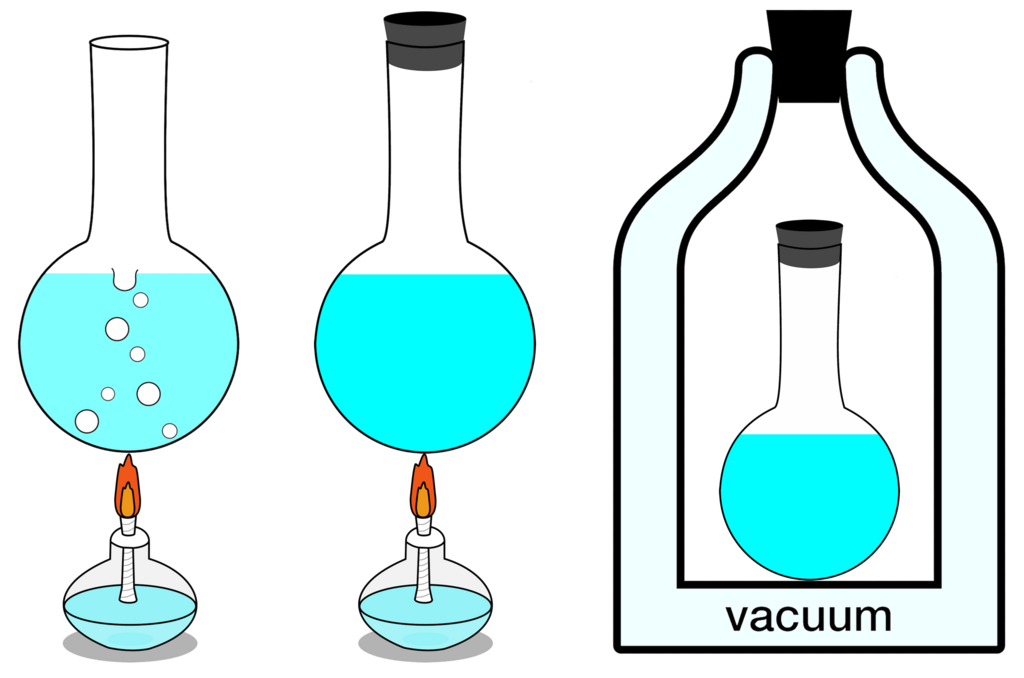
Systems aren't all the same. They're classified based on what they exchange with their surroundings across their boundary: energy (like heat or work) and matter (like atoms and molecules).
An open system can exchange both energy and matter. Our pot of boiling water without a lid is a perfect example. It's gaining energy (heat) from the stove, and it's losing matter as water evaporates into steam.
A closed system can exchange energy but not matter. If you put a tight lid on that pot of water, it becomes a closed system. Heat can still transfer in and out, but the water vapor is trapped inside. The amount of matter in the system stays constant.
An isolated system can exchange neither energy nor matter. This is a theoretical ideal, but a well-insulated, sealed thermos is a good approximation. The coffee inside stays hot and doesn't escape. For a long time, nothing gets in or out.
The State of the System
Once we've defined our system, we need a way to describe its condition, or its state. We do this using a set of measurable properties called state functions or state variables.
A key feature of a state function is that its value depends only on the current state of the system, not on how the system got there. Think about your location. Your current coordinates are a state function. It doesn't matter if you walked, drove, or biked to get there—your location is your location.
Four of the most important state functions in thermodynamics are temperature, pressure, volume, and internal energy.
Temperature
noun
A measure of the average kinetic energy of the particles in a system. It tells us how hot or cold something is.
Pressure (P) is the amount of force exerted by the system on a unit area of its container's walls. Imagine the air inside a balloon. The air particles are constantly bumping into the inner surface of the balloon, creating pressure that keeps it inflated.
Volume (V) is simply the amount of three-dimensional space the system occupies.
Temperature, pressure, and volume are macroscopic properties. We can measure them directly without knowing anything about the individual atoms or molecules.
Internal Energy (U) is a bit different. It's the sum of all the microscopic energies within the system. This includes the kinetic energy from the movement and vibration of all its molecules, plus the potential energy stored in the chemical bonds between atoms.
While we can't measure internal energy directly with a device like a thermometer or a pressure gauge, it's a crucial concept. The change in internal energy is what connects heat, work, and the transformations we see in a system.
A sealed, perfectly insulated thermos containing hot coffee is the best real-world approximation of which type of system?
Which of the following properties is NOT a state function?
These concepts—system, surroundings, and state functions—are the basic building blocks of thermodynamics. By using them, we can precisely describe and analyze how energy behaves in the world around us.