Thermodynamics and Applications of Condensation
Thermodynamics of Saturation
Pressure in the Air
The air around us isn't a single substance. It's a mixture of gases, primarily nitrogen, oxygen, argon, and a variable amount of water vapor. Each gas in this mixture exerts its own pressure, independent of the others. This is known as its partial pressure.
The total atmospheric pressure you feel is the sum of all these individual partial pressures. This concept is formalized by , which states that the total pressure of a gas mixture is the sum of the partial pressures of its component gases. For atmospheric air, this means:
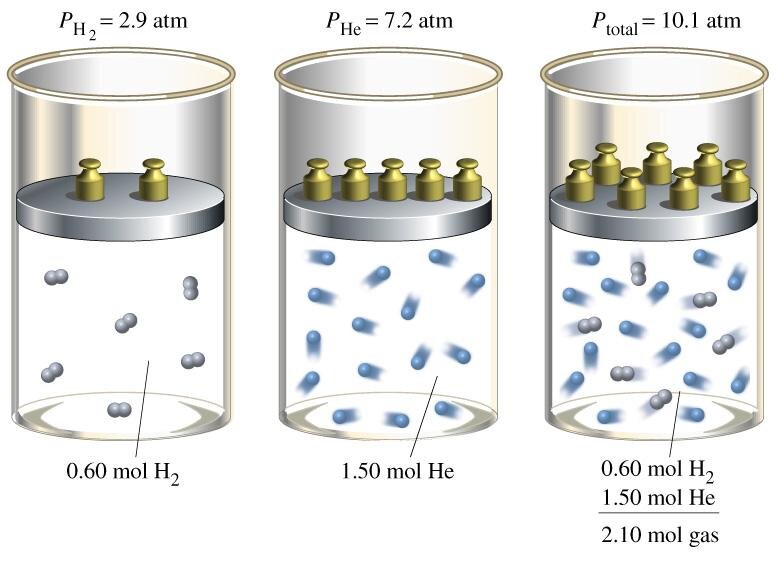
The partial pressure of water vapor is particularly important for weather and many industrial processes. It tells us exactly how much water is present in the air as a gas. When this partial pressure reaches a specific maximum value for a given temperature, the air is considered saturated.
Vapor-Liquid Equilibrium
Saturation is a state of dynamic equilibrium. At the boundary between liquid water and air, water molecules are constantly escaping the liquid surface (evaporation) while others are re-entering it from the gas phase (condensation). When the air is unsaturated, evaporation happens faster than condensation. When the air is saturated, the rates of evaporation and condensation are equal. This delicate balance is called vapor-liquid equilibrium (VLE).
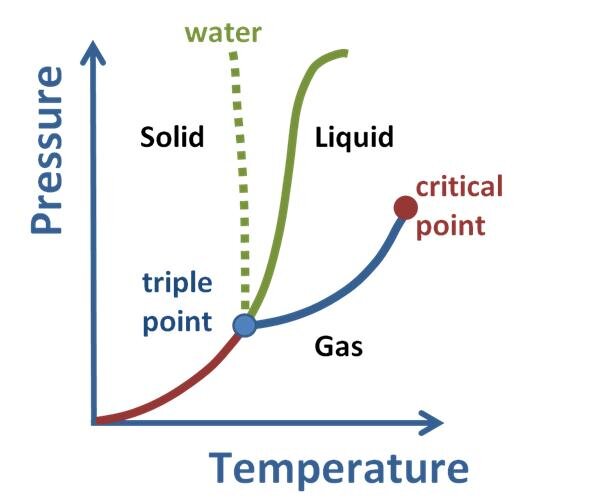
If you take a parcel of moist, unsaturated air and cool it down without changing its pressure, the amount of water vapor it can hold decreases. The partial pressure of the water vapor remains the same, but the saturation vapor pressure drops. Eventually, you reach a temperature where the actual partial pressure equals the saturation vapor pressure. This temperature is the dew point. Any further cooling will force the excess water vapor to condense into liquid water.
Cooling moist air doesn't remove water vapor; it lowers the air's capacity to hold water vapor, forcing it toward saturation.
The Clausius-Clapeyron Relation
The relationship between saturation vapor pressure and temperature is not linear. As temperature increases, the saturation vapor pressure grows exponentially. This crucial relationship is described by the Clausius-Clapeyron equation, a cornerstone of thermodynamics.
This equation provides the quantitative muscle behind the concept of dew point. It allows us to calculate how much the saturation vapor pressure will change for a given change in temperature, explaining why even a small drop in temperature on a humid evening can lead to significant dew or fog formation.
The Energetics of Condensation
So, what fundamentally drives a phase change like condensation? The answer lies in a thermodynamic quantity called (). A process, like water vapor turning into liquid, will only happen spontaneously if it leads to a decrease in the system's Gibbs free energy. In other words, nature favors lower energy states.
For condensation to occur, the Gibbs free energy of the vapor must be greater than that of the liquid (). At saturation, the system is in equilibrium. Here, the Gibbs free energy of the two phases is exactly equal (), and there is no net change. This condition of equal energy is the thermodynamic definition of the phase boundary you see on a phase diagram.
By understanding these principles—from the simple sum of partial pressures to the complex interplay of energy and temperature—we can predict and control condensation in everything from weather forecasting to industrial drying processes.
Which law states that the total pressure of a gas mixture is the sum of the partial pressures of its individual component gases?
What does the partial pressure of water vapor in the air specifically indicate?