Theology and Structure of Matthew
Matthew's Mosaic Typology
The New Moses
The Gospel of Matthew is a masterclass in theological architecture. The author doesn't just tell a story; they build an argument. A key part of this argument is presenting Jesus as a new and greater Moses. To do this, Matthew uses a literary technique called typology, where people and events in the Old Testament are seen as prefiguring, or acting as a “type” for, people and events in the New Testament.
Matthew deliberately structures his Gospel into five major sections of teaching, a clear echo of the five books of Moses, known as the Torah or Pentateuch. This isn't a coincidence. It’s a structural clue that invites the reader to see Jesus as a new lawgiver, one who has the authority to interpret and fulfill the law given through Moses.
An Ordered History
Matthew begins not with a dramatic event, but with a list of names: a genealogy. This isn't just a family tree. It's a theological statement that firmly roots Jesus in the history of Israel. The list connects Jesus directly to two of the most important figures in Jewish history: Abraham, the father of the covenant, and King David, from whose line the Messiah was expected to come.
The genealogy is meticulously arranged into three distinct sections, each containing fourteen generations. This highly stylized structure emphasizes that history is not random but is unfolding according to a divine plan.
| Section 1 | Section 2 | Section 3 |
|---|---|---|
| Abraham to David | David to the Babylonian Exile | The Exile to Jesus |
| 14 Generations | 14 Generations | 14 Generations |
Why fourteen? The number itself is significant. In Hebrew, letters have numerical values, a practice known as gematria. The name “David” (דוד) has a numerical value of fourteen (4+6+4). By structuring the genealogy around three sets of fourteen, Matthew is shouting, “Jesus is the son of David!”
Notably, Matthew includes four Gentile women in this otherwise patriarchal lineage: Tamar, Rahab, Ruth, and Bathsheba. Their inclusion is a subtle hint at one of Matthew’s key themes: the good news of Jesus is not just for Israel, but for all nations.
Echoes of the Exodus
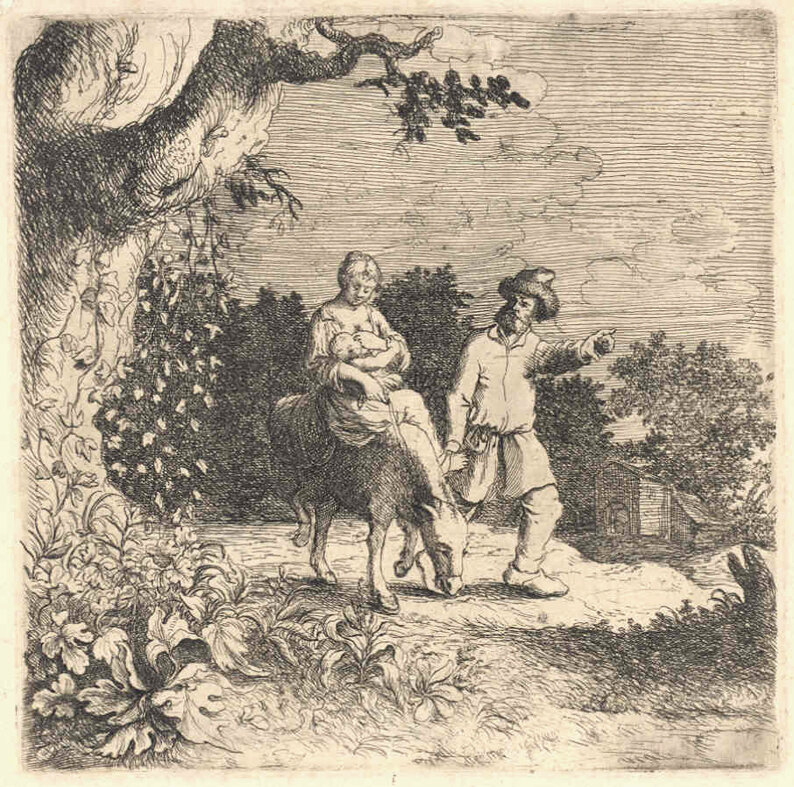
The parallels between Jesus and Moses become even clearer in Matthew’s infancy narrative. Just as Pharaoh ordered the death of all male Hebrew infants, King Herod orders the slaughter of the innocents in Bethlehem. And just as Moses was saved and later led his people out of Egypt, the infant Jesus escapes to Egypt and returns after Herod’s death.
To make sure his readers don't miss the point, Matthew repeatedly uses a literary device scholars call “Formula Citations.” He will describe an event in Jesus' life and then state, “This was to fulfill what the Lord had spoken by the prophet...” before quoting a passage from the Old Testament.
The typology continues as Jesus begins his public ministry. Moses led the Israelites through the waters of the Red Sea, an event that marked their liberation from slavery. Jesus begins his work by passing through the waters of baptism in the Jordan River. Following this, Moses spent forty years in the wilderness leading Israel; Jesus is driven into the wilderness to be tested for forty days.
The pattern is deliberate: a threat from a king, a journey to Egypt, a passage through water, and a period of testing in the wilderness. For Matthew's audience, these parallels would have been unmistakable.
This carefully constructed parallel culminates in Jesus's role as a teacher. Moses ascended Mount Sinai to receive the Law from God. Jesus goes up on a mountain to deliver his most famous block of teaching, the Sermon on the Mount. In doing so, he presents himself not as one who abolishes the Law of Moses, but as the one with the ultimate authority to interpret and fulfill it.
What is the primary theological reason Matthew structures his Gospel into five major teaching sections?
The arrangement of Jesus's genealogy into three sets of fourteen generations is a literary device intended to emphasize Jesus's connection to which key figure?