The World of Terahertz Radiation
Introduction to Terahertz Radiation
The Terahertz Gap
The electromagnetic spectrum is a vast continuum of radiation, from long radio waves to energetic gamma rays. Tucked between microwaves and infrared light lies a less-famous region: terahertz (THz) radiation. This band occupies frequencies from about 0.1 to 10 terahertz, or 100 billion to 10 trillion cycles per second.
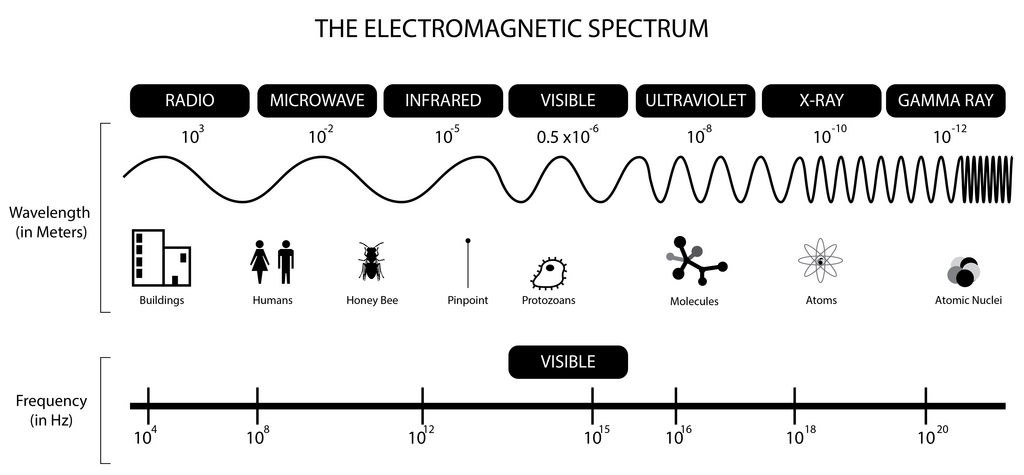
For a long time, this part of the spectrum was a scientific frontier, often called the “THz gap.” Why? Because generating and detecting these waves has been uniquely challenging. Traditional electronics, used for creating microwaves, struggle to operate at such high frequencies. Meanwhile, optical methods, used for infrared light, aren't efficient at these lower energies. This technological gap has made THz radiation difficult to harness, but new technologies are rapidly closing it.
Special Properties
What makes terahertz waves so interesting is their unique interaction with matter. One of their most important characteristics is that they are non-ionizing. Unlike X-rays or gamma rays, THz photons don't have enough energy to knock electrons out of atoms or molecules. This means they can pass through materials, including human tissue, without causing damage.
Because it's non-ionizing, terahertz radiation offers a safe way to see through certain materials.
THz radiation has a fascinating transparency profile. It can penetrate many common materials like paper, clothing, cardboard, and plastics. However, it is strongly absorbed by water and other polar liquids, and it is reflected by metals. This selective transparency is incredibly useful.
Future Applications
The unique properties of THz waves open the door to many potential applications. In security, they could be used to scan people and packages for concealed items without harmful radiation. In manufacturing, they could inspect products for defects hidden beneath the surface.
Another powerful application is spectroscopy. Many chemicals have a distinct “fingerprint” in the terahertz range, meaning they absorb specific THz frequencies. This could be used for everything from detecting explosives to identifying pollutants or analyzing the chemical makeup of pharmaceuticals. As researchers continue to develop better ways to generate and detect THz radiation, we can expect to see these applications and more become part of our daily lives.
Let's check what you've learned.
The so-called “THz gap” in the electromagnetic spectrum refers to the region between which two types of radiation?
Why is terahertz (THz) radiation considered safe for applications like scanning people?
The 'THz gap' is closing, and with it comes a new window into the world around us.