The World of Synthesizers
Introduction to Sound
What Is Sound?
At its core, sound is simple: it's a vibration. When an object vibrates, it disturbs the particles of a medium around it, like air. These particles bump into their neighbors, which then bump into their neighbors, creating a wave of energy that travels from the source. When this wave reaches our ears, our brain interprets it as sound.
Think of dropping a pebble into a still pond. The pebble creates ripples that travel outward. A sound wave is similar, but instead of water, it's usually moving through the air. The wave itself is a pattern of changing air pressure. Some parts of the wave have particles crowded together (high pressure), while others have them spread apart (low pressure).
To understand sound, we need to look at the three main properties that define any sound wave: frequency, amplitude, and timbre.
The Building Blocks of Sound
Every sound you hear, from a whisper to a symphony, can be described by its fundamental characteristics. Let's break them down.
Frequency
noun
The number of complete wave cycles (vibrations) that occur in one second.
Frequency is measured in Hertz (Hz). A wave that completes 100 cycles in a second has a frequency of 100 Hz. In music, we perceive frequency as pitch. A high frequency creates a high-pitched sound, like a flute, while a low frequency creates a low-pitched sound, like a tuba.
Amplitude
noun
The intensity or 'size' of a sound wave, which determines its volume.
Amplitude is related to the amount of energy in the wave. We perceive amplitude as loudness. A wave with a large amplitude displaces more air particles, resulting in a louder sound. A small amplitude means a quieter sound. Amplitude is often measured in decibels (dB).
Timbre
noun
The character or quality of a musical sound or voice as distinct from its pitch and intensity.
Timbre (pronounced TAM-ber) is what makes a trumpet sound different from a violin, even when they play the same note at the same volume. It's often called the tone quality or tone color.
Timbre is determined by the complexity of the sound wave. Most sounds aren't a single, pure frequency. They are a mix of a main frequency, called the fundamental, and a series of quieter, higher frequencies called overtones or harmonics. The specific combination and loudness of these harmonics give an instrument its unique voice.
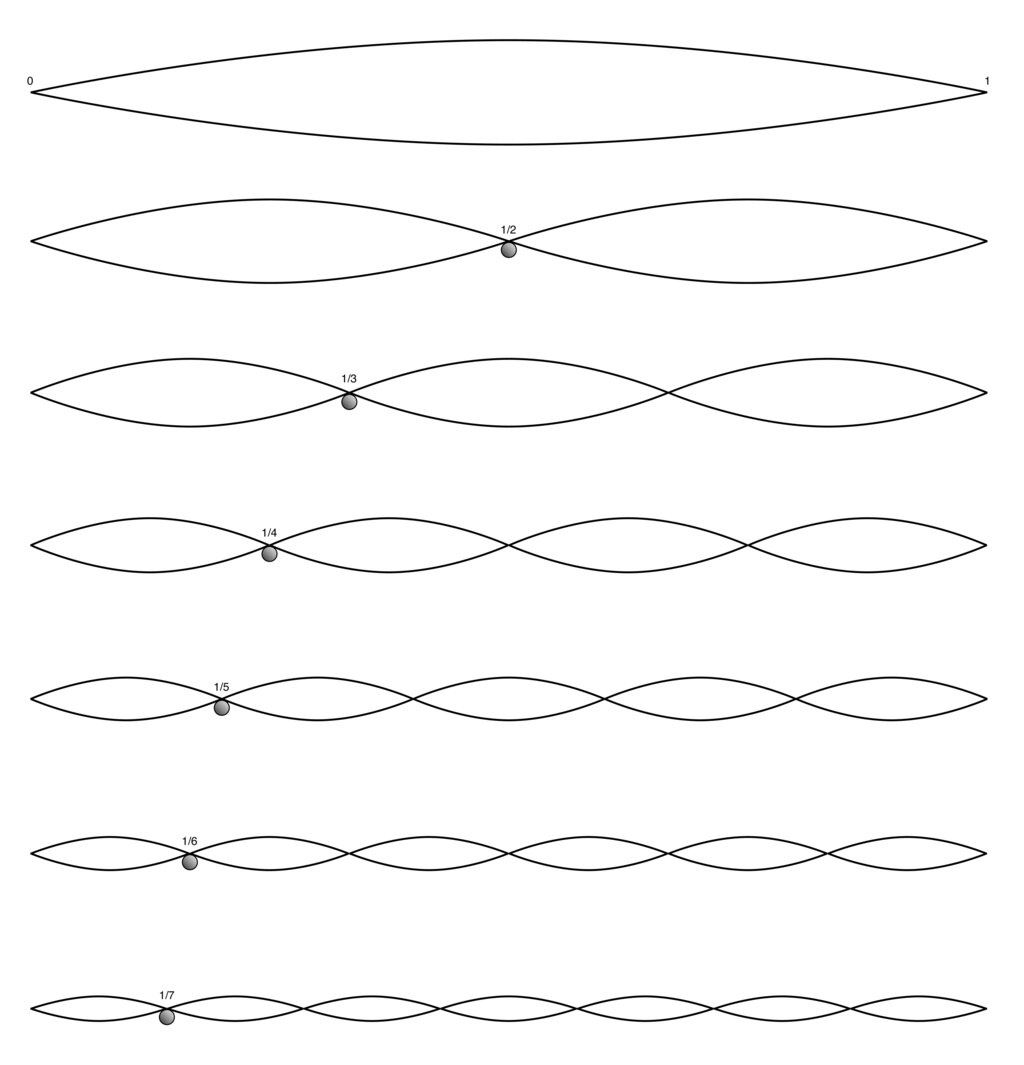
The Shapes of Sound
The relationship between the fundamental frequency and its overtones creates the overall shape of the sound wave, or its waveform. In sound synthesis, we often start with very simple, mathematically perfect waveforms.
Different waveforms have distinct timbres because they are made of different combinations of harmonics.
Here are a few of the most basic shapes:
-
Sine Wave: The purest waveform. It contains only the fundamental frequency with no overtones. It has a very smooth, clean, and gentle sound, like a soft whistle or a tuning fork.
-
Square Wave: In addition to the fundamental, it contains only odd-numbered harmonics (3rd, 5th, 7th, etc.). This gives it a bright, buzzy, and somewhat hollow sound, often associated with classic video game music.
-
Sawtooth Wave: This wave contains both even and odd harmonics. Its rich, full spectrum of overtones gives it a very sharp, bright, and brassy sound. It's a great starting point for creating string or brass sounds.
-
Triangle Wave: Like the square wave, this one has only odd harmonics. However, the harmonics are much quieter, resulting in a sound that's softer and more mellow, similar to a flute.
Understanding these basic properties—frequency, amplitude, and timbre—is the first step toward understanding how any sound is created, whether from an acoustic instrument or an electronic synthesizer.
What is the fundamental physical phenomenon that creates sound?
Which property of a sound wave do we perceive as pitch?