The World of Newspapers
Origins of Newspapers
News Before Print
Long before printing presses and the internet, people still craved news. Rulers needed to communicate with their subjects, merchants needed to know about trade routes, and citizens were curious about events in faraway lands. Information spread through town criers, handwritten letters, and official proclamations.
In ancient Rome, the state carved daily notices onto stone or metal tablets. These were called the Acta Diurna, which translates to "Daily Acts" or "Daily Public Records." Posted in public places like the Roman Forum, they informed citizens about governmental decrees, military victories, notable births and deaths, and even human-interest stories. While not newspapers in the modern sense, they were one of the first forms of regular, state-sponsored public announcements.

A similar practice existed in China during the Han dynasty. Government officials circulated news sheets among a select group of bureaucrats. These reports, known as dǐbào, covered court appointments, political news, and imperial edicts. For centuries, these palace reports were copied by hand and distributed across the vast empire, serving as a vital tool for imperial administration.
palace report
A Revolution in Print
The game changed completely in the 15th century. Around 1440, Johannes Gutenberg's invention of the printing press with movable type made it possible to produce written materials quickly and cheaply. Before this, every book or document had to be painstakingly copied by hand, a slow and expensive process that limited the spread of information to the wealthy and the clergy.
The printing press didn't just make more books. It made information accessible to a much broader audience, fueling the Renaissance, the Reformation, and the scientific revolution.
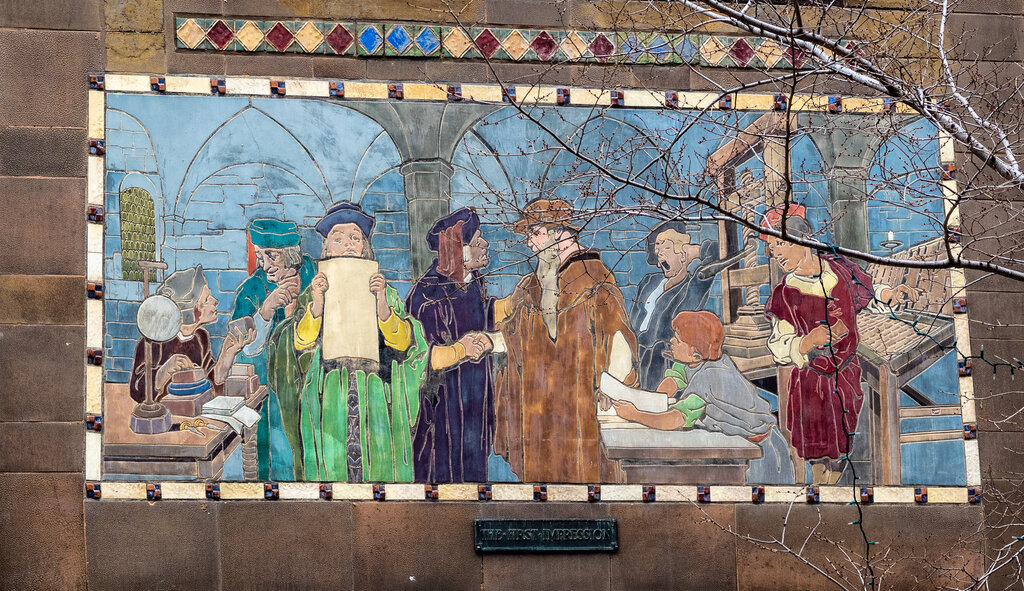
Initially, the press was used to print books, especially the Bible. But printers soon realized there was a market for timely information. They began producing short, informal pamphlets and news-books, often focused on a single sensational event—a major battle, a royal wedding, or a strange celestial phenomenon. These were the direct ancestors of the newspaper, feeding a growing public appetite for current events.
The First Newspapers Appear
The first publications that we would recognize as newspapers emerged in the early 17th century. They differed from earlier pamphlets because they were published regularly, usually weekly. This regularity established a loyal readership and created the expectation of a continuous flow of news.
Germany was the birthplace of the newspaper. The Relation aller Fürnemmen und gedenckwürdigen Historien (“Account of all distinguished and commemorable news”), first printed in Strasbourg in 1605, is widely considered the world's first newspaper. Others soon followed in cities like Wolfenbüttel and Frankfurt.
These early papers were modest, often just a single sheet. They reported on political developments, military conflicts, and trade news from across Europe, relying on networks of correspondents and postal carriers for information.
From Germany, the idea of a weekly news publication spread rapidly. Amsterdam became a major center for news, thanks to its international trade connections and relative press freedom. By the 1620s, newspapers were being printed in England, France, and Italy.
This new medium connected people to the world beyond their own town or village in a way that had never been possible before. It laid the foundation for a more informed public and changed the relationship between rulers and the ruled forever.
What was the name of the daily public notices carved onto stone or metal tablets in ancient Rome?
What key feature distinguished the first true newspapers of the early 17th century from earlier pamphlets and news-books?