The World of Mathematics
Introduction to Mathematics
The Science of Patterns
What is mathematics? It's more than just numbers and equations. At its heart, mathematics is the study of patterns, structure, and change. It's a universal language that allows us to describe the world around us, from the orbit of planets to the growth of a tiny seed. It gives us a framework for thinking logically, solving problems, and making sense of complex information.
Mathematics
noun
The abstract science of number, quantity, and space, either as abstract concepts (pure mathematics), or as applied to other disciplines such as physics and engineering (applied mathematics).
Think of it as a toolkit for the mind. Whether you're calculating a grocery bill, designing a video game, or trying to understand the stock market, you're using mathematical thinking. It’s not just for scientists and engineers; it’s a fundamental part of how we reason and interact with our environment.
The Core Branches
Mathematics is a vast field, but it's built on a few core branches that work together. Understanding these pillars helps you see the bigger picture.
Arithmetic is where it all begins. It's the study of numbers and the basic operations we use to work with them: addition, subtraction, multiplication, and division. It’s the foundation for almost everything else in math.
Algebra takes arithmetic a step further. It introduces symbols, like and , to stand in for unknown values. This allows us to write general rules and solve for unknowns, turning specific problems into universal formulas. If arithmetic is about finding an answer, algebra is about finding the method to get the answer, no matter what the numbers are.
Geometry is the branch of math that deals with shapes, sizes, and the properties of space. From the simple angles in a triangle to the complex curves of a satellite's orbit, geometry helps us understand the physical world and the objects within it.
Calculus is the mathematics of continuous change. It was developed to understand things that are always in motion or in flux, like the speed of a falling apple or the rate of a chemical reaction. It's split into two main ideas: differentiation (finding the rate of change) and integration (finding the accumulation of a quantity).
These branches aren't isolated islands. They are deeply interconnected. Algebra gives us the tools to describe geometric shapes with equations. Calculus uses algebra to analyze the changing slopes of geometric curves. And all of them rely on the fundamental rules of arithmetic. This interplay is what makes mathematics such a powerful and unified system of thought.
Math in the Real World
Mathematics isn’t just an abstract subject; it's the hidden engine driving our modern world. Its applications are everywhere, often in places you wouldn't expect.
In science, physics relies on calculus to describe motion and gravity, while biology uses statistics to analyze genetic data. In engineering, geometry and algebra are crucial for designing everything from suspension bridges to microchips. Economics uses mathematical models to forecast market trends and understand consumer behavior. And in technology, complex algorithms—a product of advanced mathematics—power search engines, secure online transactions, and create artificial intelligence.
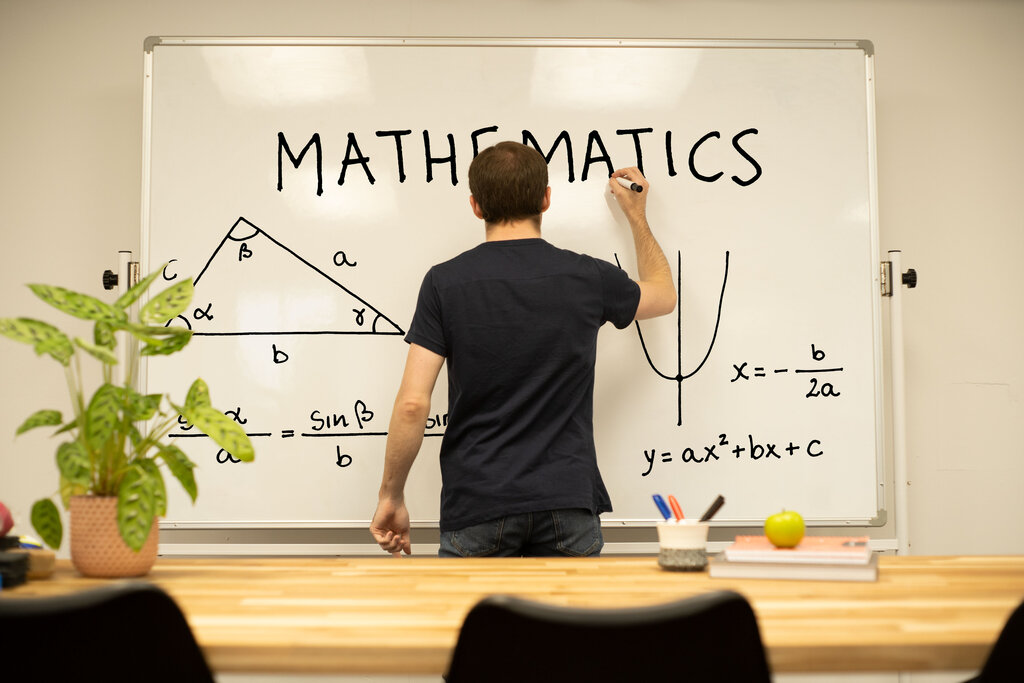
The history of mathematics is as old as civilization itself. Ancient societies in Mesopotamia and Egypt used arithmetic and geometry for farming, construction, and astronomy. The ancient Greeks, with figures like Euclid and Pythagoras, transformed it into a formal, logical system. Over centuries, mathematical knowledge grew across the globe, with major contributions from Indian, Persian, and Chinese scholars who developed concepts like the number zero and advanced algebraic techniques.
The Scientific Revolution in Europe spurred the development of calculus by Isaac Newton and Gottfried Wilhelm Leibniz, unlocking new ways to understand the physical universe. Today, mathematics continues to evolve, tackling new challenges in computing, data science, and theoretical physics.
From counting sheep to coding computers, the journey of mathematics mirrors the journey of human thought and innovation.
Now, let's test your understanding of these fundamental concepts.
At its core, what is mathematics primarily the study of?
Which branch of mathematics introduces symbols, like and , to stand in for unknown values and create general rules?