The World of Mathematics
Arithmetic Fundamentals
The Four Basic Operations
Arithmetic is the foundation of math. It all starts with four key operations: addition, subtraction, multiplication, and division. Mastering these is the first step to tackling more complex problems.
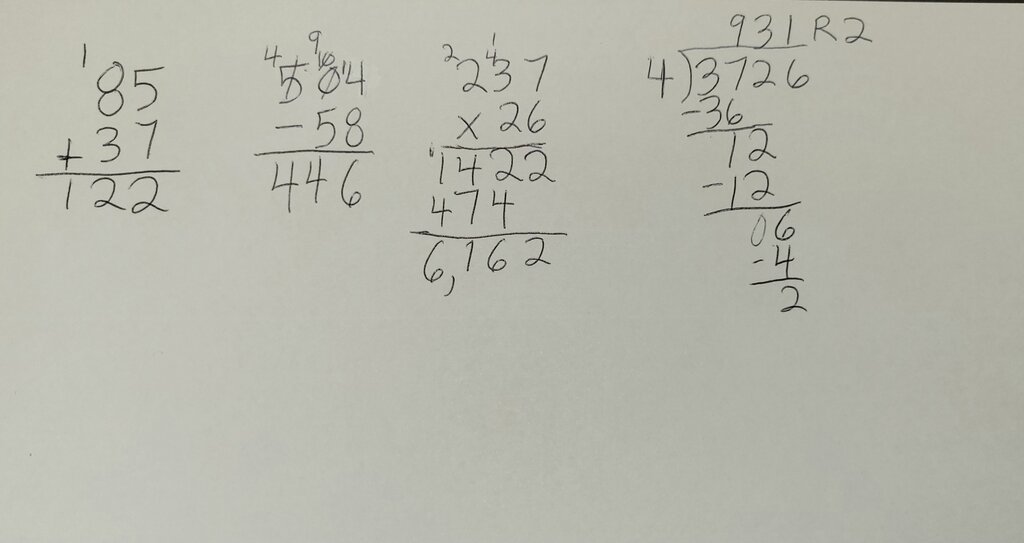
Let's quickly review what they do.
Addition (+) combines quantities. If you have 3 apples and get 2 more, you add them together to find the total: apples.
Subtraction (-) finds the difference between quantities or what's left after taking some away. If you start with 5 apples and eat 2, you have apples left.
Multiplication (×) is a shortcut for repeated addition. Instead of adding , you can multiply to get 12. It's a faster way to handle equal-sized groups.
Division (÷) is about splitting a quantity into equal parts. If you have 12 apples and want to share them among 3 friends, each person gets apples.
The Rules of the Road
Numbers follow certain rules, or properties, that make calculations predictable and often easier. These properties govern how the four operations relate to each other.
The Commutative Property states that for addition and multiplication, the order of the numbers doesn't change the outcome.
For example, is the same as , and is the same as . This property doesn't apply to subtraction or division, where order is very important.
The Associative Property means that when you add or multiply three or more numbers, the way you group them doesn't affect the result.
If you're adding , you can do to get , or you can do to get . The answer is the same.
The Distributive Property connects multiplication with addition. It tells us how to handle multiplying a number by a sum.
This property is useful for breaking down problems. To calculate , you could think of 12 as . Then, you can distribute the 5: , which is .
Order of Operations
When a calculation involves multiple operations, you need to perform them in a specific sequence to get the right answer. We use the acronym PEMDAS to remember this order.
| Letter | Operation | Meaning |
|---|---|---|
| P | Parentheses | Always do calculations inside parentheses first. |
| E | Exponents | Next, solve any exponents or roots. |
| M/D | Multiplication and Division | Perform these from left to right as they appear. |
| A/S | Addition and Subtraction | Finally, perform these from left to right as they appear. |
Let's solve an example: .
- Parentheses: First, we solve , which equals 3.
- The problem is now .
- Multiplication: Next, we multiply , which equals 15.
- The problem is now .
- Addition: Finally, we add to get 18.
Following PEMDAS is not optional. It's the universal rule that ensures everyone arrives at the same answer for the same problem.
Numbers Between Numbers
Sometimes we need to work with parts of whole numbers. We can express these parts as fractions, decimals, or percentages. They are different ways of representing the same value.
Fraction
noun
A number that represents a part of a whole, written as one number over another (e.g., 1/2).
Fractions, like , show a relationship between a part (the numerator, 3) and a whole (the denominator, 4). This fraction means we have 3 out of 4 equal parts.
Decimal
noun
A number expressed in the base-10 system, using a decimal point to separate whole numbers from fractional parts (e.g., 0.5).
Decimals are another way to write fractions, but specifically those with denominators that are powers of 10 (like 10, 100, 1000). The fraction is written as 0.75 in decimal form.
Percentage
noun
A rate or proportion per hundred, indicated by the percent sign % (e.g., 50%).
Percentages represent a fraction out of 100. The symbol % means "per hundred." So, 75% is the same as the fraction , which simplifies to .
Being able to convert between these forms is a key skill. For example, knowing that , 0.5, and 50% are all the same value allows you to choose the easiest form for solving a problem.
Let's practice what we've learned.
Which of the following operations is a shortcut for repeated addition, such as calculating ?
The commutative property states that the order of numbers doesn't change the result (e.g., ). Which operation below does NOT have this property?
Understanding these arithmetic fundamentals is the key to unlocking more advanced math. They are the tools you'll use time and time again.