The World of Magnets
Introduction to Magnetism
The Invisible Force
Magnetism is a fundamental force of nature, an invisible push or pull between certain objects. Think of it like a secret handshake between materials. Some objects get the handshake and are pulled together, while others don't and feel nothing at all. This force is what makes a refrigerator magnet stick to the door and what helps a compass point north.
Magnetism
noun
A physical phenomenon produced by the motion of electric charge, resulting in attractive and repulsive forces between objects.
Unlike gravity, which pulls all objects with mass toward each other, magnetism is selective. It only affects specific materials and can either attract (pull) or repel (push). This selective and dual nature makes it one of the most fascinating forces in the universe.
An Ancient Discovery
The story of magnetism begins over 2,500 years ago in ancient Greece. Legend tells of a shepherd named Magnes who was herding his sheep in a region called Magnesia. He was surprised to find that the iron nails in his sandals and the metal tip of his staff were sticking to the rocks on the ground.
These naturally magnetic rocks were named magnetite, likely after Magnesia or Magnes himself. The Greeks called them "lodestones," which means "leading stones," because they discovered that a piece of lodestone suspended by a thread would always point in the same direction. This led to the invention of the first compass, a revolutionary tool for navigation.
Magnetic and Non-Magnetic Materials
As the ancient Greeks discovered, not everything is affected by magnets. The world is divided into materials that respond to magnetic forces and those that don't. Try sticking a magnet to a wooden table or a plastic bottle—it won’t work. But bring it near a paperclip, and you'll feel an instant pull.
Materials that are strongly attracted to magnets are called ferromagnetic.
The most common ferromagnetic materials are iron, nickel, and cobalt. Most other materials, like wood, glass, plastic, and copper, are considered non-magnetic because their interaction with magnets is too weak to notice.
| Magnetic (Ferromagnetic) | Non-Magnetic |
|---|---|
| Iron | Wood |
| Nickel | Plastic |
| Cobalt | Glass |
| Steel (iron alloy) | Copper |
| Some ceramics | Aluminum |
Basic Properties of Magnets
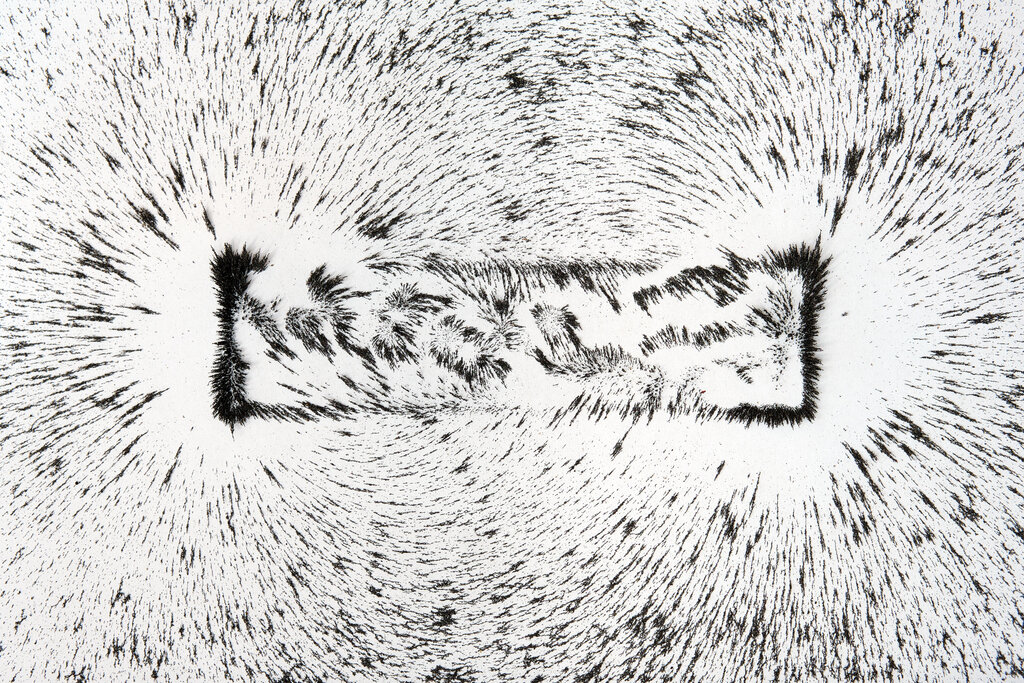
All magnets, whether a natural lodestone or a man-made bar magnet, share some fundamental properties. The first is that the magnetic force is strongest at the ends of the magnet. You can feel this if you move a paperclip along the side of a bar magnet versus its tips.
If you cut a magnet in half, you don't get one piece that attracts and one that repels. Instead, you get two smaller, complete magnets, each with its own points of attraction.
Another key property is that magnetism can act at a distance. A magnet doesn't need to touch an object to attract it; its invisible force can reach out and pull things in. This is the simple yet powerful principle that makes magnets so useful.