The World of Imaginary Numbers
Introduction to Imaginary Numbers
Numbers Beyond the Line
Think about the numbers you use every day. They can be positive, negative, or zero. We can place all of them on a number line. For centuries, this was the complete world of numbers. But a simple equation posed a big problem.
Try to solve it. If you square a positive number, you get a positive result. For example, . If you square a negative number, you also get a positive result: . Squaring zero just gives you zero.
No number on the real number line works. For a long time, mathematicians considered equations like this unsolvable. It was a frustrating dead end. But eventually, they took a creative leap. Instead of saying there's no solution, they decided to invent one.
Defining the Imaginary Unit
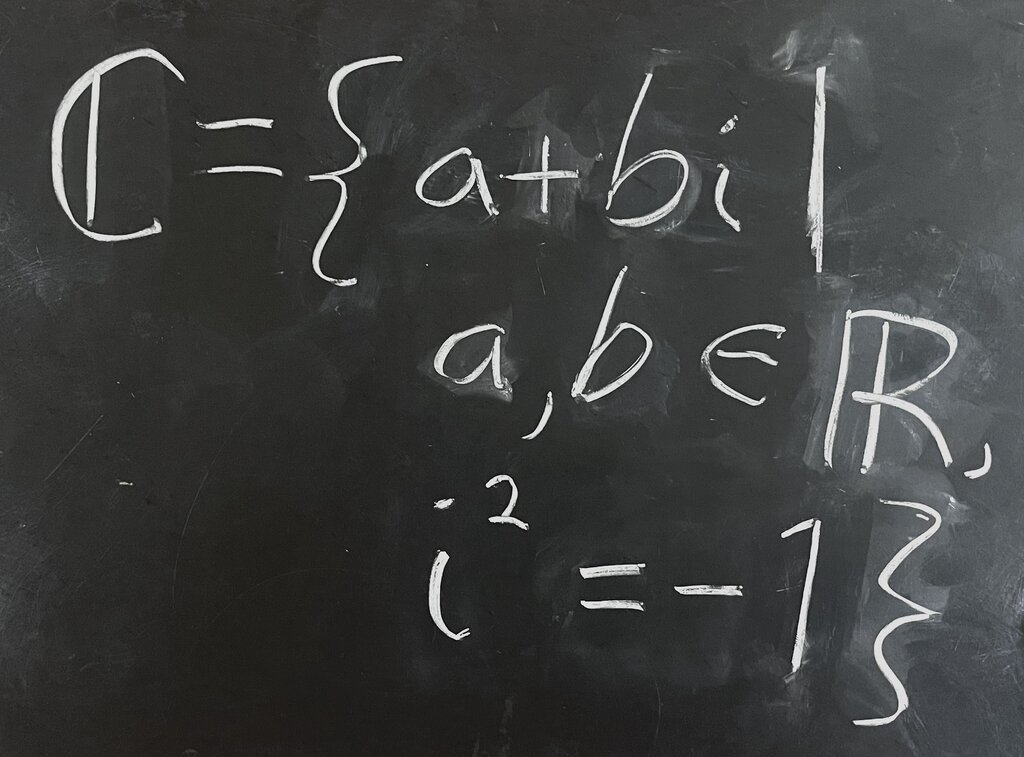
Mathematicians proposed a new number, which they called the imaginary unit, represented by the symbol i. This number was defined to have one special property: when you square it, you get -1.
imaginary unit
noun
The number 'i', defined as the square root of negative one. It is the foundation of imaginary numbers.
This single definition unlocks solutions that were previously out of reach.
This also means that i is the principal square root of -1.
An imaginary number is simply a real number multiplied by i. For example, , , and are all imaginary numbers. They represent quantities that are not on the traditional number line. Instead, they exist on their own axis, perpendicular to the real number line. We'll explore that visual idea later.
From Skepticism to Acceptance
The name "imaginary" reveals the initial distrust mathematicians had for these numbers. In the 17th century, the philosopher and mathematician René Descartes coined the term dismissively. He thought they were useless fictions.
For a long time, many shared his skepticism. These numbers didn't seem to correspond to any physical quantity you could measure, like length or weight. They felt abstract and strange.
Despite the name, imaginary numbers are not "made up" any more than negative numbers are. Both are logical extensions of our number system, created to solve new kinds of problems.
However, over the next two centuries, mathematicians like Leonhard Euler and Carl Friedrich Gauss demonstrated just how powerful and consistent these numbers were. They showed that including imaginary numbers made mathematics more complete and elegant. What started as a strange trick to solve a stubborn problem became a fundamental part of mathematics, engineering, and physics.
What is the defining property of the imaginary unit, ?
Which of the following equations requires an imaginary number for its solution?