The Wonders of the Universe
Introduction to Cosmology
The Universe as a Whole
Imagine looking up at the night sky. You might see the Moon, a few planets, and countless stars. An astronomer studies these individual objects: a specific star, a distant galaxy, or a nebula where new stars are born. They're like a botanist studying a single, unique tree in a vast forest.
Cosmology, on the other hand, is the study of the entire forest. It’s the science of the universe as a single, connected entity. Cosmologists ask questions about the forest itself: How old is it? How did it begin? What is it made of, and how is it structured? And where is it all going?
In short, cosmology is the scientific study of the origin, evolution, structure, and ultimate fate of the universe.
While astronomy looks at the individual trees, cosmology studies the entire forest—from its first seed to its final form.
The Biggest Questions
Cosmology tackles some of the most profound questions we can ask. These questions drive the entire field of research.
-
How did it all begin? The prevailing theory is the Big Bang, which suggests the universe started from an incredibly hot, dense state about 13.8 billion years ago and has been expanding ever since.
-
What is the universe made of? The stars and galaxies we see make up less than 5% of the universe. The rest is thought to be two mysterious components: dark matter (about 27%) and dark energy (about 68%). We can't see them directly, but we can detect their effects on the things we can see.
-
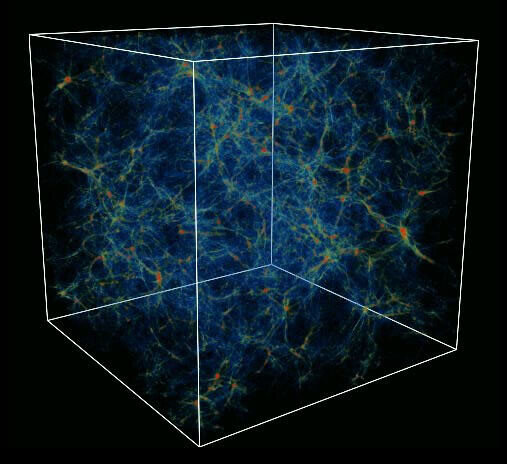
What is its large-scale structure? On the largest scales, galaxies aren't scattered randomly. They form a vast, interconnected network of filaments and clusters called the cosmic web, with enormous empty voids in between.
-
What is its ultimate fate? Will the universe expand forever, growing colder and emptier in a "Big Freeze"? Or will it one day collapse back in on itself in a "Big Crunch"? The answer seems to depend on the nature of dark energy.
How We Study the Cosmos
Since we can't run experiments on the whole universe, cosmologists act like cosmic detectives, piecing together clues from observations and theories. Their toolkit has two main parts: powerful instruments to gather data and mathematical models to interpret it.
Observational Tools
Our primary tools are telescopes, both on the ground and in space. Telescopes like the Hubble Space Telescope and the James Webb Space Telescope allow us to see galaxies billions of light-years away. Because light takes time to travel, looking at distant objects is like looking back in time. We can see galaxies as they were when the universe was much younger.
Cosmologists also study light beyond the visible spectrum, from radio waves to gamma rays. A crucial piece of evidence comes from microwaves. The Cosmic Microwave Background (CMB) is faint, leftover radiation from the Big Bang that fills the entire sky. It’s a snapshot of the universe when it was only about 380,000 years old.
Theoretical Tools
Observations are only half the story. To understand what the data means, we need a theoretical framework. The foundation of modern cosmology is Einstein's theory of General Relativity, which describes how gravity works.
Using this framework, cosmologists build theoretical models of the universe. A model is a set of mathematical equations and initial conditions that describe how the universe behaves. The goal is to find a model whose predictions match our observations.
The current leading model is called the Lambda-CDM model (CDM). It successfully explains many of our observations, including the CMB and the cosmic web. Scientists test and refine this model by running complex computer simulations to see if they can recreate the universe we observe today.
Which of the following best describes the primary focus of cosmology?
According to current cosmological models, the ordinary matter that makes up stars, planets, and galaxies accounts for approximately what percentage of the universe's total content?
Cosmology connects the physics of the incredibly small with the vastness of the entire cosmos, using observations and theory to write the biography of our universe.