The Wonders of Physics
Introduction to Physics
What is Physics?
Physics is the quest to understand the fundamental rules of the universe. It's the study of matter, energy, and how they interact, from the tiniest subatomic particles to the largest galaxies. Think of it as discovering the instruction manual for reality.
The core of physics is the search for physical laws. These aren't like human laws; they can't be broken. They are the underlying principles that govern how everything works. For example, the law of gravity describes why an apple falls from a tree and why the Moon orbits the Earth. These laws are universal, meaning they apply everywhere and at all times.
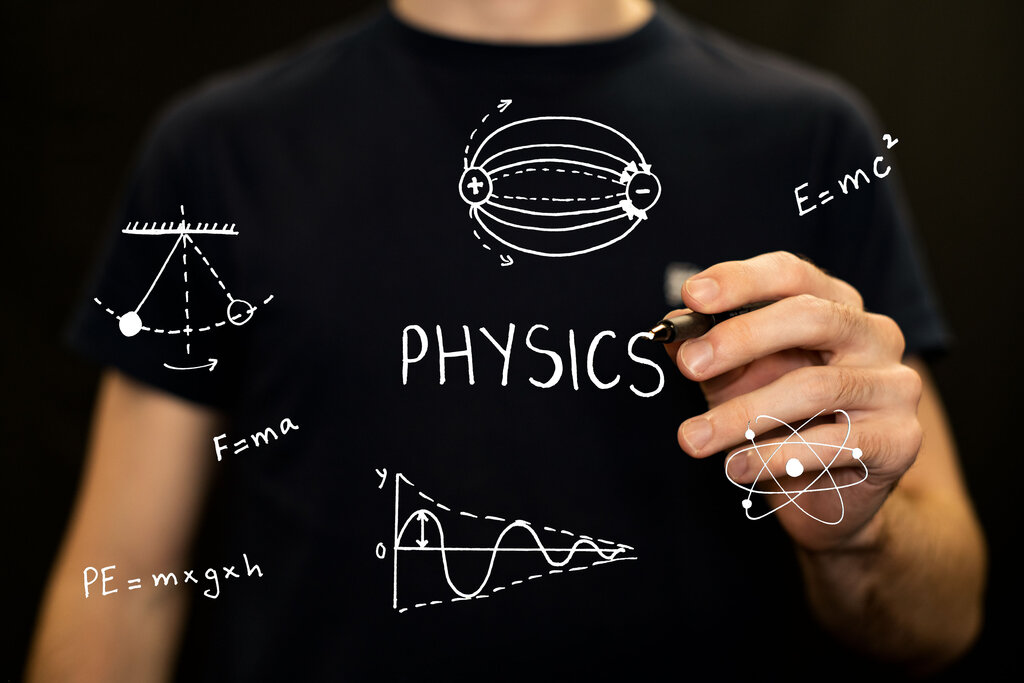
The Scientific Method
Physicists don't just guess these laws. They use a systematic process called the scientific method to test their ideas against reality. This process turns curiosity into knowledge.
It starts with an observation of the world. Then, a physicist forms a hypothesis, which is a testable explanation for that observation. Based on the hypothesis, they make a prediction. Finally, they conduct an experiment to see if the prediction is correct. If the experiment's results match the prediction, the hypothesis is strengthened. If they don't, the hypothesis needs to be revised or discarded. Over time, a hypothesis that withstands many experiments can become part of a larger theory.
The Language of Physics
To describe the laws of nature with precision, physicists use the language of mathematics. Math allows us to move beyond vague descriptions and make exact, quantitative predictions. An equation can capture a complex physical relationship in a simple, elegant form.
For example, Isaac Newton's second law of motion is a cornerstone of physics. It describes how forces affect the motion of objects.
This compact equation tells us that the force () applied to an object is equal to its mass () multiplied by its acceleration (). This isn't just a statement; it's a tool. If you know the mass of an object and the force acting on it, you can calculate exactly how its motion will change.
Branches of Physics
Physics is a vast field, often broken down into several major branches. Each focuses on a different aspect of the universe, but they are all interconnected and built on the same fundamental principles.
| Branch | What It Studies |
|---|---|
| Classical Mechanics | The motion of everyday objects, from baseballs to planets. |
| Thermodynamics | Heat, temperature, energy, and work. |
| Electromagnetism | Electricity, magnetism, and their combination: light. |
| Relativity | Motion at very high speeds and the nature of gravity. |
| Quantum Mechanics | The strange behavior of atoms and subatomic particles. |
These different areas represent humanity's evolving understanding of the world. Classical mechanics describes the world we can see and touch, while quantum mechanics and relativity explore realms far beyond our direct experience. Yet, they all work together to paint a single, coherent picture of the cosmos.
Ready to check your understanding of these core ideas?
What is the primary goal of physics?
A physicist notices that objects of different masses seem to fall at the same rate. She forms a hypothesis that gravity's acceleration is independent of mass. What is the next logical step in the scientific method?
This is just the beginning. By understanding these foundations, you're ready to explore the specific laws that govern motion, energy, and the very fabric of space and time.