The Wisdom of the Bhagavad Gita
Introduction to the Bhagavad Gita
The Song of God
The Bhagavad Gita is one of the most revered texts in Hindu philosophy. Its title translates to "The Song of God," and it's a 700-verse scripture that captures a profound conversation about duty, action, and the nature of reality. But it doesn't take place in a peaceful temple or a quiet ashram. It unfolds on a battlefield, moments before a cataclysmic war.
The Song of God
To understand the Gita, you first need to know about the epic it's embedded in: the Mahabharata. The Mahabharata is a massive ancient Indian epic, one of the longest poems ever written. It tells the story of a dynastic struggle for the throne of Hastinapura between two groups of cousins, the Pandavas and the Kauravas.
Mahabharata
noun
An ancient Indian epic poem that narrates the struggle between two groups of cousins, the Pandavas and the Kauravas, for the throne of Hastinapura.
The conflict culminates in the great Kurukshetra War. As the armies stand ready, the Bhagavad Gita begins. It is structured as a dialogue between two key figures.
A Warrior's Dilemma
The first main character is Prince Arjuna, one of the five Pandava brothers. He is a peerless warrior and archer, known for his skill and righteousness. His duty is to fight for his family's rightful claim to the kingdom.
The second character is Lord Krishna. To the world, he is Arjuna's charioteer and close friend. But he is also an avatar, or incarnation, of the god Vishnu, a supreme being who has descended to Earth to restore cosmic order. On the battlefield, Krishna serves as Arjuna's guide.
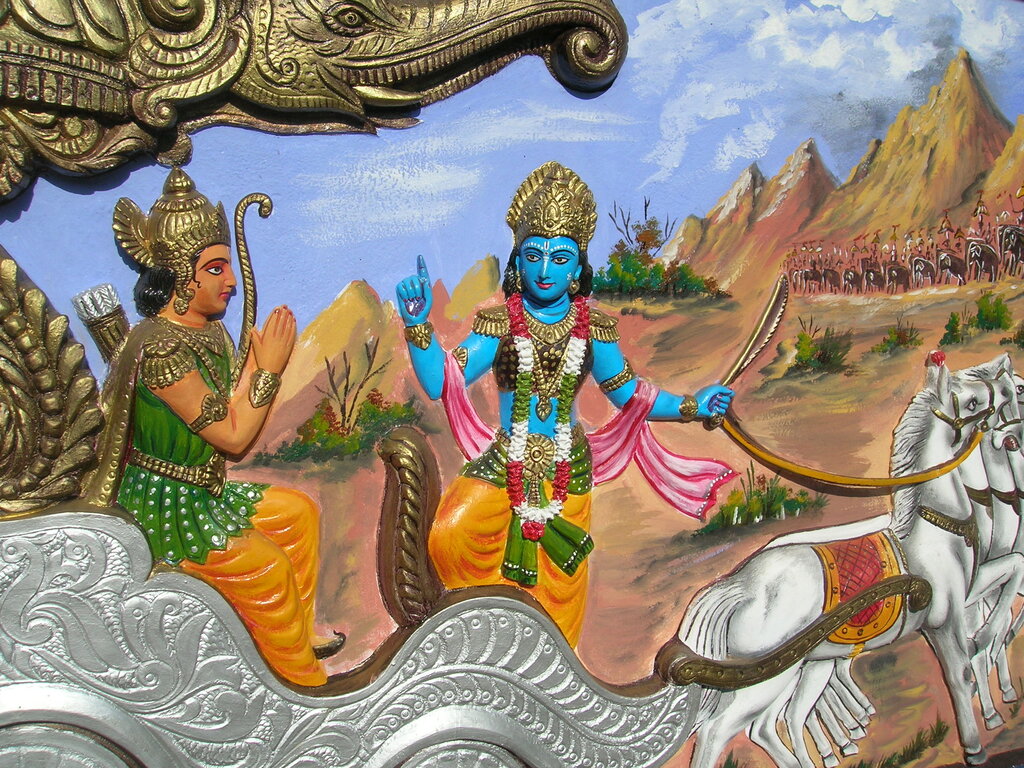
As the battle is about to start, Arjuna asks Krishna to drive their chariot to the middle of the battlefield. He looks at the opposing army and sees his own relatives: his cousins, uncles, and teachers. He is suddenly overwhelmed with grief and doubt. The thought of killing his own kinsmen for the sake of a kingdom fills him with despair.
Arjuna throws down his bow and arrows, refusing to fight. He is paralyzed by a moral crisis: how can he commit such a terrible act, even in the name of duty?
A Conversation in 18 Chapters
This moment of crisis is the starting point for the Bhagavad Gita. The scripture is composed of 18 chapters, each organized as a specific type of "Yoga," or path to spiritual understanding. The rest of the Gita is Krishna's response to Arjuna's dilemma. It's a wide-ranging discourse on duty (dharma), selfless action (karma yoga), knowledge (jnana yoga), devotion (bhakti yoga), and the ultimate nature of God and the self.
Krishna's teachings aim to lift Arjuna from his despair, clarify his duty as a warrior, and reveal deeper truths about existence. This conversation between a human prince and a divine guide forms the heart of the scripture.
The Bhagavad Gita is core text of Hindu philosophy and is known as a text that summarises the key philosophies of the Upanishads with major focus on the philosophy of karma.
It addresses fundamental human questions that resonate far beyond the ancient battlefield, which is why it remains a vital source of spiritual wisdom today. Before we dive into its teachings, let's review the key players and context.
Now, check your understanding of the Gita's background.
What is the setting for the dialogue in the Bhagavad Gita?
The Bhagavad Gita is primarily a dialogue between which two individuals?
With this context, we are now ready to explore the profound philosophical ideas presented in Krishna's dialogue with Arjuna.