The Winter War A Finnish Struggle for Survival
Geopolitical Context
A Fragile Independence
For over a century, Finland was an autonomous Grand Duchy within the Russian Empire. But when the empire collapsed during the 1917 Russian Revolution, Finland seized the opportunity. On December 6, 1917, it declared independence. This newfound freedom was immediately tested by a bitter civil war between the conservative 'Whites' and the socialist 'Reds', who were supported by the new Bolshevik government in Russia. The Whites, aided by Germany, ultimately won, securing Finland's sovereignty.
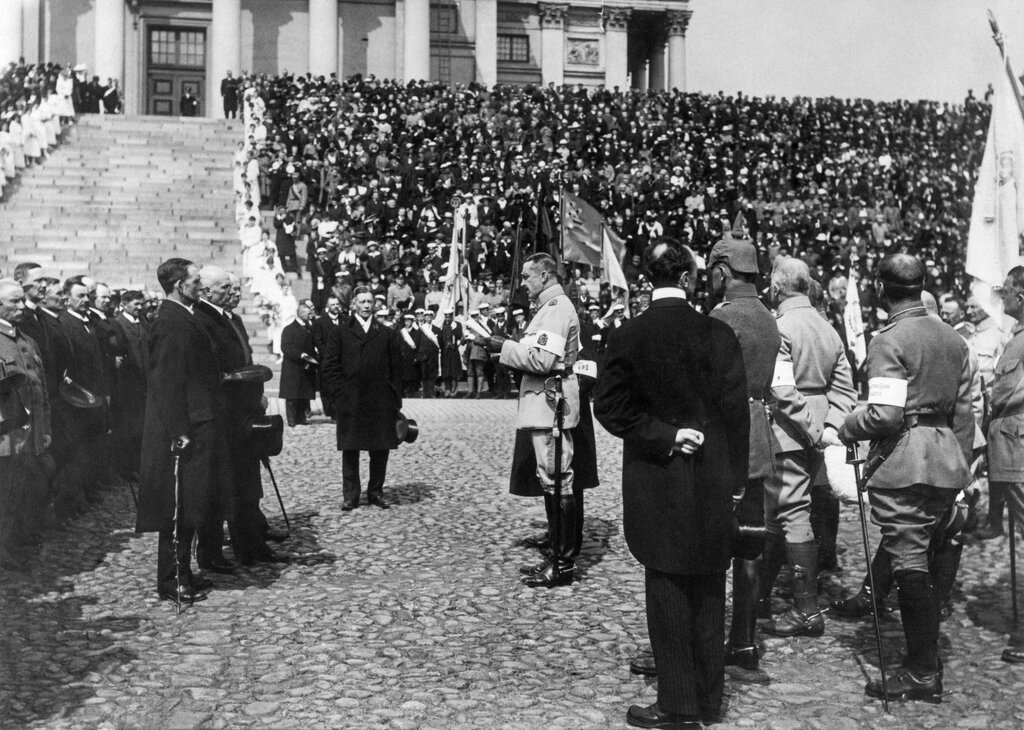
In 1920, the Treaty of Tartu formally ended the state of war and established the border between Finland and Soviet Russia. The treaty was a diplomatic victory for Finland. It secured the nation's historical boundaries and even gained the Arctic port of Petsamo, providing access to the Barents Sea. For a time, it seemed that peaceful coexistence was possible.
The View from Leningrad
By the late 1930s, the political climate in Europe had darkened. The Soviet Union, under Joseph Stalin, grew increasingly paranoid about its security. A major source of this anxiety was the Finnish border on the Karelian Isthmus, which lay only 32 kilometers (20 miles) from Leningrad (now St. Petersburg). As the second-largest city and a vital industrial center, Leningrad's proximity to a foreign power was seen as an unacceptable vulnerability. Stalin feared that a hostile nation, like Nazi Germany, could use Finland as a staging ground for an attack.
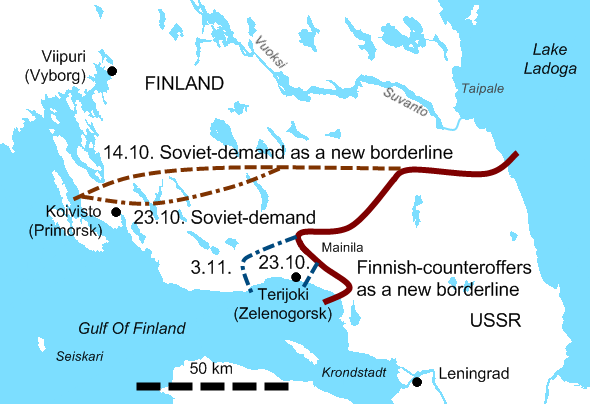
To create a buffer zone, the Soviet Union presented Finland with a series of demands in late 1939. They were framed as a land swap, but the terms were heavily skewed in the USSR's favor.
| Soviet Demand | Finnish Territory | Soviet Offer |
|---|---|---|
| Move the border westward on the Karelian Isthmus | Parts of the Karelian Isthmus | A larger, but less developed and strategically unimportant, area in Eastern Karelia |
| Lease the Hanko Peninsula for a naval base | Hanko Peninsula | - |
| Cede islands in the Gulf of Finland | Suursaari (Hogland), Tytärsaari, and others | - |
| Cede part of the Rybachy Peninsula | Western part of Rybachy Peninsula | - |
Finland was willing to negotiate some minor concessions but viewed the demands as a whole to be a violation of its sovereignty. Giving up the Karelian Isthmus meant dismantling their primary defensive line, the Mannerheim Line, and leasing Hanko would give the Soviet military a foothold deep inside Finnish territory. The Finns refused.
A Secret Pact
The Soviet Union's confidence in making these demands came from a secret agreement with its supposed ideological enemy, Nazi Germany. In August 1939, the two powers signed the Molotov-Ribbentrop Pact, a non-aggression treaty that stunned the world. Publicly, it was a promise of peace. Privately, it contained a secret protocol that carved up Eastern Europe into German and Soviet 'spheres of influence'.
Under this secret protocol, Finland, along with Estonia and Latvia, was assigned to the Soviet sphere. This effectively gave Stalin a green light from Hitler to deal with these countries as he saw fit, without fear of German interference.
With diplomacy at a standstill and its western flank secured by the pact with Germany, the Soviet Union decided to take what it wanted by force. The stage was set for war. On November 30, 1939, Soviet forces invaded Finland, beginning the conflict that would become known as the Winter War.
Now, let's test your understanding of the events that led to the conflict.
When did Finland declare its independence from the Russian Empire?
What was the Soviet Union's primary strategic reason for its territorial demands on Finland in 1939?
Understanding this geopolitical backdrop is key to grasping why the Winter War happened. It wasn't an isolated event, but the result of two decades of uneasy relations, strategic fears, and the cynical power politics of a continent on the brink of a larger conflict.