The Voyages of Henry Hudson
Age of Exploration
A New Age of Discovery
From the 1400s to the 1600s, European ships began to push the boundaries of the known world. This period, known as the Age of Exploration, saw sailors from nations like Portugal, Spain, and England venture into uncharted oceans. They were driven by a mix of ambition, faith, and economics, and their voyages would forever change the map of the world and connect continents in ways no one had before.
Why Leave Home?
What prompted thousands of people to undertake these dangerous, often deadly, journeys? The motivations were complex, but they are often summarized by three main goals: gold, God, and glory.
Gold represented the powerful economic engine behind exploration. For centuries, Europe had traded with Asia for valuable goods like spices, silk, and porcelain. However, these goods traveled overland and were controlled by various middlemen, making them incredibly expensive. When the city of Constantinople fell to the Ottoman Empire in 1453, this key trade route was effectively cut off for Christian Europe. Nations on the Atlantic coast, particularly Portugal and Spain, began searching for a sea route to Asia to bypass the old networks and gain direct access to the source of these riches.
God provided a powerful religious incentive. The Catholic Church, locked in a long struggle with Islam, was eager to spread Christianity to new lands. Explorers and the monarchs who funded them saw it as their duty to convert people in newly discovered territories. This religious zeal gave the voyages a moral purpose in their own eyes, justifying the expansion of their influence.
Glory was the personal and national ambition that fueled the competition. Emerging nations in Europe were rivals, and claiming new lands meant more resources, power, and prestige. For the explorers themselves, a successful voyage could bring immense fame and fortune, elevating them from commoners to national heroes.
This engaging passage introduces students to the three main motives for European exploration in North America: God, Gold, and Glory.
Tools of the Trade
These ambitious voyages wouldn't have been possible without key technological breakthroughs. Ship design saw a major leap forward with the development of the caravel. This small, highly maneuverable sailing ship could sail effectively against the wind thanks to its triangular lateen sails, a feature borrowed from Arab sailors. Its sturdy build allowed it to withstand the harsh conditions of the open Atlantic.
Navigators also had better tools at their disposal. The magnetic compass, a Chinese invention, helped sailors determine their direction. The astrolabe, an instrument that measures the angle of stars above the horizon, allowed them to calculate their latitude, or distance north or south of the equator. Combined with improving maps and charts, these technologies gave sailors the confidence to venture far from the sight of land.
With these tools, a new generation of explorers set sail.
Trailblazers on the High Seas
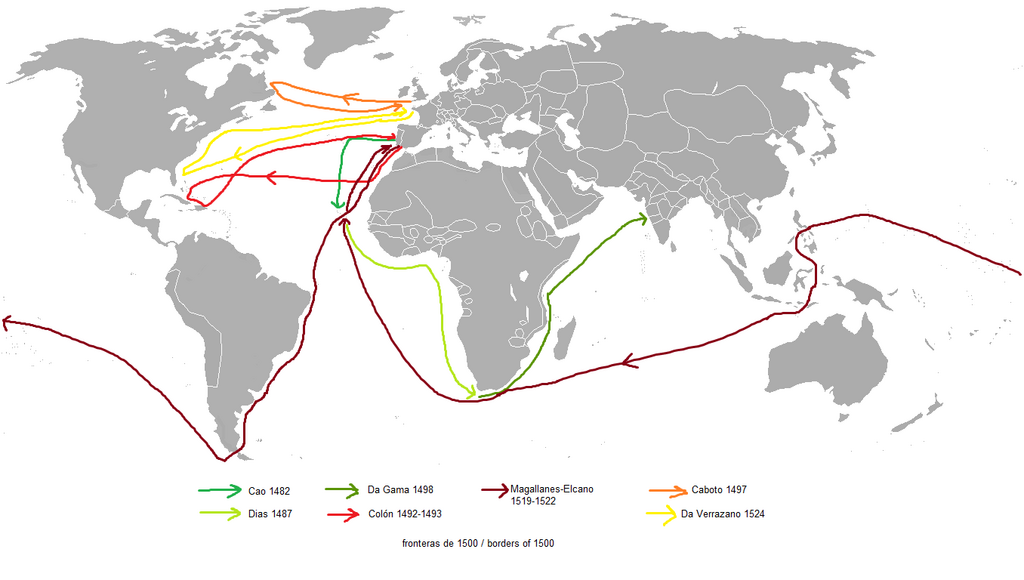
Portugal took an early lead, sponsored by Prince Henry the Navigator, who funded expeditions down the coast of Africa. In 1488, Bartolomeu Dias became the first European to round the southern tip of Africa, proving a sea route to the East was possible. A decade later, Vasco da Gama followed that route all the way to India, opening up a lucrative spice trade for Portugal.
Spain, not wanting to be left behind, funded the Italian navigator Christopher Columbus. He believed he could reach Asia by sailing west across the Atlantic. In 1492, he landed in the Americas, a "New World" to Europeans, triggering a wave of exploration and colonization. Another voyage sponsored by Spain, led by Ferdinand Magellan, completed the first circumnavigation of the globe, proving definitively that the world was round.
A World Transformed
The arrival of Europeans in the Americas had immediate and devastating consequences for indigenous populations. Lacking immunity to Old World diseases like smallpox and measles, Native American communities were decimated. European powers exploited the continents' vast natural resources and subjected its people to brutal systems of forced labor.
This period also kicked off the Columbian Exchange, the widespread transfer of plants, animals, culture, technology, and ideas between the Americas, West Africa, and the Old World. Foods like potatoes, tomatoes, and corn were introduced to Europe, while horses, cattle, and wheat were brought to the Americas. While this exchange transformed diets and economies globally, it was part of a larger process of colonization that reshaped societies on every continent.
When Europeans ended 10,000 years of separation between the western and eastern hemispheres, they did much more than settle and conquer; they permanently and fundamentally altered the ecosystems of both the old and new worlds.
Now that we've set the stage, let's test your knowledge of this transformative era.
The motivations for European exploration are often summarized as 'the three Gs'. Which of the following was NOT one of these primary motivations?
What was the primary function of the astrolabe for navigators during the Age of Exploration?
The Age of Exploration was a period of intense change, driven by bold ambitions and new technologies that connected the world in unprecedented ways. It laid the foundation for the globalized world we know today, but its legacy is complex and challenging.