The Versatile Carbon Atom
Carbon Orbitals and Hybridization
Carbon's Bonding Puzzle
Carbon should be simple. With six electrons, its configuration is . The two electrons in the orbital are paired, and the two in the orbitals are unpaired. Based on this, you might expect carbon to form just two bonds. Yet, in molecules like methane (), carbon clearly forms four identical bonds. How does it do this?
The answer starts with a process called excitation. A small amount of energy promotes one of the electrons into the empty orbital. This gives the carbon atom four unpaired electrons: one in the orbital and three in the orbitals. This explains the four bonds, but it creates a new problem. The and orbitals have different shapes and energy levels. If carbon used these to bond, we would expect methane to have three bonds of one type and one bond of another, which isn't what we observe. All four C-H bonds in methane are identical.
The solution is hybridization, a model where atomic orbitals mix to form a new set of identical hybrid orbitals. These new orbitals have the right energy and shape to form the stable, symmetrical bonds we see in nature.
sp³ Hybridization and Tetrahedral Shape
The most common type of hybridization in carbon is called . This occurs when carbon's single orbital mixes with all three of its orbitals. Think of it like a recipe: combine one part and three parts to create four new, identical hybrid orbitals.
These four new orbitals naturally repel each other. To get as far apart as possible, they arrange themselves into a tetrahedral shape, pointing towards the corners of a tetrahedron. This arrangement results in bond angles of 109.5° between each orbital.
Methane () is the classic example. The carbon atom is hybridized, and each of its four hybrid orbitals overlaps head-on with the orbital of a hydrogen atom. This direct overlap forms four strong, identical single bonds called sigma bonds (). This hybridization scheme is the foundation for all alkanes, which are hydrocarbons with only single bonds.
Double and Triple Bonds
What about molecules with double or triple bonds, like ethene () or ethyne ()? For these, carbon uses different hybridization schemes that leave some orbitals untouched.
Hybridization and Planar Geometry
For double bonds, carbon undergoes hybridization. Here, the orbital mixes with only two of the orbitals. This creates three identical hybrid orbitals and leaves one orbital unhybridized.
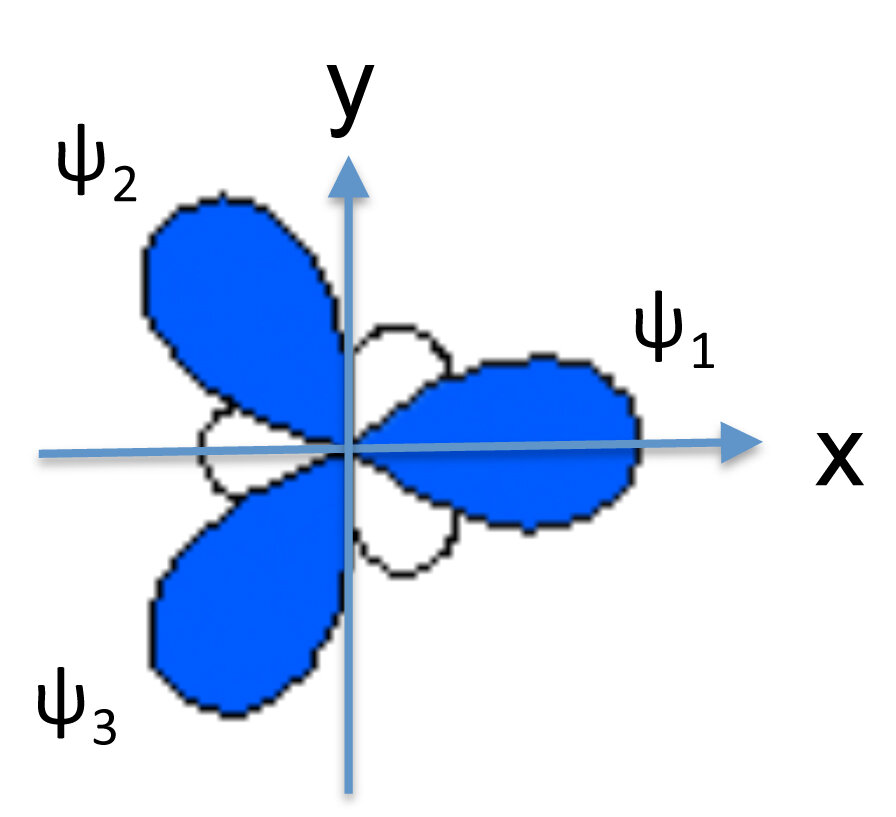
The three orbitals lie in a flat plane, pointing to the corners of a triangle. This is called a trigonal planar geometry, with bond angles of 120°. The remaining unhybridized orbital sits perpendicular to this plane, with one lobe above and one below.
In ethene (), each carbon atom is hybridized. They form a sigma bond with each other through the head-on overlap of one orbital from each carbon. The other two orbitals on each carbon form sigma bonds with hydrogen atoms. This creates the molecule's flat framework. The double bond itself consists of this sigma bond plus a second bond, called a pi bond (), formed by the sideways overlap of the unhybridized orbitals.
Hybridization and Linear Geometry
For triple bonds, carbon uses hybridization. The orbital mixes with just one orbital, creating two hybrid orbitals and leaving two orbitals unhybridized.
These two orbitals point in opposite directions, creating a linear geometry with a bond angle of 180°. The two unhybridized orbitals are perpendicular to each other and to the line of the orbitals.
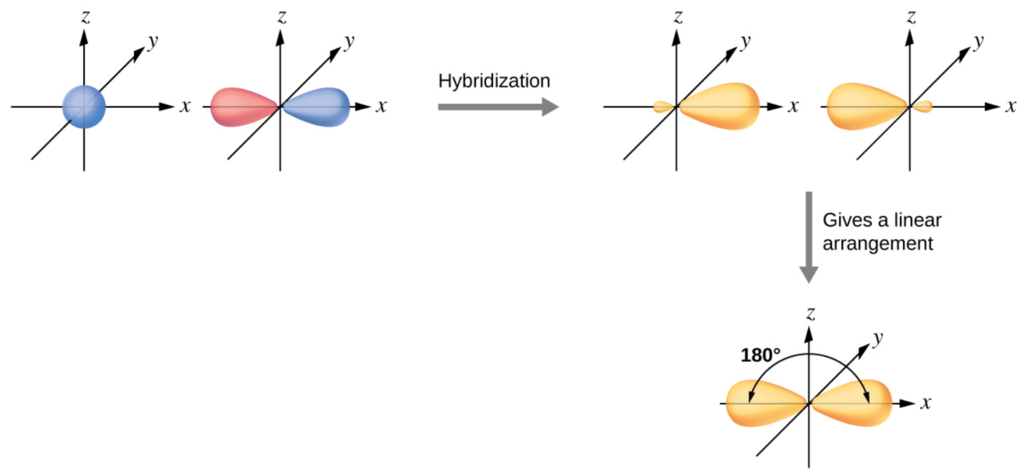
In ethyne (), the two carbon atoms are hybridized. They form a strong sigma bond by overlapping their orbitals. The other orbital on each carbon bonds to a hydrogen. The triple bond is completed by the formation of two pi bonds, created by the sideways overlap of the two pairs of unhybridized orbitals.
| Hybridization | Atomic Orbitals Mixed | Hybrid Orbitals Formed | Geometry | Bond Angle | Example |
|---|---|---|---|---|---|
| one s, three p | 4 | Tetrahedral | 109.5° | Methane () | |
| one s, two p | 3 | Trigonal Planar | 120° | Ethene () | |
| one s, one p | 2 | Linear | 180° | Ethyne () |
Hybridization is a powerful model that connects the electron configuration of an atom to the three-dimensional shape of the molecules it forms. By understanding these hybrid orbitals, we can predict and explain the geometry and bonding in a vast number of organic compounds.
Ready to test your knowledge?
Based on its ground-state electron configuration of , carbon would be expected to form only two bonds. What process allows it to form four bonds?
A carbon atom undergoing hybridization will have what molecular geometry and approximate bond angles?
Understanding these geometries is the first step to visualising how complex organic molecules fit together and react.