The Universe of Knowledge
Introduction to Knowledge Domains
What Is a Knowledge Domain?
Think of all human knowledge as a vast, sprawling library. If you wanted to find a book on a specific topic, you wouldn't just wander aimlessly. You'd look for a section, like 'History' or 'Science'. Each of these sections is like a knowledge domain. It's a field of study with its own set of concepts, theories, and methods.
domain
noun
A specific area of knowledge or activity.
Organizing knowledge into domains helps us make sense of the world. It allows experts to specialize and push the boundaries of what we know, while also giving learners a structured path to follow. Without these categories, learning would be like trying to drink from a firehose, a chaotic flood of disconnected facts.
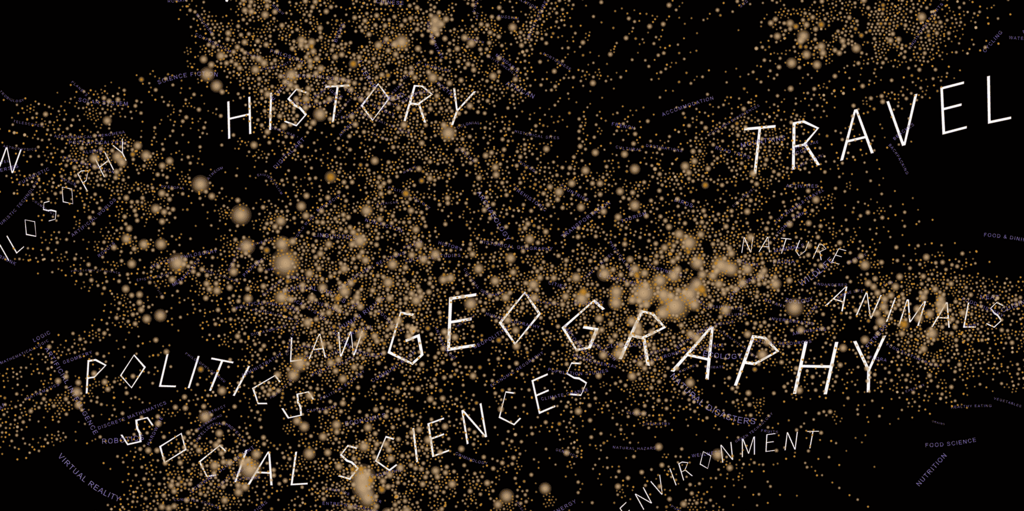
How We Group Knowledge
While there are countless individual subjects, they are often grouped into a few major categories. This helps us see the bigger picture and understand how different fields relate to one another. The most common top-level classifications are the humanities, social sciences, natural sciences, and formal sciences.
| Category | Focus of Study | Example Disciplines |
|---|---|---|
| Natural Sciences | The physical and natural world | Physics, Chemistry, Biology |
| Social Sciences | Human society and relationships | Psychology, Sociology, Economics |
| Humanities | Human culture and expression | Literature, History, Philosophy |
| Formal Sciences | Systems of formal logic and rules | Mathematics, Computer Science, Logic |
These categories aren't perfectly rigid. Some fields sit at the crossroads, borrowing ideas and methods from multiple domains. For example, geography can be seen as both a natural science (studying landforms) and a social science (studying human populations).
The lines between knowledge domains are often blurry. The most exciting discoveries frequently happen at the intersection of different fields.
A Brief History of Disciplines
The idea of separate academic disciplines is relatively new. In ancient Greece, philosophy was an all-encompassing field that included what we now call science, ethics, and politics. Thinkers like Aristotle studied everything from marine biology to logic.
Over centuries, this single tree of knowledge began to branch out. The Scientific Revolution in the 16th and 17th centuries helped establish the natural sciences as a distinct domain, with a focus on empirical observation and experimentation. Later, fields like psychology and sociology emerged from philosophy to become their own social sciences.
Modern universities played a key role in formalizing these domains by creating separate departments, each with its own curriculum and research focus. This specialization allowed for incredible depth of knowledge but also created intellectual silos.

Bridging the Gaps
While specialization is powerful, many of today's most complex problems can't be solved from a single perspective. Climate change, for example, isn't just a problem for atmospheric scientists. It requires input from economists, political scientists, engineers, and sociologists.
This is where interdisciplinary studies come in. This approach involves combining knowledge and methods from different domains to gain a more complete understanding. By breaking down the walls between disciplines, we can find more innovative and effective solutions.
Understanding the landscape of knowledge, from its broad domains to the specialized fields within them, is the first step toward becoming a more effective learner and thinker. It gives you a map to navigate the vast world of information and the tools to make connections between seemingly unrelated ideas.