The Titanic Disaster
Naval Architecture Constraints
Engineering the Olympic Class
The Olympic-class liners were feats of engineering that balanced the competing demands of speed, opulence, and safety, yet the myth of their invincibility often obscures the technical reality of their construction. In this chapter, we will look beyond the surface to examine the specific design choices behind the double bottoms, watertight bulkheads, and lifeboat configurations that defined early 20th-century maritime architecture. By the end, you will understand exactly how the engineering decisions made on the drafting table compared to the tragic limitations exposed at sea.
The Anatomy of a Double Bottom
In the early 20th century, the first line of defense for a massive liner like the Titanic was its . Imagine the ship's hull not as a single layer of steel, but as two distinct floors separated by a complex web of steel girders. If you have ever worn a pair of sneakers with a thick rubber sole, you have used a similar principle. The outer sole takes the brunt of the terrain, while the inner cushioning protects your foot. In shipbuilding, this secondary layer acted as a structural insurance policy.
This design was intended to serve as a shock absorber for the ship's underbelly. If the vessel scraped against a jagged reef or suffered a minor puncture in the outer plating, the inner skin would remain intact, keeping the engine rooms and cargo holds dry. For the liners, this was considered state-of-the-art protection. It reflected a philosophy where the greatest danger was thought to be grounding in shallow coastal waters rather than a high-speed collision in the open ocean.
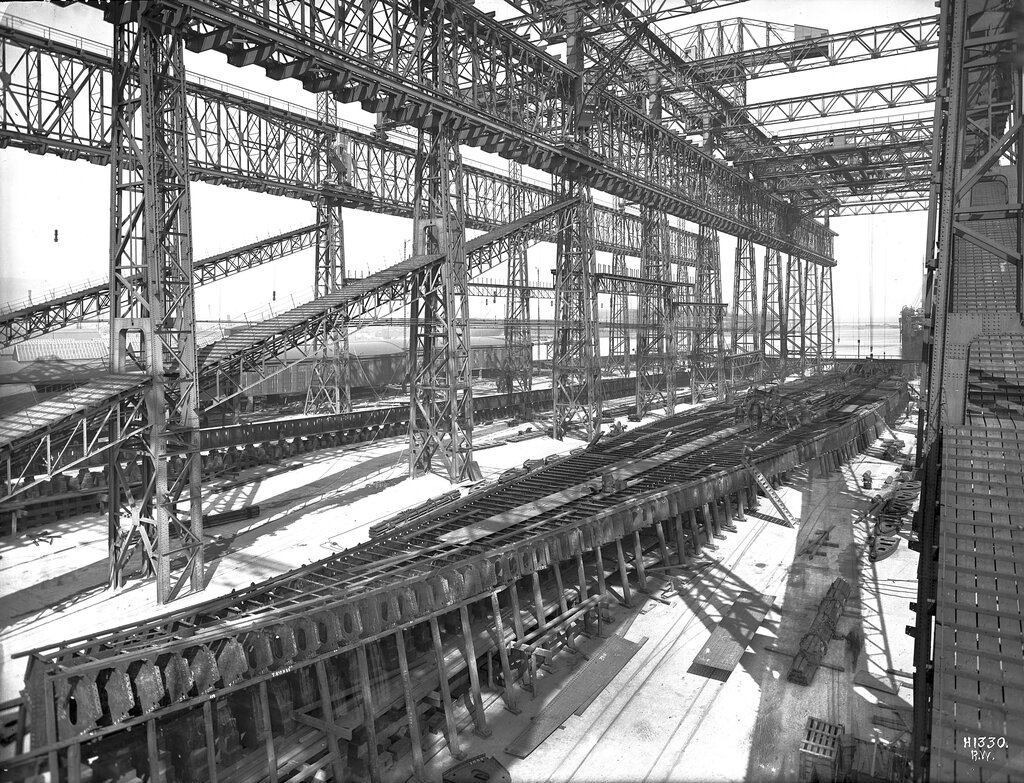
Technically, the double bottom relied on a system of and longitudinal girders. This created a rigid, grid-like skeleton that gave the ship immense longitudinal strength. However, this engineering focus had a specific blind spot. The double bottom only protected the very floor of the vessel. It did not extend up the sides of the hull. While this was a robust solution for a ship resting on a sandbar, it offered no secondary barrier against an object that sliced into the ship's side from the waterline down.
Dismantling the Unsinkable Myth
The tragedy of the Titanic's collision with the iceberg is often framed as a freak accident, but from a naval architect's perspective, it was a failure of geometry. The iceberg did not strike the floor of the ship; it delivered a 'glancing' blow that buckled the steel plates along the side. Because the double bottom ended where the turn of the bilge began, the water bypassed the 'insurance policy' entirely.
The impact occurred along a series of rivets, opening small but fatal gaps over a length of roughly 300 feet. The inner skin of the double bottom was perfectly intact, yet it was useless because the water was entering from above it. This highlighted a critical engineering constraint: a feature is only as good as its alignment with the threat. By protecting against grounding, the architects had prepared for the wrong disaster. This structural approach directly dictated how the next layer of defense—the watertight bulkheads—would have to function.
Understanding the limits of the double bottom helps us see the ship as a collection of calculated risks. The engineers knew they couldn't protect against every possible scenario, so they prioritized the most common ones. This transition from the horizontal protection of the floor to the vertical protection of the interior leads us to the ship's most famous feature: the watertight compartments. As we will explore next, the way these walls were arranged would ultimately determine the vessel's fate.
 Why were the bulkheads not tall enough to stop the flooding?
The Open Top Problem
A common misconception is that the Titanic’s watertight were sealed silos, similar to the individual chambers in a modern submarine. In reality, they were more like the walls in a series of connected rooms where the doors are closed, but the transoms—the spaces above the doors—remain wide open. To visualize this, think of an ice cube tray. Each little cube is a separate compartment. If you hold the tray level and pour water into one cube, it stays there. But if you tilt the tray, the water eventually reaches the top of the divider and spills over into the next cube, then the next, and the next. This spillover effect is exactly what happened as the Titanic’s bow began to sink.
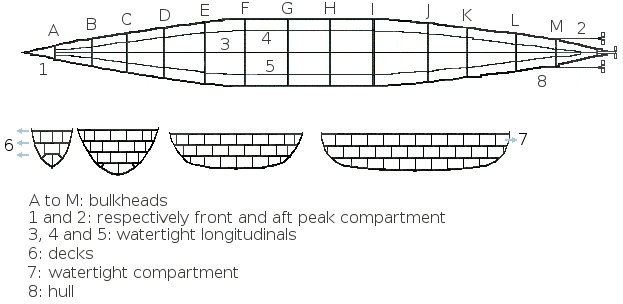
The engineering rationale for these 'open' tops was rooted in standard maritime practice and a specific theory of survivability. The bulkheads were designed to keep the ship afloat if one or two compartments were breached. In those scenarios, the ship would stay relatively level, and the water would never reach the top of the walls. Designers assumed that even a severe accident wouldn't damage more than four compartments. They didn't foresee a scenario where a 300 foot gash would flood five sections, pulling the ship's nose down so steeply that the water could pour over the tops of the bulkheads like a waterfall.
This design choice was also influenced by the ship's internal layout. The grand staircases and wide passenger decks required open spaces to maintain the sense of luxury and scale. If the bulkheads had extended through these areas, the ship would have felt like a claustrophobic maze of steel walls. The engineers at made a calculated trade-off: they sacrificed absolute watertight integrity for the sake of the high-end experience, betting that the ship's massive size made it statistically impossible to suffer such extensive damage.
Another significant change to ship design after the sinking of the Titanic was bringing the bulkheads higher above the waterline, so that each compartment would truly be watertight.
Ultimately, the height of the bulkheads was a failure of foresight rather than a simple error. The designers were correct that the ship could survive a localized breach, but they were wrong about the nature of the risks in the North Atlantic. This specific limitation in height, combined with the earlier decision to omit a full double hull, meant that once the iceberg opened five compartments, the ship’s fate was mathematically sealed. The weight of the water in the bow acted as a lever, pulling the tops of the bulkheads below the waterline and rendering the 'unsinkable' design moot.
By understanding that the Titanic's interior was more like an open tray than a sealed box, we can see how a series of small engineering compromises led to a massive catastrophe. The bulkheads were high enough for most accidents, but they weren't high enough for the one that actually happened.