The Three-Body Problem Demystified
Newtonian Mechanics
The Rules of Motion
Imagine pushing a heavy box across the floor. To get it moving, you have to apply a force. To make it move faster, you have to push harder. If you stop pushing, it eventually stops. For centuries, this is what people observed, and they concluded that the natural state of things was to be at rest. It took Isaac Newton to realize this was a flawed view. An object in motion doesn't stop because it wants to; it stops because of friction, an outside force acting on it.
This insight led to Newton's First Law of Motion, the law of inertia. It states that an object will stay at rest or continue moving at a constant velocity unless an outside force acts on it. A hockey puck gliding on an endless, frictionless sheet of ice would never stop. Your textbook sitting on your desk won't spontaneously fly into the air. They both stay in their state of motion (or non-motion) until a force, like friction or your hand, changes it.
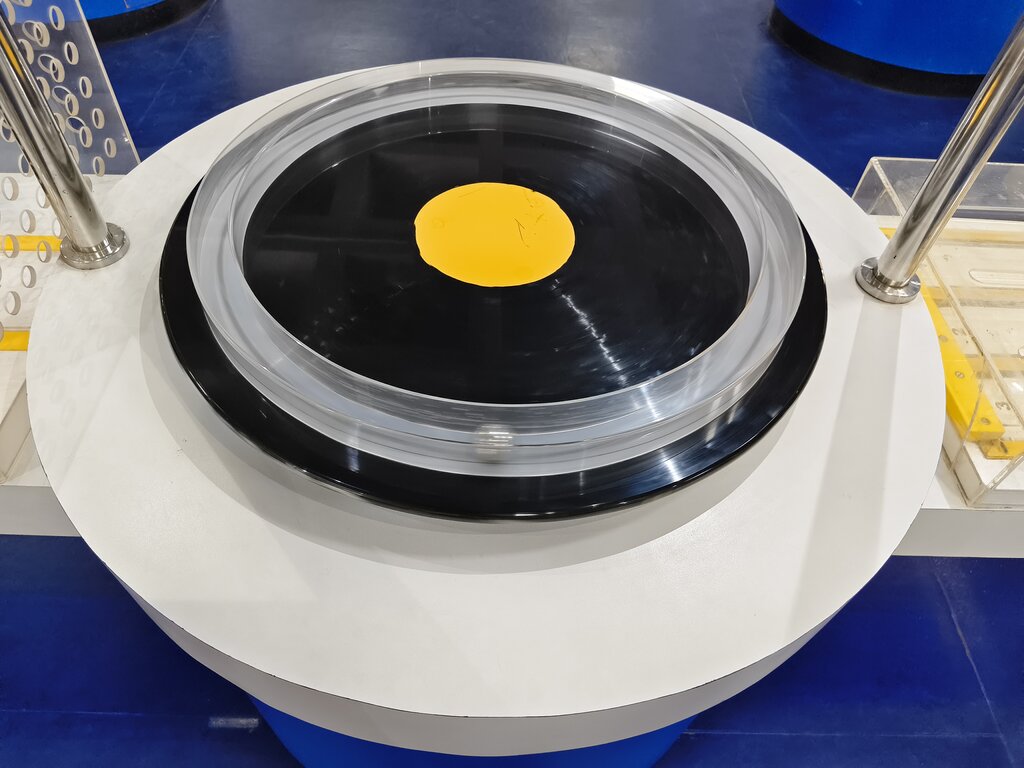
Newton’s Second Law gets more specific and gives us a way to calculate the effect of a force. It connects three key ideas: force, mass, and acceleration. Mass is the amount of 'stuff' in an object, while acceleration is the rate at which its velocity changes. The law is famously summarized by a simple equation:
In plain English: the force () required to move an object is the product of its mass () and its acceleration (). This is why it’s much harder to push a car than a shopping cart. The car has more mass, so it requires a much larger force to achieve the same acceleration.
This also means that if you apply the same force to two different objects, the one with less mass will accelerate more quickly.
Finally, Newton’s Third Law states that for every action, there is an equal and opposite reaction. Forces always come in pairs. When you push on a wall, the wall pushes back on you with the same amount of force. When a rocket expels gas downwards (action), the gas pushes the rocket upwards (reaction), launching it into space. The forces are equal in strength but point in opposite directions.
A Universal Pull
Newton’s laws of motion describe how things move when pushed or pulled. But what does the pushing and pulling? One of the most important forces in the universe is gravity. Newton proposed that gravity isn't just something that keeps us on Earth; it's a universal force of attraction between any two objects with mass.
This is the essence of his Law of Universal Gravitation. Every object in the universe pulls on every other object. You have a gravitational pull on the person next to you, and the Sun has a gravitational pull on planets light-years away. The strength of this pull depends on two things: the mass of the objects and the distance between them.
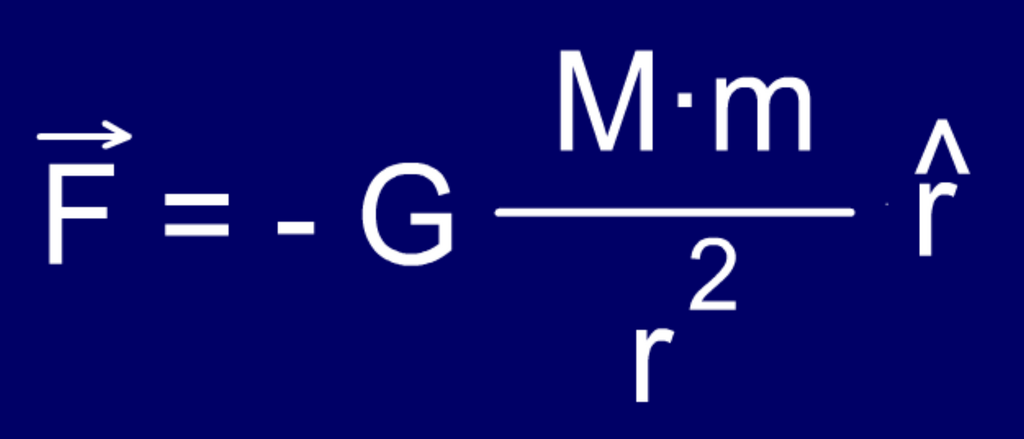
The mathematical relationship is elegant:
Here's what it means:
- is the gravitational force between the two objects.
- and are the masses of the two objects. The more massive the objects, the stronger the force.
- is the distance between the centers of the two objects. The force gets weaker as the objects get farther apart. Specifically, it decreases with the square of the distance, so doubling the distance makes the force four times weaker.
- is the gravitational constant, a tiny number that scales the force. Because is so small, the gravitational force between everyday objects is almost unnoticeable.
Connecting Motion and Gravity
The Law of Universal Gravitation describes the force, and the Second Law of Motion () describes what that force does. Gravity is the force that causes an apple to accelerate towards the ground. The Earth pulls on the apple, and that force causes it to speed up as it falls.
What's truly profound is that the same force governs the orbit of the Moon around the Earth, and the Earth around the Sun. An object in orbit is essentially in a constant state of falling. It has enough sideways velocity that as it falls toward the central body, it continuously misses. Newton imagined firing a cannonball from a very high mountain. A little gunpowder, and the ball travels a short distance before falling to Earth. More gunpowder, and it travels farther. With just the right amount of force, the cannonball would travel so fast that the Earth's surface would curve away from it at the same rate it falls. It would never land. It would be in orbit.
These fundamental principles, from the three laws of motion to universal gravitation, form the foundation of classical mechanics. They allow us to predict the motion of everything from a baseball to a planet, laying the groundwork for understanding the complex dance of celestial bodies.
According to Newton's First Law of Motion, what will happen to a hockey puck gliding on a perfectly frictionless, endless sheet of ice?
If the same net force is applied to a 10 kg bowling ball and a 20 kg boulder, which object will experience the greater acceleration?