The TCP/IP Model Explained
Introduction to Networking
What Is a Computer Network?
At its heart, a computer network is just a group of devices connected together. The goal is simple: to share information and resources. Think of it like a city's road system. Roads connect homes, stores, and offices, allowing people and goods to travel between them. In the same way, network connections link computers, phones, and printers, letting digital information flow freely.
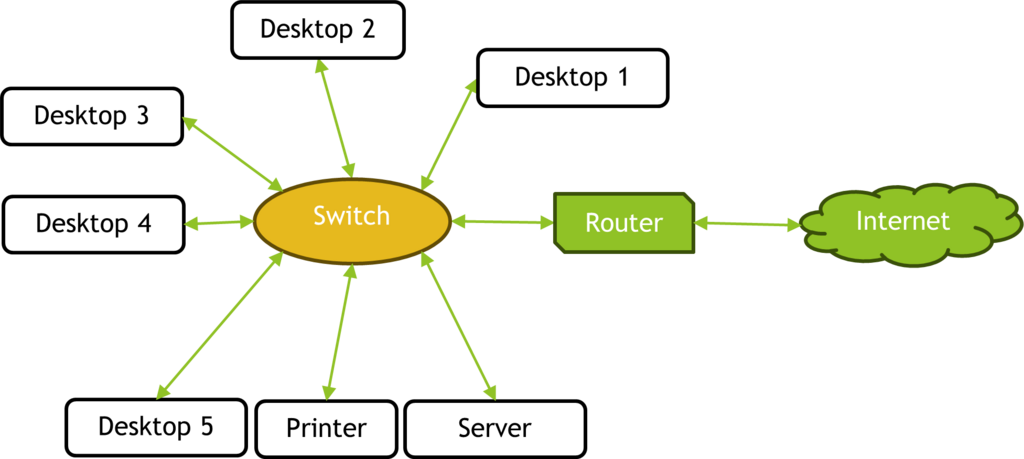
This setup lets us do all sorts of useful things. We can send an email to a colleague, stream a movie from a server across the world, or print a document from a shared office printer without plugging directly into it. The internet itself is the ultimate example—a massive, global network connecting billions of devices.
The Building Blocks of a Network
Every network, from the one in your home to the global internet, is built from a few key components. Let's start with the devices you use every day.
End Device
noun
Any device that is the source or destination of a message on a network.
End devices are where network communication begins and ends. They're also called hosts. But for these devices to talk to each other, they need help from some specialized hardware.
This is where switches and routers come in. They act as the traffic controllers of the network, making sure data gets where it needs to go.
A switch connects multiple devices together to form a local network, like the one in your home or a single office. Think of it as a mail sorter in a local post office. It looks at a message, sees which specific device it's for, and sends it only to that device. This keeps communication efficient and prevents messages from getting mixed up.
Router
noun
A device that connects different networks together and forwards data packets between them.
A router's job is to connect different networks. Your home Wi-Fi router is a perfect example. It connects all your personal devices (your local network) to the internet (a massive, global network). It acts like an airport traffic controller, figuring out the best path for your data to travel across the vastness of the internet to reach its destination.
How Networks Are Laid Out
The way a network's components are physically or logically arranged is called its topology. It's like the map of the network. There are many different topologies, but two of the most common are star and bus.
In a star topology, all devices connect to a central hub or switch. This is very common in home and office networks. If one computer's cable fails, the rest of the network is unaffected. However, if the central switch fails, the whole network goes down.
In a bus topology, all devices share a single communication line. It's simple to set up, but if the main cable breaks, the entire network is disrupted. It also gets slow if too many devices are trying to communicate at once.
The Rules of the Road
For devices on a network to understand each other, they must follow a common set of rules. These rules are called protocols.
Think of network protocols as the "languages" that computers use to talk to each other.
Protocols define everything from how a message is formatted, how it's broken into smaller pieces for sending, and how errors are handled. They ensure that a message sent from a computer in Tokyo can be received and understood by a server in New York, even if they are made by different manufacturers and run different software.
You've probably heard of some of them, like HTTP (Hypertext Transfer Protocol), which your web browser uses to fetch websites, or TCP/IP (Transmission Control Protocol/Internet Protocol), which is the fundamental suite of protocols that powers the internet. Without these agreed-upon rules, the global communication we rely on would be impossible.
Now let's check your understanding of these core networking concepts.
What is the primary purpose of a computer network?
Which device is specifically designed to connect multiple different networks together, for example, your home network to the internet?
That's a quick look at the fundamentals of networking. Understanding these basic building blocks is the first step toward seeing how the entire digital world is connected.