The Sword of Allah Strategic Legacy of Khalid ibn al Walid
Makhzum Military Heritage
The Sword of Mecca
Before he was known as the Sword of God, Khalid ibn al-Walid was the sword of Mecca. He belonged to the Banu Makhzum, one of the most powerful and wealthy clans of the Quraysh tribe. They weren't just merchants; they were Mecca's military aristocracy, responsible for the city's defense and war efforts.
From a young age, Khalid was immersed in this martial culture. The Banu Makhzum traditionally managed the city's armaments and horses, and they were expected to lead the cavalry in battle. This upbringing didn't just teach Khalid how to fight. It taught him how to think about warfare—how to manage logistics, assess terrain, and command respect from elite horsemen. His entire world was shaped by the principles of strategy, honor, and the decisive power of a well-timed cavalry charge.
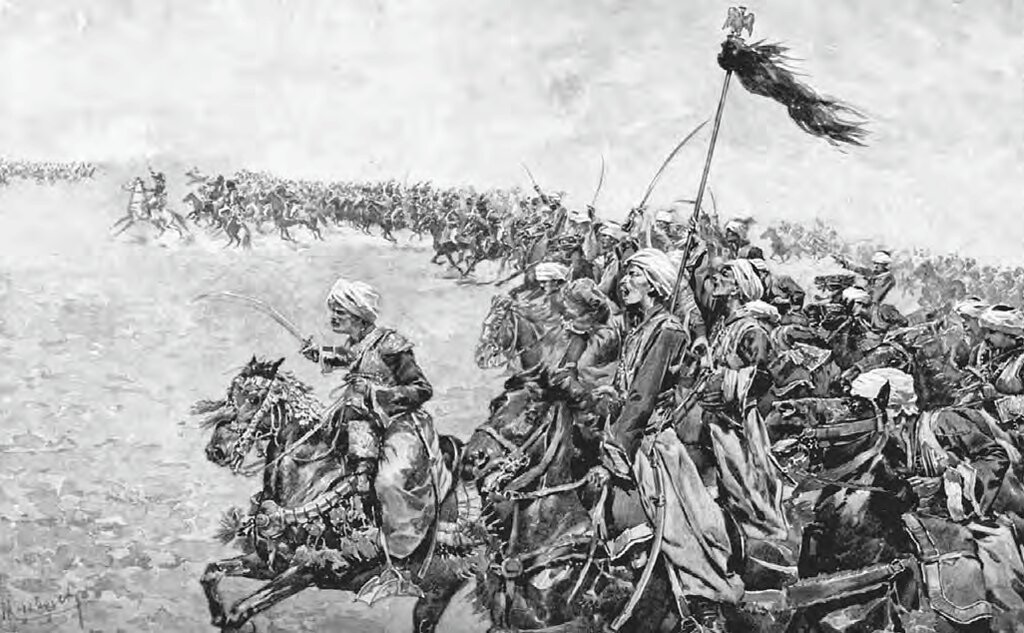
The Masterstroke at Uhud
Khalid's military genius first became undeniable at the Battle of Uhud in 625 CE. At this point, he was fighting against the nascent Muslim community led by the Prophet Muhammad. During the battle, the Muslim forces initially gained the upper hand, pushing the Meccan infantry back.
As the Muslim archers, positioned on a nearby hill to protect the flank, saw the Meccan retreat, most disobeyed their orders and abandoned their post to collect spoils. Khalid, commanding the Meccan right flank cavalry, saw the opening instantly. It was a fleeting moment of tactical opportunity.
He led his horsemen on a wide, sweeping maneuver around the hill, a difficult move over rough terrain. They crashed into the unprotected rear of the Muslim army, sowing chaos and completely reversing the battle's momentum. This flank attack, a classic cavalry tactic executed with perfect timing, turned a near defeat for the Meccans into a strategic victory. It was a clear demonstration of his ability to read a battlefield and act decisively.
For several years, hostilities continued. Yet, the strategic landscape began to shift. The signing of the Treaty of Hudaybiyyah in 628 CE marked a crucial turning point. On its face, the treaty seemed to favor the Meccans, imposing strict conditions on Muslim pilgrims. In reality, it was a ten-year truce that fundamentally altered the conflict.
The treaty de-escalated open warfare and allowed for diplomacy and travel between Mecca and Medina. For the first time, Meccans could observe the growing Muslim state without the filter of battle. They saw its order, its justice, and the deep conviction of its followers. The truce effectively ended Mecca's ideological blockade.
The Conversion
The period of peace gave Khalid time to reflect. He was a man who respected strength and success, and he could no longer deny the incredible growth and resilience of the Muslim community. He saw that the momentum was not with the Quraysh, whose internal divisions and traditionalism were holding them back. The future was being forged in Medina.
His brother, an early convert to Islam, wrote to him, telling him that the Prophet had asked about "the great commander" and expressed hope that he would join them. This personal recognition from his long-time adversary likely played a significant role.
In 629 CE, Khalid traveled to Medina with another prominent Meccan commander, 'Amr ibn al-'As. When they arrived, Khalid stood before Muhammad, the man whose forces he had routed at Uhud. He declared his faith, embracing Islam without reservation. The Prophet welcomed him, praying for him and bestowing upon him the title Sayf-ullah—the Sword of God. It was the beginning of a new chapter, one where Khalid's unparalleled military talent would be used to build one of history's great empires.
To which powerful and wealthy clan of the Quraysh tribe did Khalid ibn al-Walid belong?
During the Battle of Uhud, what critical mistake by the Muslim forces created an opening for Khalid's cavalry?