The Story of English
Origins of English
The Ancestors of English
The story of English begins long before England existed. It starts with a language we can't read or hear, spoken thousands of years ago on the steppes of Eurasia. Linguists call it Proto-Indo-European, or PIE for short.
Everyone agrees on one key point: the Indo-European languages descend from a common ancestor, a mother tongue called Proto-Indo-European, or PIE.
PIE was the parent of a huge family of languages, from Hindi and Persian to Greek and Spanish. We have no written records of it, but we can reconstruct parts of it by comparing its daughter languages. We find words with shared roots, called cognates, that point to a common origin. For example, the words for mother are mātár in Sanskrit, mētēr in Greek, māter in Latin, and modor in Old English. They all echo a PIE word, likely méh₂tēr.
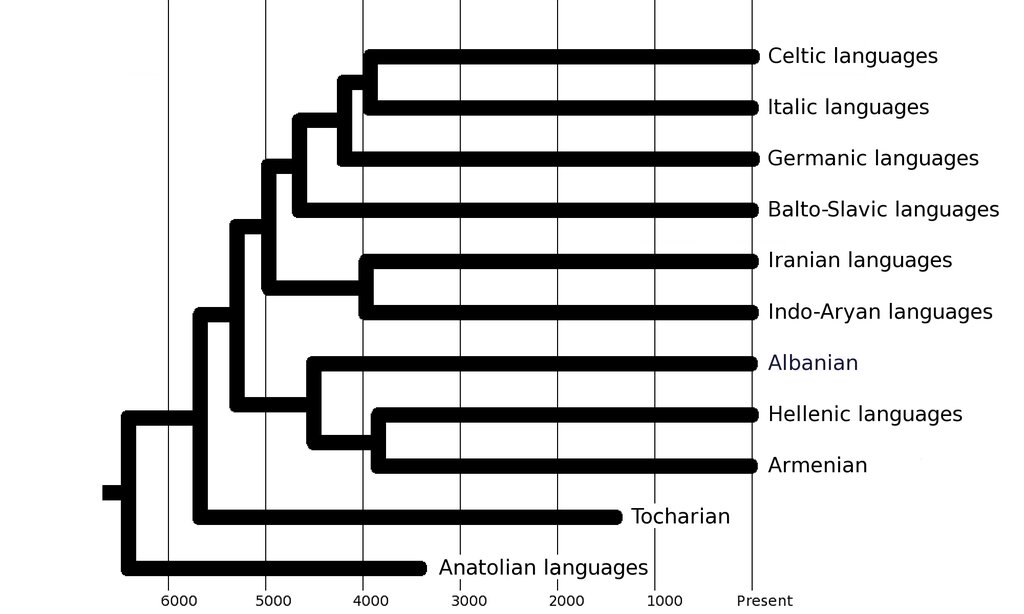
One major branch of the PIE family is Germanic. Over time, groups speaking this early Germanic language developed their own distinct sounds and grammar. This branch, known as Proto-Germanic, would eventually split into languages like German, Dutch, Swedish, and, of course, English.
A New Language Arrives in Britain
For centuries, the island of Britain was a Roman province. The local Celtic peoples spoke their own languages, but the language of government and the elite was Latin. Around the year 410 AD, the Roman legions withdrew to defend their crumbling empire, leaving Britain vulnerable.
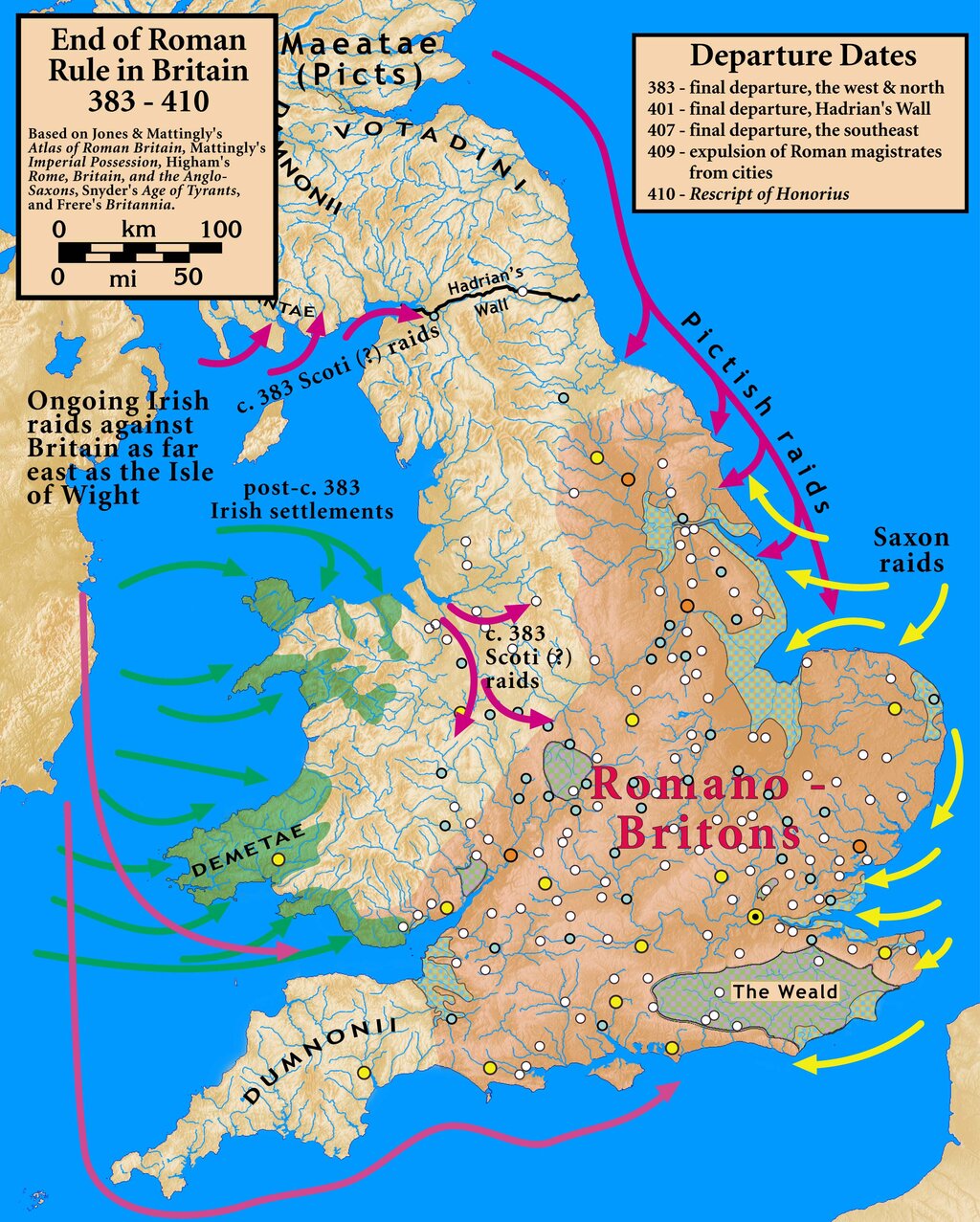
Soon after, waves of Germanic tribes from mainland Europe began to cross the North Sea. These groups, mainly Angles, Saxons, and Jutes, were looking for new land. They settled, conquered, and eventually pushed the native Celtic-speaking Britons to the west and north, into what we now know as Wales, Cornwall, and Scotland.
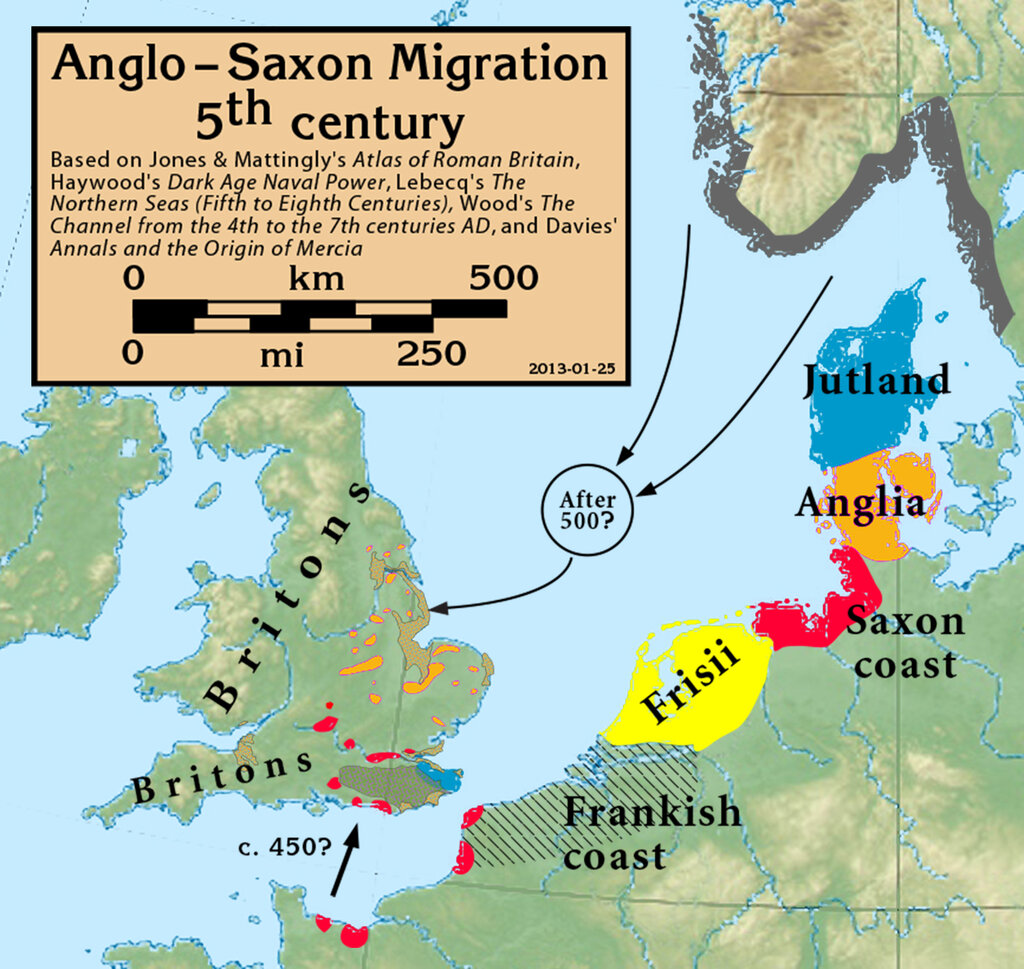
The dialects these tribes spoke began to merge and evolve in their new home. This new language, a blend of different West Germanic dialects, became what we now call Anglo-Saxon, or Old English.
The Makings of Old English
If you heard Old English today, you probably wouldn't recognize it as English. It sounds more like a distant cousin of German or Dutch. The grammar was also far more complex than Modern English. Nouns had grammatical gender (masculine, feminine, neuter) and changed their endings based on their role in a sentence, a system known as inflection.
inflection
noun
The modification of a word to express different grammatical categories such as tense, case, voice, aspect, person, number, gender, and mood.
Despite pushing out the Celtic languages, Old English did borrow a few words, mostly for places. The names of many rivers (like Thames and Avon) and cities (like London and Dover) have Celtic origins.
Latin was another key influence, arriving in two major waves. The first came from Britain's time as a Roman province, leaving words related to trade and military life like weall (wall, from Latin vallum) and strǣt (street, from Latin strata). The second, larger wave came with the arrival of Christianity in the 6th century. Missionaries brought religious and scholarly terms like mæsse (mass), scōl (school), and biscop (bishop).
The core of our modern language—words for family, farming, and everyday actions like drink, sleep, and fight—comes directly from Old English.
Old English wasn't a single, uniform language. It was a collection of dialects, with four main ones: Northumbrian, Mercian, Kentish, and West Saxon. Most of the Old English writing that survives today is in the West Saxon dialect, as it was the language of the powerful kingdom of Wessex.
Now let's check your understanding of these linguistic origins.
What is Proto-Indo-European (PIE)?
The language we now call Old English began to form in Britain after which major historical event?
From these ancient roots on the Eurasian steppe and its transformation in the British Isles, Old English set the stage for the language we speak today. The next chapters of its story would involve Vikings, Normans, and a great deal of change.