The Story of Baseball
Origins of Baseball
From Pastime to Phenomenon
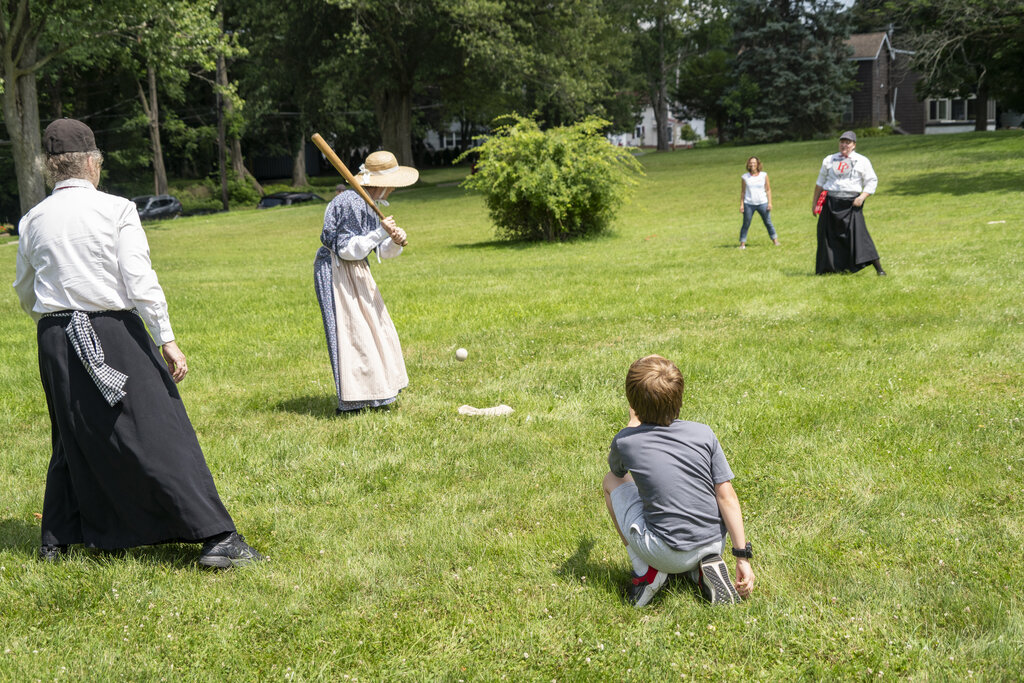
Baseball didn't spring into existence overnight. Its family tree has deep roots, stretching back centuries to folk games played across Europe. Games involving a stick, a ball, and bases have been around for a long time. These weren't organized sports but simple pastimes, with rules that changed from town to town.
Two British games in particular are clear ancestors of modern baseball: cricket and rounders. Cricket, with its pitcher (a bowler), batter, and fielders, shares an obvious strategic DNA. But rounders is the more direct relative. It involved hitting a ball with a bat and running around a circuit of bases to score a "rounder," or run.
Rounders
noun
An English bat-and-ball game played between two teams. It involves hitting a small, hard leather-cased ball with a rounded bat and then running around four bases to score.
These games crossed the Atlantic with colonists, who adapted them into local variations. In early America, you might find people playing "town ball," "base ball," or "goal ball." The names were different, but the core idea was the same. The rules, however, were a mess. One town might allow fielders to get a runner out by hitting them with a thrown ball, a practice called "soaking" or "plugging." Another might have a different number of bases or no foul territory.
The Knickerbocker Rules
The first major step toward standardization came from a group of men in New York City. In 1845, Alexander Cartwright and the New York Knickerbocker Base Ball Club wrote down a formal set of 20 rules. This was a game-changer, literally.
The Knickerbocker Rules eliminated the chaotic practice of "soaking" runners. Instead, they established the modern concept of tagging a runner or forcing them out at a base.
These new rules also established foul lines for the first time, creating a defined field of play. They set the number of players to nine per side and introduced the idea of three outs ending a team's turn at bat. While this was a huge leap forward, some key elements were still missing. The distance between bases wasn't fixed, and games ended when one team reached 21 runs, not after a set number of innings.
More teams began to adopt the Knickerbocker style of play. This led to the first major baseball convention in 1857, where delegates from over a dozen New York area clubs met to create a unified set of rules. It was here that some of the most recognizable features of baseball were locked in.
Doc Adams established base paths at 90 feet, nine men to a team, nine innings to a game, and other rules that laid the foundation for the game as we know it.
The 1857 convention officially set the distance between bases at 90 feet. More importantly, it established that a game would consist of nine innings. This shifted the objective from a race to 21 runs to a contest of skill over a defined length, creating the dramatic, clock-less structure we know today.
The Doubleday Myth
For many years, a simple, patriotic story was told about baseball's origin. The story claimed that Abner Doubleday, a future Civil War general, invented the game in a cow pasture in Cooperstown, New York, in 1839. This tale came from the Mills Commission, a committee formed in the early 1900s to investigate the sport's origins.
There's just one problem: it's not true. Historians have thoroughly debunked the myth. Doubleday was at West Point in 1839, not Cooperstown. He never claimed to have invented baseball and left no writings about the sport. The story was based on the flimsy, uncorroborated testimony of one man decades after the supposed event.
Baseball wasn't invented by a single person. It evolved naturally from older games and was later standardized by committees.
The Doubleday myth was appealing because it gave America's pastime a distinctly American origin story, free from British influence. But the real story of collaboration and gradual evolution is far more accurate.
Ready to test your knowledge?
Which British game is considered the most direct ancestor of modern baseball, involving hitting a ball and running a circuit of bases to score?
What was a key innovation introduced by Alexander Cartwright and the New York Knickerbocker Club in their 1845 rules?
The game's foundations were now set. From these rules, baseball would grow into the organized, professional sport that became a cornerstone of American culture.