The Stock Market Explained
Stock Market Basics
What Is a Stock Market?
The stock market isn't a physical place so much as it is a vast network where pieces of companies are bought and sold. Think of it like a massive, organized marketplace. Instead of selling apples or antiques, this market sells tiny slices of ownership in businesses.
stock
noun
A type of security that signifies a proportionate ownership in the issuing corporation. This entitles the stockholder to a proportion of the corporation's assets and earnings.
These slices are called stocks or shares. When you buy a company's stock, you become a part-owner, or a shareholder. The purpose of the market is twofold. For companies, it’s a way to raise money to grow, fund new projects, or hire more people. For individuals and institutions, it's a way to invest their money, hoping that the value of their shares will increase over time.
In its most basic form, the stock market is where regular people are investors – and they make money by buying and selling shares of companies.
The Key Players
Three main groups keep the market running: investors, brokers, and exchanges.
| Participant | Role |
|---|---|
| Investors | Individuals or institutions (like pension funds) who buy and sell stocks. They are the buyers and sellers in the marketplace. |
| Brokers | The intermediaries who execute buy and sell orders on behalf of investors. You can't just walk up to an exchange and buy stock; you need a licensed broker. |
| Exchanges | The organized markets where the buying and selling actually happens. They provide the platform and ensure that trading is fair and orderly. |
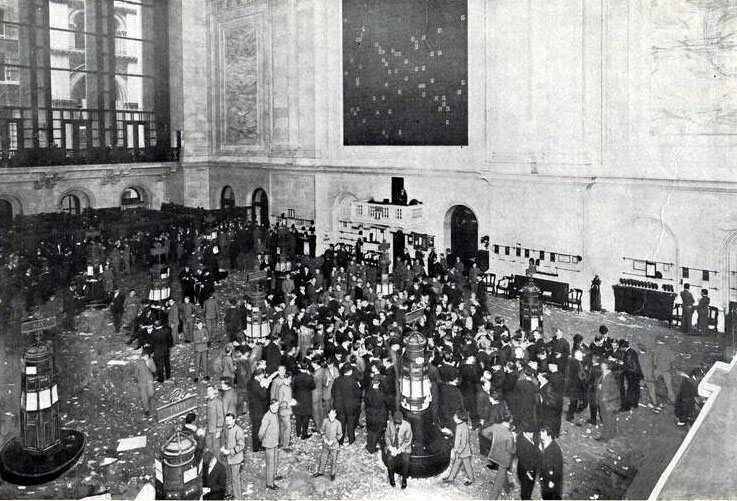
Famous exchanges include the New York Stock Exchange (NYSE) and the Nasdaq. They act as the central hub, connecting buyers and sellers from all over the world through a network of brokers.
How Prices Are Set
A stock's price isn't random. It’s determined by the simple, powerful principle of supply and demand. Supply is the number of shares available for sale, and demand is the number of shares people want to buy.
- When more people want to buy a stock than sell it (high demand), the price goes up.
- When more people want to sell a stock than buy it (high supply), the price goes down.
The price you see at any given moment is simply the last price at which a buyer and seller agreed to make a trade. This constant tug-of-war between buyers and sellers is what makes stock prices move throughout the day.
The market is a giant collection of these individual supply-and-demand stories playing out simultaneously for thousands of different companies.
Gauging the Market
With so many stocks, how do we know if the market as a whole is doing well or poorly? That’s where market indices come in.
An index is a curated list of stocks that represents a portion of the market. It's like a snapshot. If the index value is going up, it generally means the stocks within it are, on average, increasing in value. The most well-known indices are the S&P 500 (tracking 500 of the largest U.S. companies), the Dow Jones Industrial Average (tracking 30 large, established companies), and the Nasdaq Composite (heavy on technology companies).
Market indices don't tell you about any single stock, but they give you a quick, broad sense of the market's overall health and direction.
Another key metric for understanding a company's scale is its market capitalization, or "market cap." This is the total dollar value of all of a company's outstanding shares. It's a simple way to gauge a company's size from the market's perspective.
For example, a company with 10 million shares trading at $50 per share has a market cap of $500 million. This number helps investors quickly categorize companies into groups like large-cap, mid-cap, and small-cap.
Let's check your understanding of these core concepts.
What does purchasing a company's stock fundamentally represent?
The price of a stock is primarily determined by which two forces?
These are the fundamental building blocks of the stock market. Understanding them is the first step toward understanding how wealth is created and how economies grow.