The Speed of Quantum Computers
Introduction to Quantum Computing
A New Way to Compute
For decades, computers have worked on a simple principle: bits. A bit is a switch that is either on or off, represented by a 1 or a 0. All the amazing things classical computers do, from sending emails to playing movies, are built on billions of these simple, definite states.
Quantum computing is different. It doesn't just aim to make classical computers faster; it rethinks the entire process from the ground up. It operates on the strange and counterintuitive rules of quantum mechanics, the physics of very small particles. This allows quantum computers to tackle problems that are practically impossible for even the most powerful supercomputers today.
Quantum computers approach solving problems in a fundamentally new way.
From Bits to Qubits
The fundamental building block of a quantum computer is the qubit. Unlike a classical bit, which must be either a 0 or a 1, a qubit can exist in a combination of both states at the same time. This is a core principle of quantum mechanics called superposition.
qubit
noun
The basic unit of quantum information. It is the quantum analogue of the classical bit.
Think of a classical bit as a light switch. It can only be on or off. A qubit is more like a dimmer switch, able to exist in any state between fully on and fully off, including both at once. While a spinning coin is in the air, it's a mix of heads and tails. Only when it lands (when we measure it) does it settle into one definite state. A qubit behaves similarly. Before measurement, it exists in a superposition of 0 and 1. When measured, it collapses to either 0 or 1.
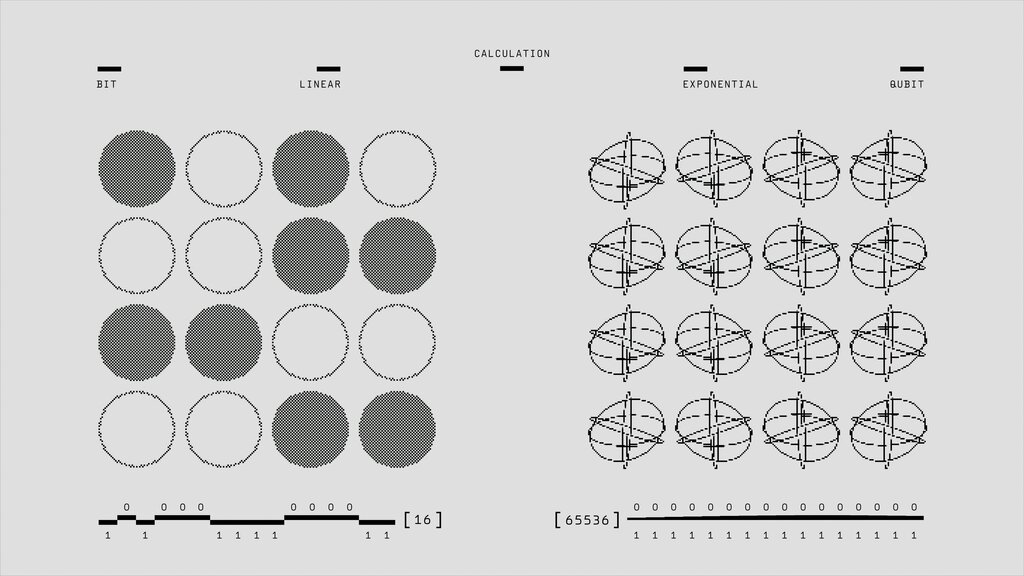
This ability to exist in multiple states at once is what gives quantum computers their power. Two classical bits can represent one of four possible combinations (00, 01, 10, 11) at any given time. Two qubits, however, can represent all four of those combinations simultaneously. As you add more qubits, this power grows exponentially. With just 300 qubits, a quantum computer could represent more states than there are atoms in the known universe.
The Power of Entanglement
Another quantum phenomenon is entanglement. This is a special connection between two or more qubits. When qubits are entangled, their fates are linked, no matter how far apart they are. If you measure one entangled qubit and find it's a 0, you instantly know the state of its partner. Albert Einstein famously called this "spooky action at a distance."
Entanglement allows qubits to be perfectly correlated. An action on one qubit can instantly influence another, enabling powerful parallel processing that isn't possible in classical computers.
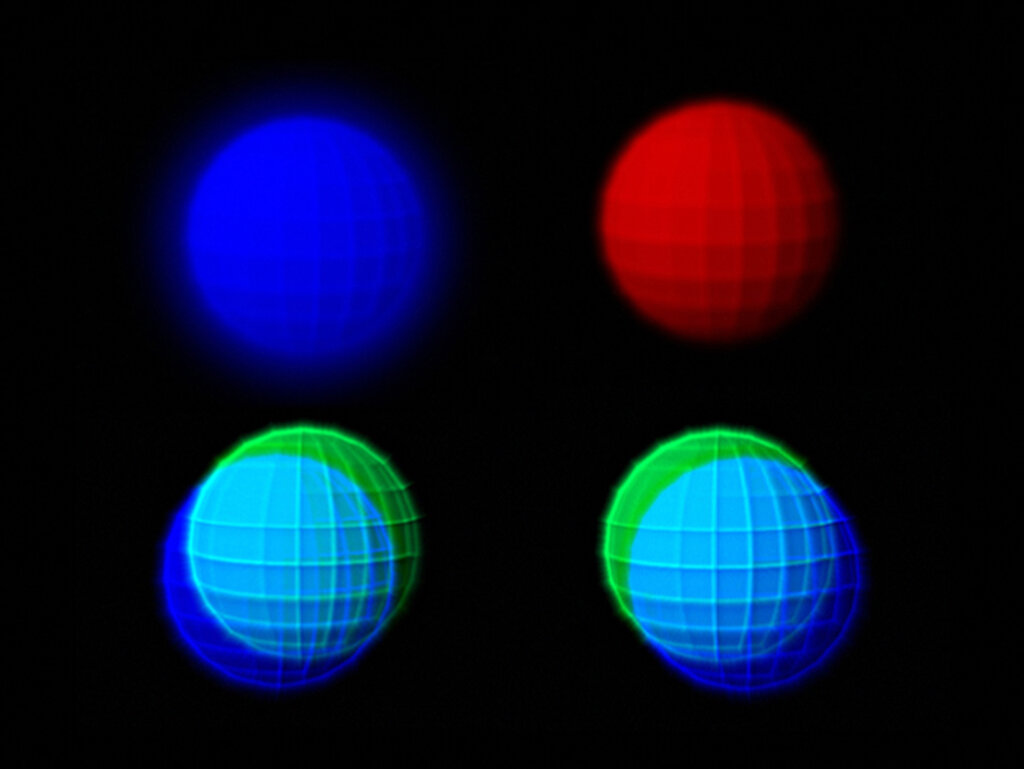
This deep connection allows for powerful computational shortcuts. By manipulating one qubit in an entangled pair, you can affect the entire system, allowing quantum computers to perform complex calculations in a highly efficient and coordinated way.
Why We Need Quantum Computers
Quantum computers won't replace the device you're using to read this. For everyday tasks like browsing the internet or word processing, classical computers are perfectly fine and much more practical. The power of quantum computing is for solving specific, incredibly complex problems that are beyond the reach of any classical machine.
| Problem Type | Classical Computer Approach | Quantum Computer Advantage |
|---|---|---|
| Drug Discovery | Simulates molecules one interaction at a time. Very slow for complex molecules. | Can simulate all possible interactions of a molecule at once, drastically speeding up development. |
| Cryptography | Relies on the difficulty of factoring very large numbers. | Can factor large numbers exponentially faster, potentially breaking current encryption standards. |
| Optimization | Checks possible solutions sequentially to find the best one. | Explores all possible solutions simultaneously to find the optimal one much faster. |
These machines open up new possibilities in fields like medicine, materials science, and artificial intelligence. They represent a completely new tool for solving humanity's most challenging problems.
Now, let's test your understanding of these fundamental concepts.
What is the fundamental unit of a quantum computer, and how does it differ from a classical bit?
The principle that allows a qubit to be in a combination of both 0 and 1 at the same time is known as:
While we're still in the early days of quantum computing, its principles promise to revolutionize technology and science in the coming decades.