The Space Race
Early Strategic Pivots
A Scientific Race with Military Roots
By the mid-1950s, the Cold War was not just a military standoff; it was a contest for technological and ideological prestige. Both the United States and the Soviet Union were developing long-range Intercontinental Ballistic Missiles (ICBMs), but testing these weapons openly was politically risky. A perfect proxy competition emerged from an unlikely source: a global scientific collaboration.
The International Geophysical Year (IGY), set for 1957-58, was a multinational effort to study the Earth. As a gesture of scientific goodwill, both superpowers pledged to launch an artificial satellite into orbit. This provided a peaceful, civilian cover for what was fundamentally a test of rocket technology. The first nation to place a satellite in orbit would not only score a major scientific victory but also demonstrate to the world that it possessed the capability to deliver a payload anywhere on the planet.
The Soviet Union took a direct approach. Their premier rocket designer, Sergei Korolev, led a design bureau that was developing the , the world's first ICBM. Its immense power, designed to carry a heavy nuclear warhead, was more than enough to launch a small satellite. For the Soviets, the goal was singular: get a rocket into space. Whether it carried a weapon or a satellite was a secondary concern. This dual-use strategy gave them a critical head start.
America's Divided Efforts
In contrast, the American effort was fragmented and complicated by internal politics. The Eisenhower administration, wanting to portray its satellite program as purely scientific, made a fateful decision. They chose , a proposal from the Naval Research Laboratory (NRL), to represent the U.S. during the IGY. The project was deliberately firewalled from military missile development. Its three-stage rocket had to be designed largely from scratch, using sounding rockets as a starting point rather than the more powerful ballistic missile hardware being developed by the Army.
This created a bizarre situation. A team under Wernher von Braun at the Army Ballistic Missile Agency (ABMA) already had a rocket, the Jupiter-C, that was more than capable of launching a satellite. Based on their proven Redstone missile, it was ready to go. In fact, von Braun was explicitly ordered to avoid placing a satellite into orbit during a 1956 test flight. The administration was committed to Vanguard's success.
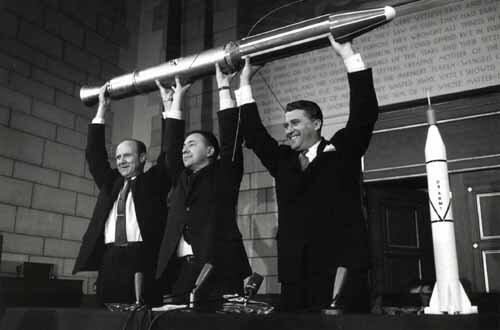
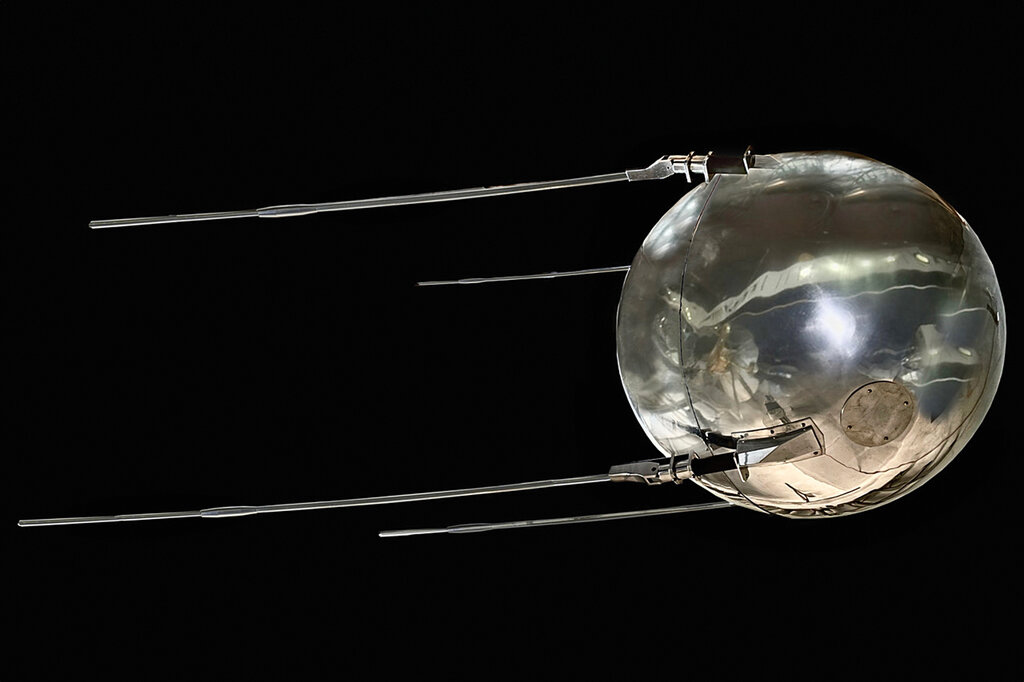
Then came the shock of Sputnik 1 in October 1957. Two months later, in a humiliating and highly public spectacle, the first Vanguard rocket blew up on the launchpad. The political pressure became unbearable. The White House reversed course and gave von Braun's team the green light. Just 84 days later, on January 31, 1958, their Jupiter-C rocket successfully launched Explorer 1, America's first satellite. The trade-off between political purity and practical engineering had proven costly.
A New Agency for a New Era
The chaotic race to launch Explorer 1 exposed a deep flaw in the American approach. The intense rivalry between the Navy, Army, and a fledgling Air Force space program was inefficient. It was clear that to compete with the centralized Soviet program, the United States needed a single, civilian agency to coordinate its space efforts. The foundation for this new organization already existed.
For over 40 years, the NACA had served as the nation's premier agency for aeronautical research. In July 1958, President Eisenhower signed the National Aeronautics and Space Act, which dissolved NACA and transferred its assets and personnel to a new agency: the National Aeronautics and Space Administration (NASA). This pivot consolidated the disparate military and civilian projects, including Project Vanguard and von Braun's team, under one roof. The organizational structure for the Space Race was now in place.