The Sloane Sky Survey
Introduction to Cosmology
The Expanding Universe
When we look up at the night sky, the universe can seem static and unchanging. But in reality, it's a dynamic place, and it's been getting bigger for billions of years. On the largest scales, every galaxy is moving away from every other galaxy. This is known as cosmic expansion.
Think of it like a loaf of raisin bread rising in the oven. As the dough expands, every raisin moves away from every other raisin. From the perspective of any single raisin, all the others appear to be receding. The farther away a raisin is, the faster it seems to move away. This is exactly what we see with galaxies. This observation, that distant galaxies are moving away from us faster than nearby ones, is a cornerstone of modern cosmology.
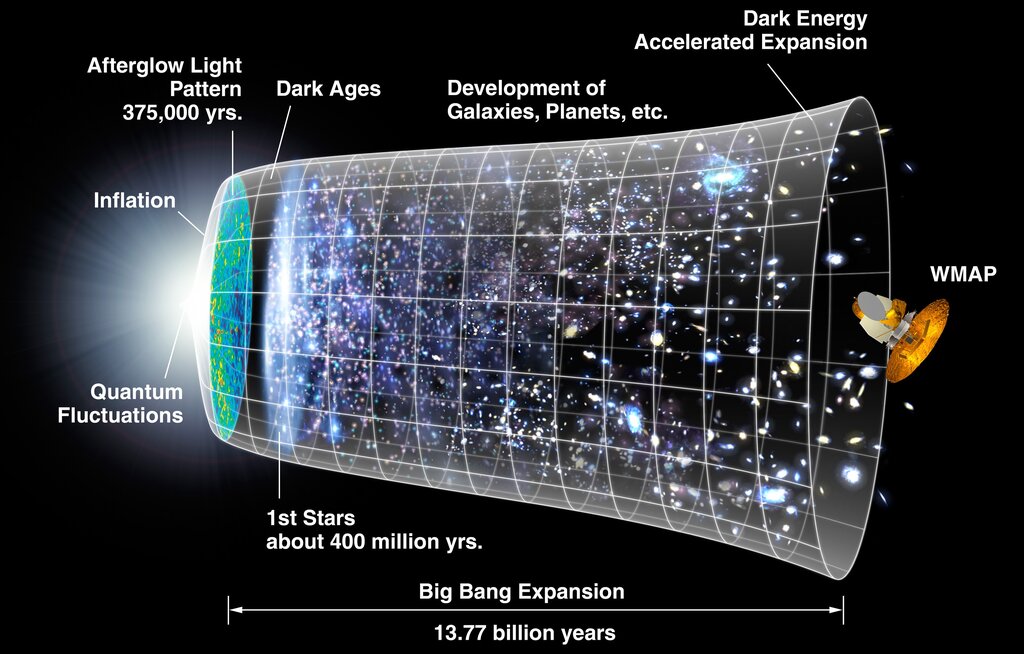
If the universe is expanding, it means that in the past, everything must have been much closer together. If we rewind the clock far enough, we arrive at a point when everything in the cosmos was packed into an incredibly hot, dense state.
A Cosmic Beginning
This starting point is what we call the Big Bang. It’s important to understand that the Big Bang wasn't an explosion in space, but rather the beginning of space and time itself. About 13.8 billion years ago, the entire observable universe was smaller than an atom.
From that moment, space began to expand and cool. In the first fractions of a second, the universe was a soup of fundamental particles. As it cooled over thousands of years, protons and neutrons formed, and later, they captured electrons to create the first atoms—mostly hydrogen and helium. The universe became transparent, allowing light to travel freely for the first time. The faint glow of this ancient light, called the Cosmic Microwave Background, can still be detected today.
The Big Bang wasn't an explosion in space. It was the rapid expansion of space everywhere, carrying matter along with it.
The Cosmic Web
The early universe wasn't perfectly uniform. There were tiny, random fluctuations in the density of matter, like minuscule ripples on a calm sea. Over millions of years, gravity went to work on these imperfections.
Regions that were slightly denser than average had more gravitational pull. They began to attract more and more matter, pulling it away from the less dense regions. These denser areas became the seeds of cosmic structures. Gas and dust gathered into enormous clouds, which eventually collapsed under their own gravity to ignite the first stars. These stars then grouped together to form the first galaxies.
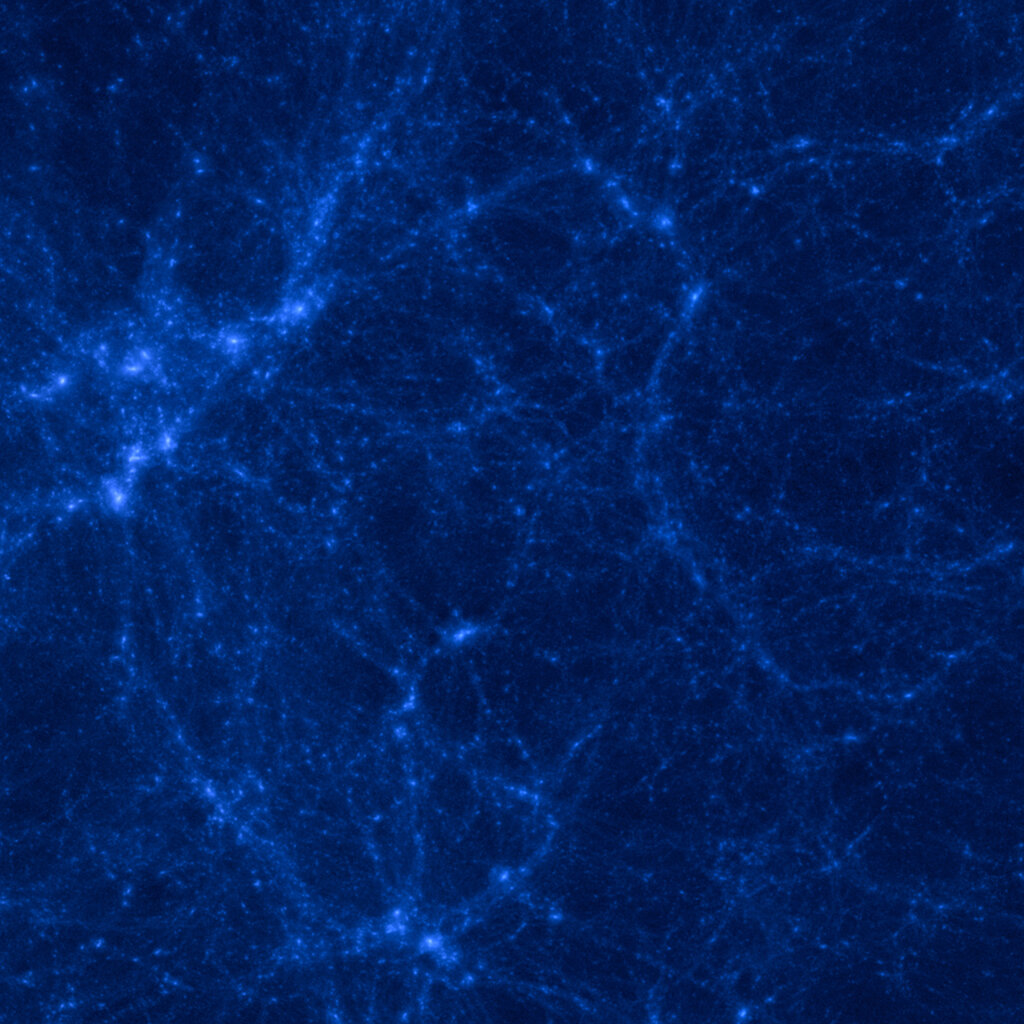
This process didn't stop with galaxies. Over billions of years, gravity continued to assemble galaxies into even larger structures. Galaxies are often found in groups called clusters, and these clusters are linked together by long, thin filaments of matter. This creates a vast, sponge-like pattern known as the cosmic web.
The cosmic web is the largest known structure in the universe. It consists of dense clusters and filaments of galaxies surrounding enormous, nearly empty regions called cosmic voids. Our own galaxy, the Milky Way, is just one of hundreds of billions of galaxies embedded in this immense cosmic structure.
According to the "raisin bread" analogy for cosmic expansion, what does the expanding dough represent?
True or false: The Big Bang was a massive explosion that occurred at a specific point in pre-existing space.
Understanding these fundamental ideas—the expansion of the universe, its hot and dense beginning, and the gravitational growth of stars, galaxies, and the cosmic web—provides a framework for mapping our universe and understanding our place within it.