The Sine Rule Explained
Triangle Basics
The Anatomy of a Triangle
Triangles are one of the most fundamental shapes in geometry. They are polygons with three edges and three vertices, or corners. The most important rule for any flat triangle is that its three interior angles always add up to 180 degrees. It doesn’t matter if the triangle is long and skinny or perfectly balanced, the sum is always the same.
This simple rule is the foundation for many other geometric principles.
Not All Triangles Are the Same
We can classify triangles based on the lengths of their sides. This gives us three main types.
Equilateral
adjective
A triangle with three equal sides. Because the sides are equal, all three interior angles are also equal, each measuring 60 degrees.
Think of it as the most symmetrical type of triangle.
Isosceles
adjective
A triangle with two equal sides. The angles opposite the two equal sides are also equal to each other.
This type has a line of symmetry right down the middle.
Scalene
adjective
A triangle where all three sides have different lengths. Consequently, all three angles are also different.
These are the most general, irregular-looking triangles.
Twins and Cousins
Sometimes, triangles can be related to each other in specific ways. Two important relationships are congruence and similarity.
Congruent triangles are exact copies of each other. They have the same size and the same shape. If you could pick one up, you could place it directly on top of the other, and it would be a perfect match. All corresponding sides are equal in length, and all corresponding angles are equal.
Similar triangles have the same shape but can be different sizes. Think of it like a photograph and its enlargement. All their corresponding angles are equal, but their corresponding sides are proportional. If one side of a triangle is twice as long as the corresponding side of a similar triangle, then all its sides will be twice as long.
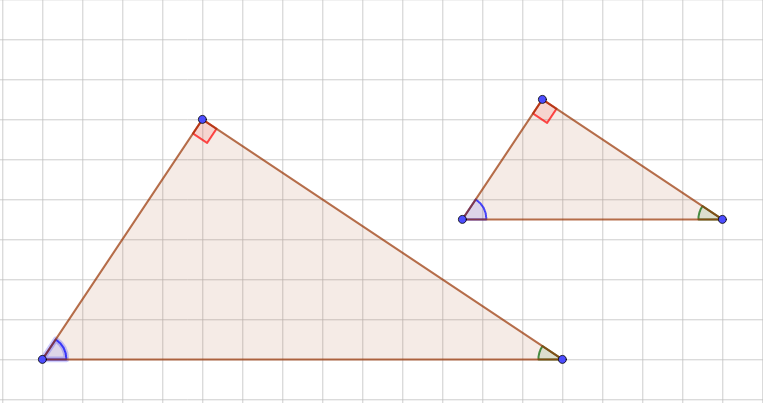
In short: Congruent triangles are identical twins. Similar triangles are like family members who share the same features but at different scales.
The Famous Right Triangle
One special type of triangle deserves its own category: the right-angled triangle. As the name suggests, one of its angles is a perfect right angle (90 degrees). The other two angles must be acute (less than 90 degrees) because all three need to sum to 180.
The side opposite the right angle is the longest side and has a special name: the hypotenuse. The other two sides are called the legs.
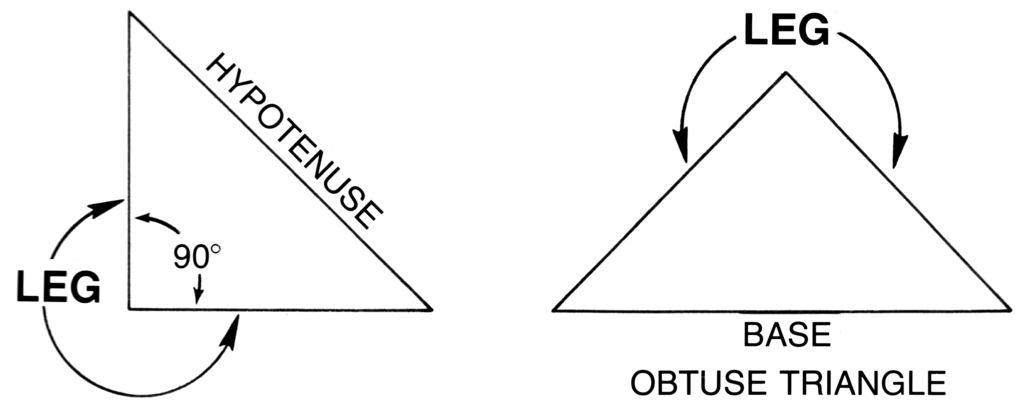
Right triangles are famous for the relationship between their sides, described by the Pythagorean theorem. It states that the square of the hypotenuse is equal to the sum of the squares of the other two sides.
If the legs of a right triangle are named and , and the hypotenuse is , then the theorem gives us a powerful formula.
This formula allows us to find the length of a missing side if we know the lengths of the other two.
For example, imagine a right triangle with legs of length 3 and 4. To find the length of the hypotenuse, , we can use the theorem:
So, the hypotenuse is 5 units long. This 3-4-5 combination is a classic example of a right triangle.
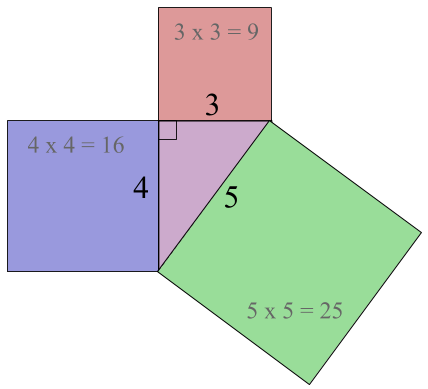
With these foundational concepts, you're ready to explore the deeper world of geometry and trigonometry.
Ready to test your knowledge?
What is the sum of the interior angles of any flat triangle?
Two triangles have the exact same shape, but one is a larger version of the other. This relationship is called ________.