The Secrets of Cyclic Quadrilaterals
Introduction to Quadrilaterals
Four-Sided Figures
Let's move beyond three-sided shapes and add another side. A quadrilateral is any polygon with four sides, four vertices (corners), and four angles. It's a broad category that covers a lot of familiar shapes.
A key property of all convex quadrilaterals is that their interior angles always add up to 360 degrees.
Just like triangles, quadrilaterals come in many forms. We classify them based on their properties, like the length of their sides, the size of their angles, and whether any sides are parallel.
The Parallelogram Family
One of the most important groups of quadrilaterals is the parallelogram family. These shapes all share a fundamental property: they have two pairs of parallel sides. This simple rule leads to a whole set of useful characteristics.
Let's break down each member of this family.
Parallelogram
noun
A quadrilateral with two pairs of parallel sides.
Because its opposite sides are parallel, a parallelogram has a few other traits:
- Opposite sides are equal in length.
- Opposite angles are equal.
- Diagonals bisect each other (they cross at their midpoints).
Rectangle
noun
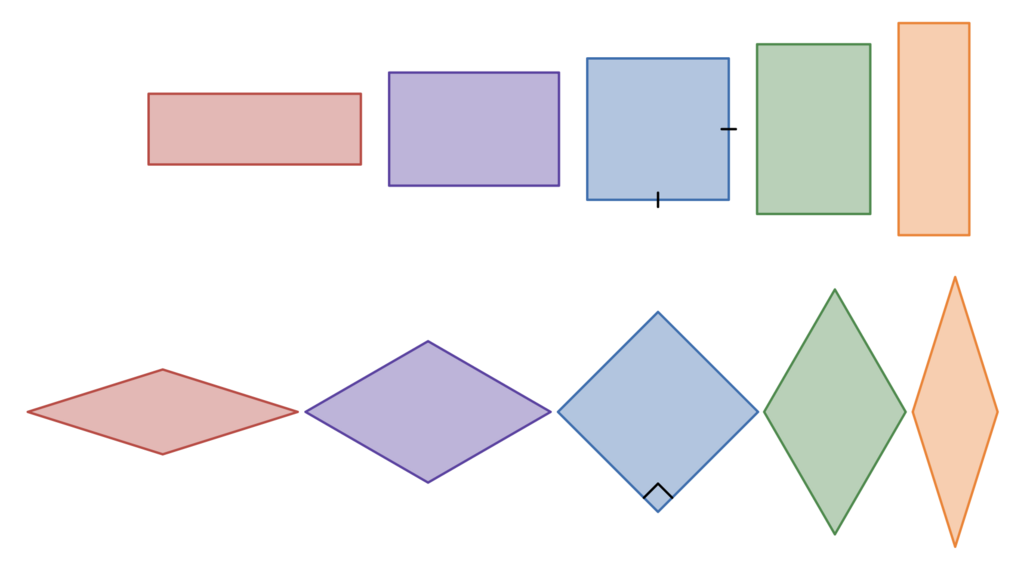
A parallelogram with four right angles (90°).
Since a rectangle is a type of parallelogram, it has all the properties of one. But its right angles give it an extra feature: its diagonals are equal in length.
Rhombus
noun
A parallelogram with all four sides of equal length.
A rhombus is also a parallelogram, so it shares those core properties. Its unique features come from its equal sides:
- The diagonals are perpendicular; they intersect at a 90° angle.
- The diagonals also bisect the corner angles (cut them in half).
Square
noun
A parallelogram with four equal sides and four right angles.
A square is the most specific type of parallelogram. It's a rectangle (because it has four right angles) and a rhombus (because it has four equal sides). This means it has all the properties of parallelograms, rectangles, and rhombuses combined.
Comparing Properties
It can be helpful to see the properties side-by-side. Notice how each shape inherits the properties of the one before it, then adds something new.
| Property | Parallelogram | Rectangle | Rhombus | Square |
|---|---|---|---|---|
| Two pairs of parallel sides | ✓ | ✓ | ✓ | ✓ |
| Opposite sides are equal | ✓ | ✓ | ✓ | ✓ |
| Opposite angles are equal | ✓ | ✓ | ✓ | ✓ |
| Diagonals bisect each other | ✓ | ✓ | ✓ | ✓ |
| All angles are 90° | ✓ | ✓ | ||
| Diagonals are equal | ✓ | ✓ | ||
| All sides are equal | ✓ | ✓ | ||
| Diagonals are perpendicular | ✓ | ✓ |
Understanding these basic four-sided shapes is a crucial first step. Their definitions and properties are the building blocks for exploring more complex geometric figures and relationships.
What is the defining property of any parallelogram?
A quadrilateral has four equal sides and diagonals that are perpendicular. What is the most specific name for this shape?