The Scientific Revolution Explained
Pre-Scientific Worldviews
The World Through Greek Eyes
Long before telescopes and laboratories, people looked at the world and tried to make sense of it. The ancient Greeks were among the first to move beyond myths and gods to explain natural phenomena. They believed the universe wasn't random but an orderly, understandable place—a cosmos. This search for rational explanations was the birth of natural philosophy.
At the heart of this movement was Aristotle. He wasn't just a philosopher; he was a keen observer of nature. He argued that we could understand the world through logic and direct experience. For Aristotle, everything was made of four basic elements: earth, water, air, and fire. Each element had a natural place. Earth, being the heaviest, naturally sought the center of the universe. Water rested on top of earth, air above water, and fire, the lightest, flickered upwards.
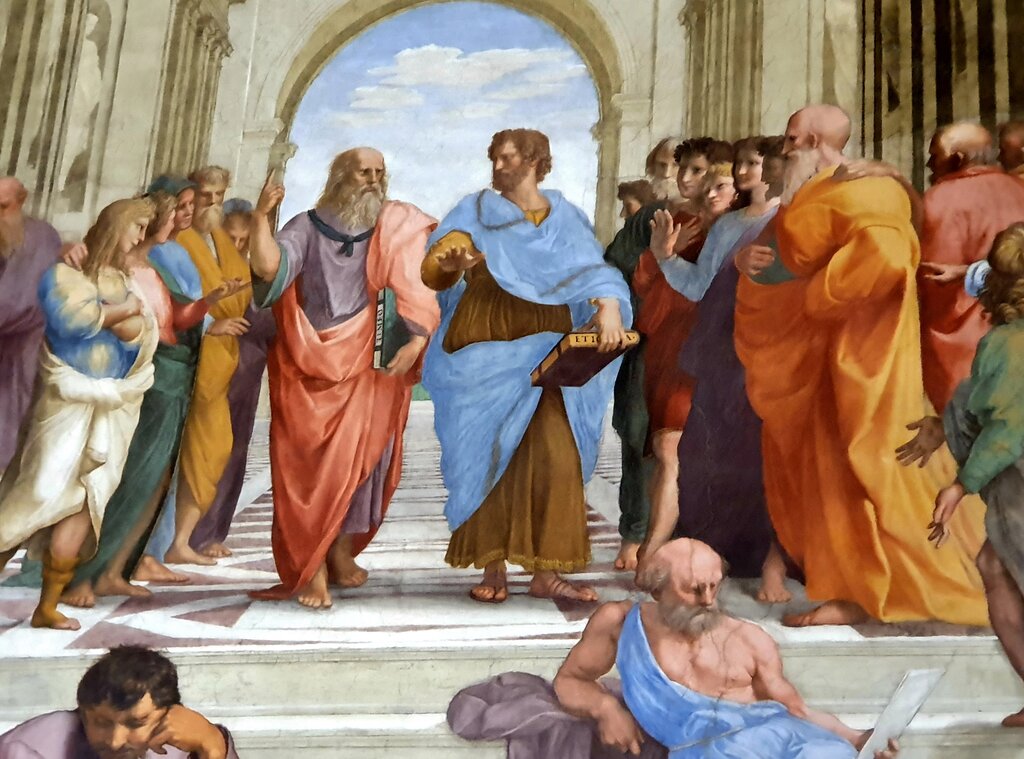
This simple idea had a huge consequence: it placed our world, the Earth, at the very center of everything. It was not a conclusion born of arrogance, but of logical reasoning based on everyday observation. A rock falls to the ground; smoke rises to the sky. To the Greeks, this was proof of an ordered universe with Earth as its stationary core.
An Earth-Centered Cosmos
Building on these Greek foundations, the Roman-era astronomer Claudius Ptolemy created a model of the universe that would dominate Western thought for over 1,500 years. His system, known as the Ptolemaic or geocentric model, was a mathematical masterpiece that aimed to explain and predict the movements of the heavens.
The model was elegant in its basic structure. The Earth sat perfectly still at the center. Around it, in a series of nested, transparent spheres, revolved the Moon, Mercury, Venus, the Sun, Mars, Jupiter, and Saturn. The outermost sphere held the fixed stars, which twinkled in unison as the sphere turned.
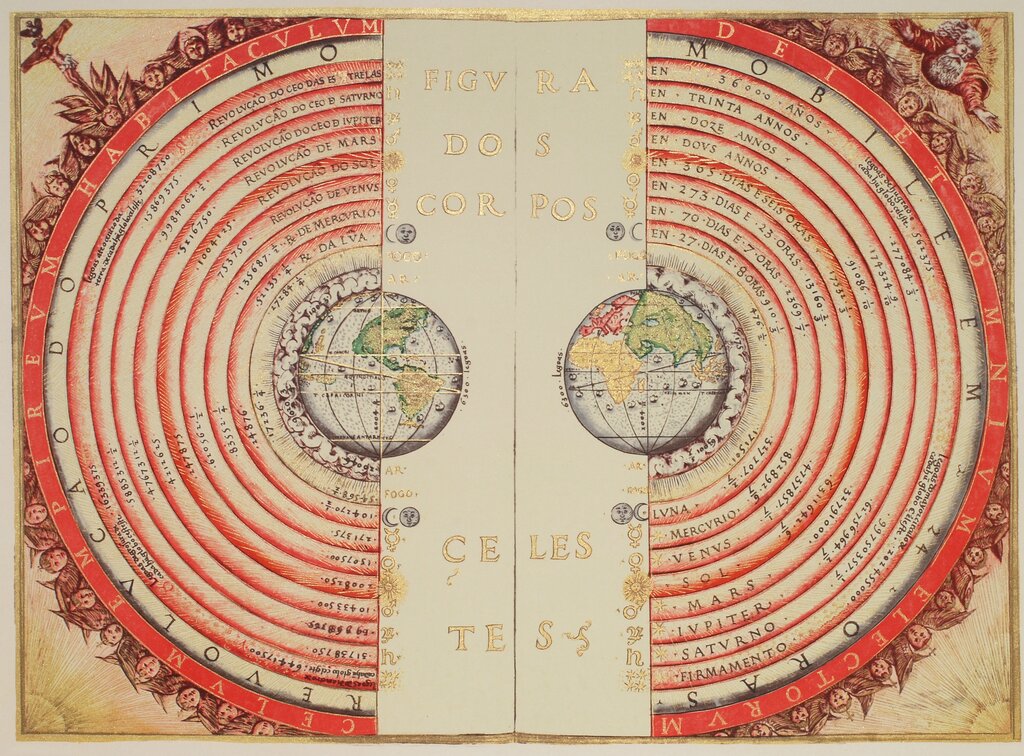
But there was a problem. Planets don't always move smoothly across the sky. Sometimes, they appear to slow down, stop, and even move backward—a phenomenon called retrograde motion. To account for this, Ptolemy added a clever tweak: epicycles. He proposed that each planet moved in a small circle (the epicycle) while the center of that circle moved along a larger circle around the Earth. It was a complex but effective solution that allowed the model to match what people actually saw in the night sky.
The Medieval Synthesis
After the fall of the Roman Empire, much of this ancient Greek knowledge was lost to Western Europe. However, it was preserved and built upon by scholars in the Islamic world. When these works were translated back into Latin during the High Middle Ages, they sparked an intellectual revolution.
This new wave of old ideas presented a challenge for the dominant institution of the time: the Church. How could the rational philosophy of Aristotle be reconciled with the divine truths of Christian scripture? The answer came from a movement called scholasticism. Scholastics were university scholars who used logic and reason to analyze and defend religious doctrine.
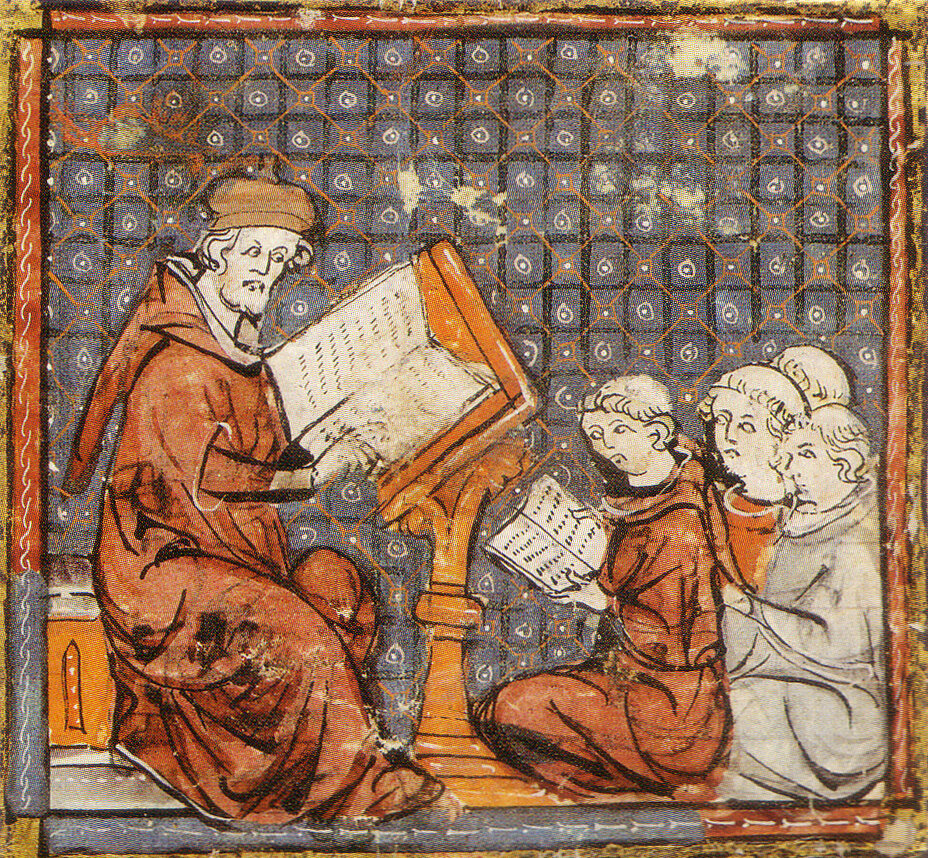
The most influential scholastic was Thomas Aquinas. He masterfully blended Aristotle's philosophy with Christian theology, arguing that reason and faith were two harmonious paths to the same truth. For Aquinas, studying the natural world—Aristotle's world—was a way of understanding God's creation.
This synthesis created a powerful and unified worldview. The Ptolemaic model, with Earth at the center, was not just a scientific theory; it became a reflection of the divine order. Earth was humanity's home, the focus of God's attention, and the heavens were a perfect, unchanging realm that declared His glory.
This worldview, combining Greek reason with Christian faith, provided a complete and satisfying explanation for nearly everything. It defined humanity's place in the cosmos and shaped the intellectual landscape of Europe for centuries, setting the stage for the dramatic changes that were to come.