The Science of Teleportation
Introduction to Quantum Mechanics
A Different Set of Rules
In our everyday world, things are predictable. A thrown ball follows a clear path. A car is either here or there. But when we zoom in to the level of atoms and particles, these familiar rules break down. This is the realm of quantum mechanics, a branch of physics that describes the universe at its smallest scales. It’s a place governed by probability, not certainty, where particles can be in many places at once.
Both a Wave and a Particle
One of the first strange ideas from quantum mechanics is that tiny things like electrons can behave as both particles and waves. This is called wave-particle duality.
Imagine firing tiny marbles at a wall with two vertical slits. You'd expect to see two lines of marble hits on the back wall, one behind each slit. That's how particles behave. Now imagine sending waves through the same two slits. The waves interfere with each other, creating a complex pattern of many bright and dark bands on the back wall. That's how waves behave.
Here's the weird part: when scientists fire electrons one by one at a double-slit setup, they don't get two simple lines. They get an interference pattern, just like waves. It seems each electron, traveling alone, somehow passes through both slits at once and interferes with itself.
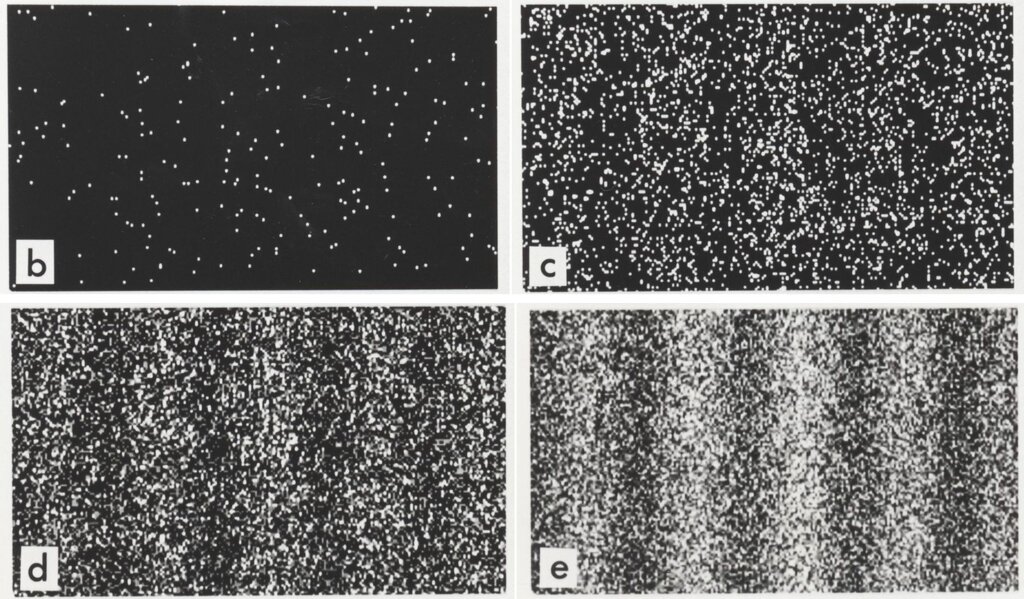
But if you try to watch which slit an electron goes through, the interference pattern vanishes. The very act of observing forces the electron to behave like a particle, picking one path and creating a simple two-line pattern. The electron is a wave of possibilities until we look, at which point it becomes a particle with a definite location.
Many States at Once
This leads to another core quantum concept: superposition. It means a quantum system can exist in a combination of all its possible states at the same time. Think of a spinning coin. While it's in the air, it's not heads or tails—it's a blur of both possibilities. Only when it lands (and we measure it) does it settle into a single state.
A particle in superposition is similar. Before measurement, an electron isn't at point A or point B; it exists in a fuzzy cloud of probabilities of being at both A and B, and everywhere in between. All of these possibilities are described by a mathematical object called a quantum state, or wave function, often written as .
Superposition isn't about not knowing a particle's state. The particle genuinely is in all states at once until measured.
This state contains all the information about the particle. For a simple system with two possible outcomes, like the spin of an electron (up or down), we can write its state like this:
Here, and are the two possible states. The numbers and are called probability amplitudes. They tell us how likely we are to find the electron in each state when we measure it. The actual probability is the amplitude squared ( or ).
Entanglement and Measurement
Perhaps the most baffling quantum idea is entanglement. This happens when two or more particles become linked in such a way that their fates are intertwined, no matter how far apart they are. Their shared quantum state contains information about the whole system, but not about the individual parts.
Imagine two entangled coins. You know one is heads and one is tails, but you don't know which is which. You give one to a friend who travels to the other side of the world. The moment you look at your coin and see it's heads, you instantly know your friend's coin is tails. There's no message sent; the information is revealed instantly because their states were always connected.
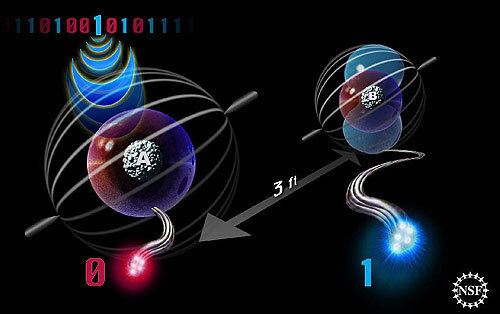
This brings us back to measurement. In the quantum world, measuring is an active process. When we measure a property of a particle in superposition, its wave function “collapses.” The cloud of possibilities randomly solidifies into a single, definite outcome.
For entangled particles, measuring one particle collapses the wave function for the entire system. If you measure the spin of one entangled electron and find it's “up,” you instantly know its partner, wherever it is, must be “down.” This interconnectedness, which Albert Einstein famously called “spooky action at a distance,” is a fundamental feature of our universe.
In the famous double-slit experiment, what pattern emerges on the screen when electrons are fired one by one without being observed?
What happens to the interference pattern in the double-slit experiment if a detector is used to observe which slit each electron passes through?