The Science of Sound
Introduction to Sound Waves
What is Sound?
Sound is a form of energy that travels in waves. Unlike light, which can travel through a vacuum, sound needs a medium to move through. This medium can be a solid, a liquid, or a gas, like the air around us. Think of it like a ripple in a pond. When you drop a stone in, the energy creates waves that spread out. Sound works similarly, but instead of water, the waves are vibrations passing through particles.
These vibrations are called mechanical waves because they require a medium to transfer energy from one point to another.
When an object vibrates, like a guitar string being plucked, it pushes and pulls on the particles of the medium around it. This creates areas where the particles are bunched together (compressions) and areas where they are spread apart (rarefactions). This pattern of compressions and rarefactions is the sound wave, propagating outward from the source.
How Sound Travels
Waves can be classified based on the direction of their particle motion relative to the direction of wave travel. There are two main types: transverse and longitudinal.
Light waves are transverse, but sound waves are longitudinal. In a longitudinal wave, the particles of the medium vibrate back and forth in the same direction that the wave is traveling. The compressions and rarefactions we mentioned earlier are the signature of a longitudinal wave. The particles of air don't travel from the guitar to your ear; they just bump into their neighbors, passing the energy along.
Properties of a Sound Wave
To describe a sound wave, we use a few key properties. These properties determine what we actually hear, like whether a sound is high or low, loud or quiet.
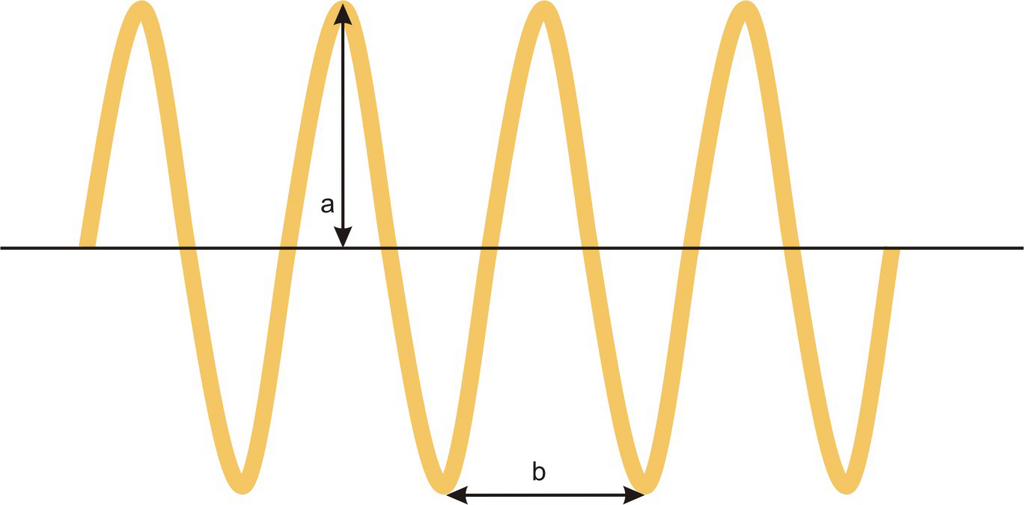
Amplitude
noun
The maximum displacement or distance moved by a point on a vibrating body or wave measured from its equilibrium position.
Amplitude corresponds to the intensity of the sound. In simple terms, it's the sound's loudness. A wave with a large amplitude carries more energy and sounds louder. A wave with a small amplitude is quieter.
Frequency
noun
The rate at which a vibration occurs that constitutes a wave, measured in hertz (Hz).
Frequency is perceived as pitch. A high-frequency sound wave results in a high-pitched sound, like a whistle. A low-frequency wave creates a low-pitched sound, like a bass drum. Humans can typically hear frequencies between 20 Hz and 20,000 Hz.
Wavelength is the distance between two consecutive points on a wave, such as from one compression to the next. It's inversely related to frequency. If the frequency is high, the wavelength is short. If the frequency is low, the wavelength is long.
Finally, the speed of sound () is how fast the wave travels through a medium. It's determined by the properties of the medium itself, like its temperature, density, and stiffness. For example, sound travels much faster through steel than through air. The relationship between speed, frequency (), and wavelength () is shown in the formula above.
| Property | Perception |
|---|---|
| Amplitude | Loudness |
| Frequency | Pitch |
Ready to check your understanding?
What type of wave is a sound wave?
If you increase the amplitude of a sound wave, what is the primary effect on the sound you hear?
Understanding these basic properties is the first step to exploring the physics of sound and music.