The Science of Sound
Sound Basics
What Is Sound?
Sound begins with a vibration. When you clap your hands, the strings of a guitar vibrate, or a speaker cone pushes back and forth, it creates a disturbance. This disturbance travels outwards as a wave, not of light or heat, but of pressure. Think of it like a ripple spreading across a pond after you toss in a stone. The water itself doesn't travel across the pond, but the wave energy does.
These pressure waves need something to travel through—a medium, like air, water, or even a solid wall. The wave causes molecules in the medium to bump into their neighbors, which then bump into their neighbors, and so on. This chain reaction carries the sound from its source to our ears. Because it requires a medium, sound is known as a mechanical wave. In the vacuum of space, where there are no molecules to bump into each other, there is no sound.
Anatomy of a Sound Wave
To understand sound, we can visualize it as a simple, repeating wave. This model helps us describe its fundamental properties: amplitude, wavelength, and frequency.
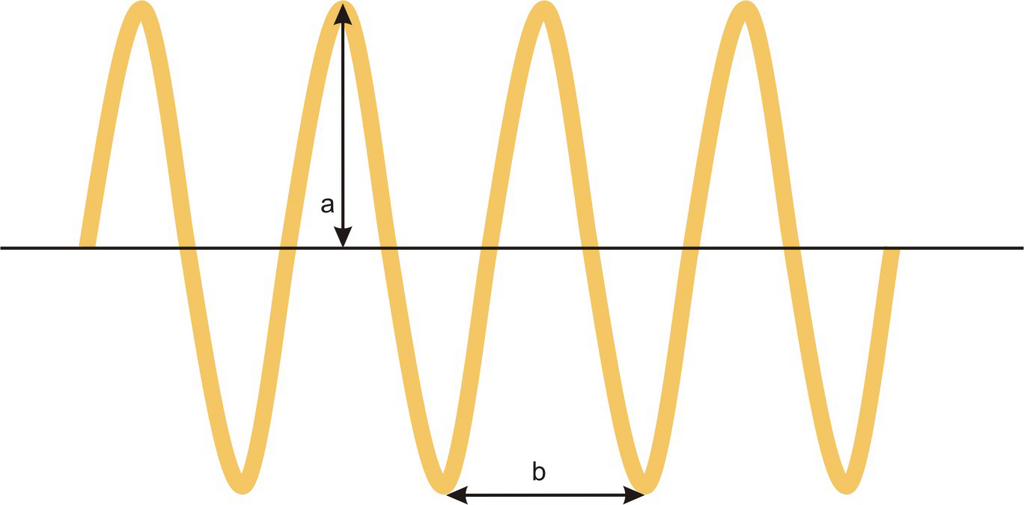
Amplitude is the size of the vibration. On a wave diagram, it’s the height from the center line to the peak. A wave with a large amplitude carries more energy than one with a small amplitude.
Wavelength is the distance over which the wave's shape repeats. You can measure it from one peak to the next, or from one trough to the next.
Frequency is how many full wave cycles happen in one second. It's measured in a unit called Hertz (Hz). A wave that completes 100 cycles in a second has a frequency of 100 Hz.
From Wave to Perception
Our brains don't think in terms of frequency or amplitude. Instead, we perceive these physical properties as pitch and loudness. These two characteristics are the basic building blocks of everything we hear, from speech to music.
The frequency of a sound is the number of vibrations that occurs within a given time, and is perceived in the brain as pitch, while the amplitude, or magnitude of the vibration, is perceived as dynamic intensity, or loudness.
The relationship is straightforward. A sound wave's frequency determines its pitch—how high or low we perceive it to be. A high-frequency wave sounds high-pitched, like a flute, while a low-frequency wave sounds low-pitched, like a tuba.
Similarly, a sound wave's amplitude determines its loudness. A high-amplitude wave is perceived as a loud sound, while a low-amplitude wave is perceived as a quiet one.
| Physical Property | Perceptual Quality | Description |
|---|---|---|
| Frequency | Pitch | How high or low the sound is. |
| Amplitude | Loudness | How loud or quiet the sound is. |
So, when a musician plays a soft, low note on a cello, they are creating a sound wave with a low frequency and a small amplitude. A loud, high note from a violin comes from a wave with a high frequency and a large amplitude. Every sound you hear is just a combination of these basic properties.
What is sound fundamentally?
An astronaut watches a distant asteroid explode in the vacuum of space. They see the explosion but hear nothing. Why?