The Science of Language
Introduction to Linguistics
What is Linguistics?
Linguistics is the scientific study of human language. It’s not about learning to speak many languages, just like an automotive engineer doesn’t need to know how to drive every car. Instead, linguists want to understand the engine that powers all language: the human mind.
They ask fundamental questions. What are the rules that govern how we speak? How do children learn a language so effortlessly? Why are there so many different languages, and what do they all have in common? To answer these, linguists gather data from spoken, written, and signed languages around the world. They form hypotheses about the underlying structures and test them, just like in any other science.
The goal is to figure out the unconscious knowledge that every speaker has—the intricate system of rules that allows you to create and understand sentences you've never heard before.
The Core Questions
Linguistic research revolves around a few key puzzles.
First, what is the structure of language? Every language has a system. Sounds combine to form words, words combine to form sentences, and sentences convey meaning. Linguists aim to map out this system, from the smallest sound to the most complex conversational turn.
Second, how do we acquire language? A child learns their native language without formal lessons. They are exposed to a messy, limited set of examples, yet they develop a rich and complex grammatical system. This suggests that the human brain is uniquely wired for language.
Finally, how do languages change and vary? No language is static. They evolve over time, borrowing words, shifting sounds, and altering grammar. At the same time, languages spoken by different communities can vary dramatically, creating the thousands of distinct languages we see today. Linguists study both this historical change and present-day variation.
The Building Blocks of Language
To study language systematically, linguists break it down into different levels of analysis. Think of it like a biologist studying a living organism, moving from the level of ecosystems down to cells and molecules. Each level has its own set of rules and patterns.
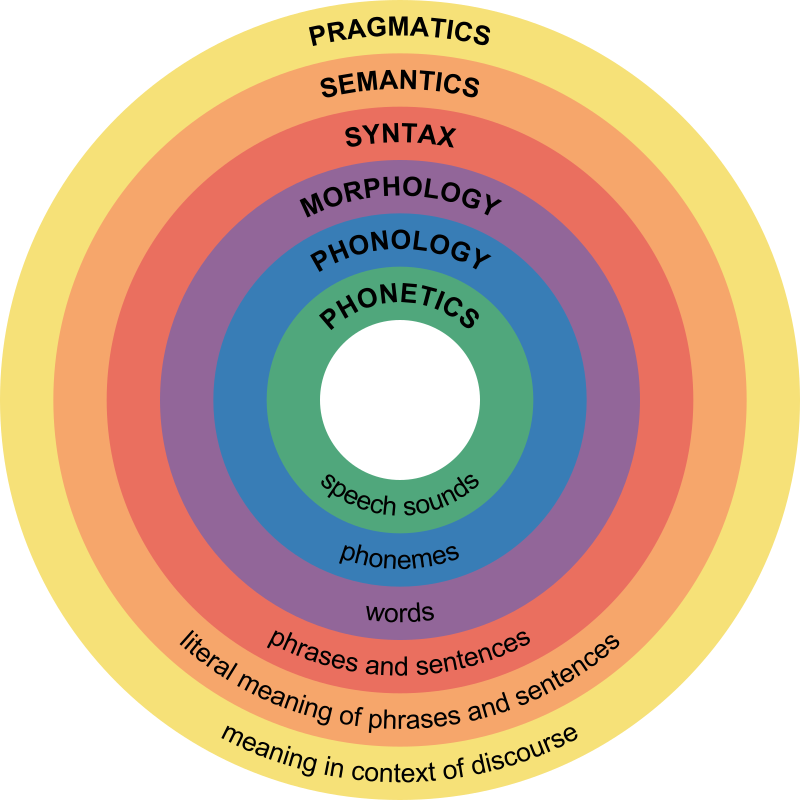
These levels are the main subfields of linguistics:
Phonetics
noun
The study of the physical properties of speech sounds. It looks at how sounds are produced by the vocal tract and how they are perceived by the ear.
Phonology
noun
The study of the abstract sound systems of languages. It examines how sounds are organized in the mind and how they pattern to create meaning.
Morphology
noun
The study of the internal structure of words. It looks at how words are formed from smaller meaningful units, like prefixes and suffixes.
Syntax
noun
The study of the structure of sentences. It describes the rules for combining words into phrases and phrases into sentences.
Semantics
noun
The study of literal meaning in language. It deals with the meanings of words and how they combine to form the meanings of sentences.
Pragmatics
noun
The study of meaning in context. It explores how we use language in social situations and how we understand more than what is literally said.
Together, these fields provide a comprehensive framework for understanding what language is and how it works. In the next steps, we'll dive into each of these areas to see what they reveal about our most human capability.
What is the primary focus of linguistics as a scientific discipline?
Which of the following is NOT one of the key puzzles mentioned that linguistic research tries to solve?