The Science of Ignition and the Human Quest for Fire
Fire Tetrahedron Dynamics
Beyond the Triangle
Most people are familiar with the fire triangle: heat, fuel, and oxygen. It's a simple, effective model. Remove any side, and the fire goes out. But it's incomplete. It explains how to start a fire, but not what keeps it going. To understand that, we need to add a fourth element: the uninhibited chemical chain reaction. This turns the triangle into a tetrahedron, a three-dimensional pyramid.
This fourth element is the engine of a self-sustaining fire. It’s the process where the fire generates enough energy to trigger the next reaction, creating a continuous loop. Without it, you might get a flash of light or a brief burst of heat, but you won't get a lasting flame.
Oxygen, heat, and fuel are frequently referred to as the "fire triangle." Add in the fourth element, the chemical reaction, and you actually have a fire "tetrahedron." The important thing to remember is: take any of these four things away, and you will not have a fire or the fire will be extinguished.
The Molecular Dance
At its heart, fire is a rapid oxidation reaction. This is a type of chemical reaction where a substance loses electrons. When wood burns, carbon atoms in the wood are giving up their electrons to oxygen atoms from the air. This exchange isn't a peaceful handover; it's a energetic release.
exothermic
adjective
A reaction or process that releases energy, usually in the form of heat or light. Combustion is a classic example.
This process is exothermic—it releases more energy than it consumes. The heat you feel from a fire is the direct result of this energy being liberated. The general reaction for the combustion of a simple hydrocarbon like methane (natural gas) looks like this:
The energy released is crucial. It provides the activation energy needed to kickstart the next set of reactions. The heat from one burning molecule provides the spark for its neighbor, which then ignites its neighbor, and so on. This is the chain reaction.
Keeping the Fire Alive
For a fire to be self-sustaining, the chain reaction must be uninhibited. This means nothing is interfering with the process. The reaction must produce enough heat to keep the fuel at its ignition temperature, allowing it to continuously react with oxygen.
Think of it like a line of dominoes. The fire triangle components are the dominoes themselves (fuel), the setup on a stable surface (oxygen available), and the initial push (heat). The fire tetrahedron's fourth component is the fact that each domino is close enough to knock over the next one. If you remove a domino from the line, the chain reaction stops. Similarly, if you remove heat, fuel, or oxygen, the molecular chain reaction is broken.
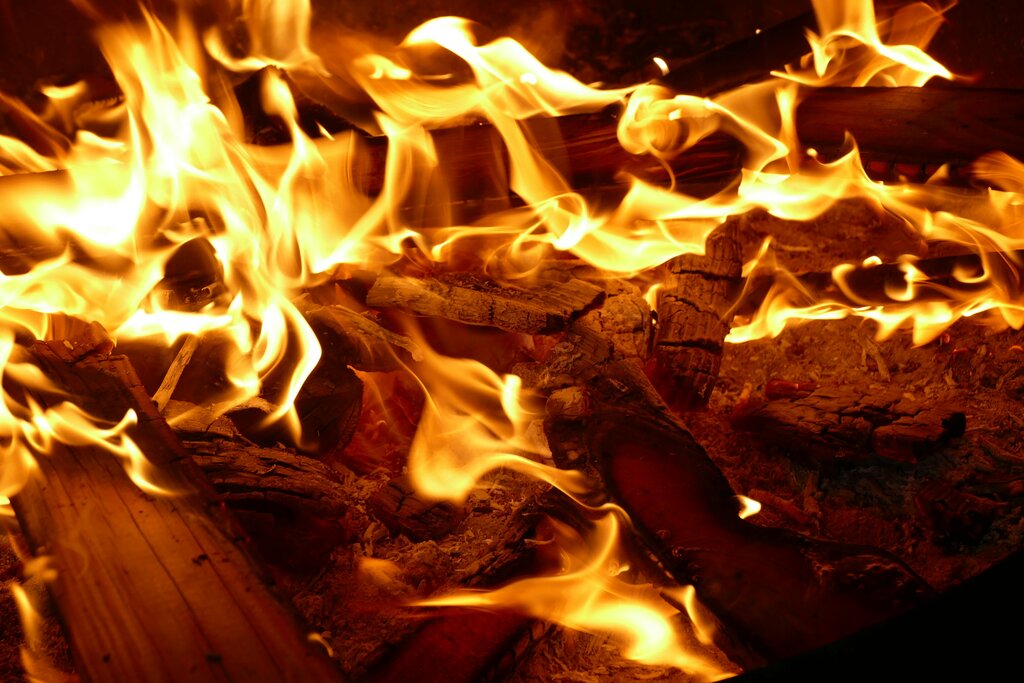
This is why simply having fuel, heat, and oxygen isn't always enough. A pile of damp wood won't burn well because the heat energy is spent evaporating water instead of propagating the chain reaction. The reaction is inhibited. The energy released by one reaction isn't sufficient to trigger the next, and the fire sputters out. The key is the continuous, self-feeding loop that defines a stable fire, made possible by the release of free radicals during combustion.
Understanding the fire tetrahedron shifts our perspective from just starting a fire to engineering a sustainable chemical process. It’s not about a single event, but about creating the conditions for a continuous cascade of energy release.
Time to check your understanding of the dynamics of fire.
What is the fourth element that transforms the fire triangle into the fire tetrahedron?
According to the text, why will a pile of damp wood struggle to burn even when heat, fuel, and oxygen are present?
By adding the chemical chain reaction to the classic triangle, we gain a much deeper appreciation for the complex, self-perpetuating process that is fire.