The Science of Human Stupidity
Cognitive Heuristics and Errors
The Cognitive Miser
Your brain is lazy. This isn't an insult; it's a design feature. Faced with a constant flood of information, the brain takes shortcuts to conserve energy. These mental shortcuts, or heuristics, allow us to make quick judgments and navigate the world without getting bogged down in endless analysis. Think of it as running on autopilot.
This fast, intuitive system is incredibly efficient. It helps you decide if an approaching animal is a threat or catch a ball without calculating its trajectory. But this efficiency comes at a cost: accuracy. The brain prioritizes speed over correctness, making it a 'cognitive miser.' It defaults to the easiest path, which often leads to predictable, systematic errors. Stupidity, in this context, isn't about low IQ. It's the natural output of a system built for a different world, one where a fast, good-enough decision was better than a slow, perfect one.
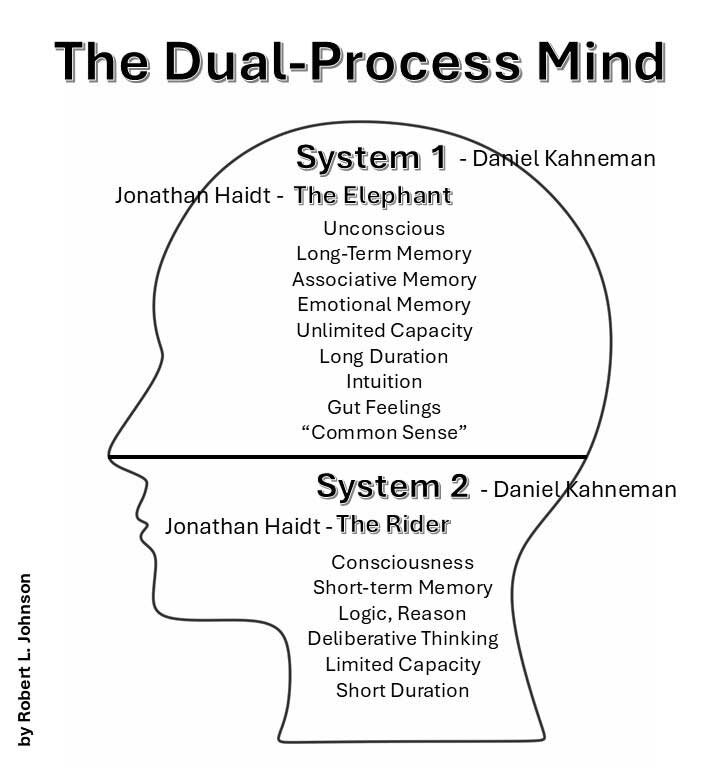
The alternative to heuristic thinking is analytic thought. This is the slow, deliberate, and energy-intensive process you use to solve a math problem or learn a new skill. It's powerful but limited. We simply don't have the mental bandwidth to apply it to every decision we make throughout the day. So, most of the time, we rely on our gut, our intuition, our heuristics.
The Peak of Unknowing
One of the most profound consequences of our cognitive shortcuts is a failure in self-assessment. In the late 1990s, social psychologists David Dunning and Justin Kruger observed a peculiar pattern: people with the least ability in a given area were the most likely to overestimate their skill. This is now known as the Dunning-Kruger effect.
It's a breakdown in meta-cognition, the ability to think about one's own thinking. To accurately judge your competence, you need a certain level of knowledge in that area. If you don't know the rules of grammar, you can't see the errors in your own writing. If you don't understand strategy, you won't realize you're a terrible chess player.
meta-cognition
noun
Awareness and understanding of one's own thought processes.
This creates what's known as the 'dual burden' of incompetence. The very lack of skill that makes a person perform poorly also prevents them from recognizing their poor performance. They lack the tools for accurate self-evaluation. Conversely, experts often underestimate their own abilities, mistakenly assuming that tasks they find easy must be easy for everyone else, too.
The skills required to produce a right answer are often the very skills required to recognize a right answer.
The Smart Person's Stumble
You might think that high intelligence would be a shield against these kinds of errors. The reality is more complicated. While intelligent people may be less susceptible to certain logical fallacies, they are often more vulnerable to a particularly sneaky error: the bias blind spot.
The bias blind spot is the tendency to recognize the impact of biases on the judgment of others, while failing to see the impact of biases on one's own judgment. We're all brilliant at spotting the flaws in someone else's argument but comfortably oblivious to our own. High intelligence can actually make this worse. A smarter person has more cognitive firepower to construct elaborate justifications and rationalizations for their pre-existing beliefs. They are better storytellers, and the most convincing stories they tell are to themselves.
Cognitive biases—those invisible mental shortcuts and distortions—undermine judgment, warp perception, and quietly sabotage performance.
This means that being smart doesn't automatically make you a better thinker. Without intellectual humility and a conscious effort to challenge your own assumptions, intelligence can simply become a tool for reinforcing your own errors.
Old Brain, New World
The root of these cognitive quirks lies in an evolutionary mismatch. The human brain evolved over millennia in an environment vastly different from our own. Our ancestors lived in small hunter-gatherer groups where survival depended on quick decisions based on incomplete information. Is that rustle in the grass a predator? Is this person a friend or foe?
Heuristics were perfectly adapted for this world. They allowed for fast, life-saving judgments. But the modern world is a firehose of abstract data, complex social networks, and long-term problems that our evolutionary programming is ill-equipped to handle. The mental shortcuts that kept us safe on the savanna can lead us astray when trying to evaluate climate change data, financial markets, or online misinformation.
Our brains are still operating with the same basic hardware as our ancestors. We are trying to navigate a digital, globalized society with a mind built for a local, immediate reality. The result is a predictable set of errors, not because we are unintelligent, but because our environment has changed faster than our brains have.
Why does the brain often rely on mental shortcuts, or heuristics?
The Dunning-Kruger effect describes a 'dual burden' of incompetence. What does this mean?
Understanding these cognitive traps is the first step toward overcoming them. By recognizing our brain's default settings, we can learn when to slow down, question our intuitions, and engage in more deliberate, analytic thought.