The Science of Holograms
Introduction to Holography
More Than a 3D Photo
When you think of a hologram, you might picture a futuristic 3D projection floating in mid-air. While that's the sci-fi version, the real science is arguably even more fascinating. Holography is a technique for recording and reconstructing a complete light field, not just a flat image.
Holography
noun
A technique that enables a light field, which is generally the product of a light source scattered off objects, to be recorded and later reconstructed when the original light field is no longer present.
The idea isn't new. It was invented in 1947 by Hungarian-British physicist Dennis Gabor, who later won a Nobel Prize for his work. Unlike a photograph that captures a single perspective, a hologram captures the way light waves from an object look from all directions. To understand how, we need to look at the behavior of light itself.
The Secret of Light Waves
Imagine dropping two pebbles into a calm pond. Each creates ripples that spread outwards. Where the crest of one ripple meets the crest of another, they combine to make a bigger wave. Where a crest meets a trough, they cancel each other out. This interaction is called interference.
Light behaves in a similar way, traveling as waves. Holography uses this property to record information. It also relies on another property called diffraction, which is the tendency of waves to bend and spread out as they pass through an opening or around an obstacle.
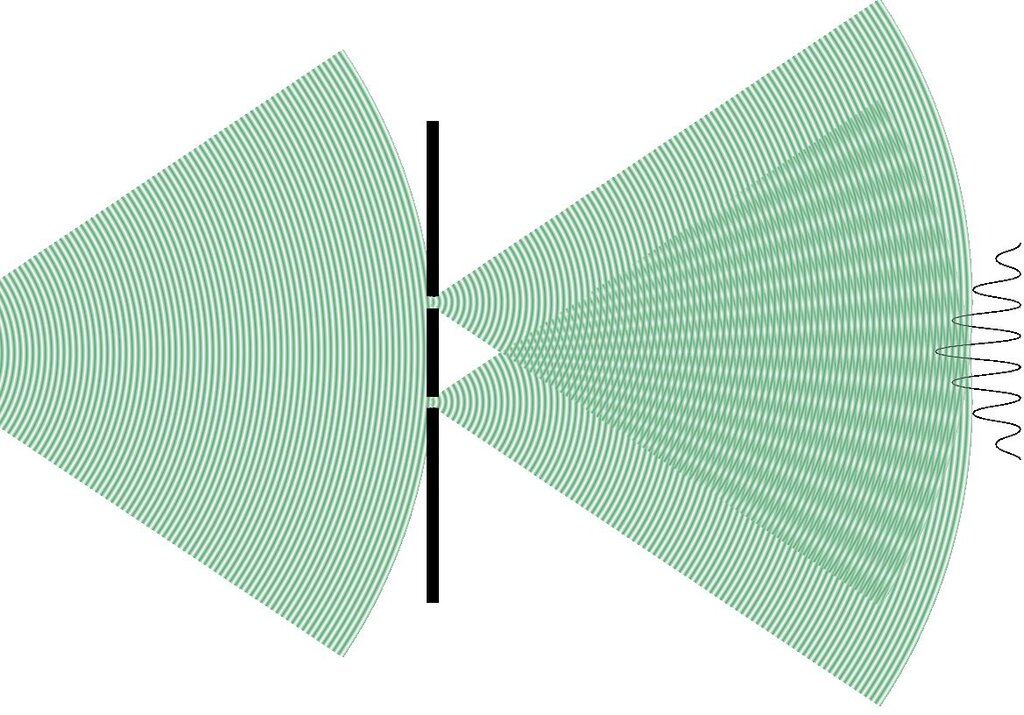
In essence, a hologram is a frozen, microscopic pattern of interference and diffraction. It’s a physical recording of what happened when two light waves met and interacted.
Capturing a Wavefront
So how is a hologram different from a regular photograph? A camera captures only the brightness (amplitude) and color of light rays reflecting off an object. It discards a crucial piece of information: the phase of the light waves. The phase tells us about the wave's position in its cycle and, by extension, the depth and shape of the object.
| Feature | Traditional Photography | Holography |
|---|---|---|
| Records | Light intensity (amplitude) | Intensity and phase |
| Illumination | Regular light (sun, flash) | Coherent light (laser) |
| Dimension | 2D | 3D |
| Perspective | Single viewpoint | Multiple viewpoints |
To record the phase, holography uses a clever trick. A single laser beam is split in two. One part, the object beam, shines on the object and then onto a special photographic plate. The other part, the reference beam, is aimed directly at the same plate.
When these two beams meet at the plate, they create an interference pattern. This pattern encodes the differences in phase between the two beams. It's a microscopic landscape of light and dark fringes that contains all the information about the object's 3D structure.
Reconstructing the Image
The developed plate, now called a hologram, looks like a foggy piece of film. The magic happens when you shine the original reference beam back through it.
The microscopic interference pattern on the hologram diffracts the light, bending it in a very specific way. It essentially unscrambles the recorded information, recreating the exact same light waves that originally bounced off the object.
When you look through the hologram, your brain interprets these reconstructed waves as if the object were still there, creating a perfect, three-dimensional virtual image. You can even move your head to see the object from different angles, revealing parts that were previously hidden, just as you would with a real object.
This process of recording and reconstructing a complete wavefront is what gives holograms their unique, lifelike quality, setting them apart from all other forms of imaging.
What key piece of information does a hologram record that a traditional photograph does not?
In the process of creating a hologram, a laser is split into two beams. The beam that illuminates the object is called the ______, while the beam aimed directly at the recording plate is the ______.