The Science of Heat Transfer
Heat Transfer Basics
How Heat Moves
Heat, or thermal energy, is always on the move. It naturally flows from hotter objects to cooler ones, seeking a balance. A cup of hot coffee cools down because it transfers heat to the cooler air around it. An ice cube in your hand melts because heat flows from your hand to the ice. This movement of energy is called heat transfer, and it happens in three main ways: conduction, convection, and radiation.
There are three methods by which heat transfer can take place: conduction, convection, and radiation.
Conduction
Conduction is heat transfer through direct contact. Imagine holding one end of a metal rod and placing the other end in a fire. Soon, the end you're holding will become hot. Heat travels directly through the material from one molecule to the next, like a chain reaction. The particles in the hot end vibrate vigorously, bumping into their neighbors and passing the energy along until it reaches your hand.
This process is most effective in solids, where particles are packed tightly together. Metals are excellent conductors, which is why a metal spoon in a hot soup quickly becomes hot to the touch. Materials like wood or plastic are poor conductors, also known as insulators.
The rate of heat conduction is described by Fourier's Law. It tells us that the rate of heat flow () depends on the material's thermal conductivity (), the area through which heat is flowing (), and the temperature gradient ( rac{dT}{dx}), which is how rapidly the temperature changes over a distance.
The minus sign in Fourier's Law indicates that heat flows from higher to lower temperatures, moving down the temperature gradient.
Convection
Convection is heat transfer through the movement of fluids—liquids or gases. When you boil a pot of water, the burner heats the water at the bottom. This water expands, becomes less dense, and rises. The cooler, denser water from the top sinks to take its place, gets heated, and rises in turn. This circulation, called a convection current, distributes heat throughout the water.
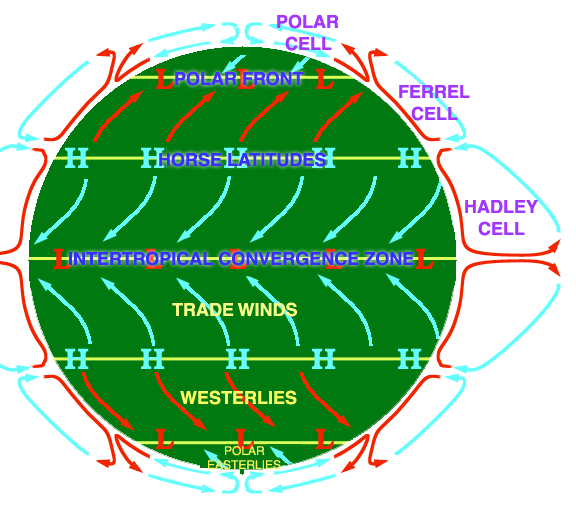
Convection can be natural, like the boiling water example, driven by density differences. It can also be forced, like when you use a fan to blow hot air from a heater around a room. The fan forces the air to move, speeding up the heat transfer process.
Newton's Law of Cooling describes convective heat transfer. It states that the rate of heat transfer () is proportional to the difference between the surface temperature () and the fluid temperature ().
Here, is the convection heat transfer coefficient, which depends on factors like fluid properties and flow speed, and is the surface area.
Radiation
Radiation is the transfer of heat through electromagnetic waves, and it doesn't require any medium to travel through. This is how the Sun's heat reaches Earth through the vacuum of space. Every object with a temperature above absolute zero emits thermal radiation.
You feel radiant heat when you stand near a campfire or a hot stove. The heat you feel isn't coming from hot air (convection) or direct touch (conduction), but from the infrared waves traveling from the fire to your skin.
The Stefan-Boltzmann Law describes the rate at which an object radiates thermal energy. It says the radiated power () is proportional to the object's surface area () and the fourth power of its absolute temperature () in Kelvin.
In this equation, is the Stefan-Boltzmann constant, and is the emissivity of the surface, a value between 0 and 1 that describes how effectively it radiates energy. A perfect black body has an emissivity of 1, while a shiny, reflective surface has an emissivity close to 0.
Because temperature is raised to the fourth power, radiation becomes a much more significant mode of heat transfer at very high temperatures.
Time for a quick check on these core concepts.
Which of the following best describes heat transfer by conduction?
You feel the warmth of a campfire on your face primarily due to which form of heat transfer?
Understanding these three modes is the first step in analyzing how heat moves through our world, from cooking a meal to designing a spacecraft.