The Science of Healthy Hair
Hair Structure
The Anatomy of a Hair Strand
Each strand of hair on your head is much more complex than it looks. It's primarily made of a strong protein called keratin, the same material that makes up your fingernails and the outer layer of your skin. Think of a single hair strand as a tiny, intricate cable.
Keratin
noun
A type of structural protein that is the key material making up hair, feathers, horns, claws, hooves, and the outer layer of the skin among vertebrates.
This cable has three distinct layers, though not every hair has all three. The structure of these layers determines much about your hair's texture and appearance.
-
The Cuticle: This is the outermost layer. It's made of overlapping scales, like shingles on a roof. A healthy, smooth cuticle lies flat, which makes hair look shiny and feel smooth. When the cuticle is damaged, these scales lift, causing hair to look dull and feel rough.
-
The Cortex: This is the thickest layer of the hair shaft and provides its strength, color, and texture. The cortex contains melanin, the pigment that gives your hair its natural color. Chemical treatments like dyeing or perming work by altering the structure of the cortex.
-
The Medulla: This is the soft, innermost core of the hair shaft. It’s not always present, especially in people with very fine or naturally blonde hair. Its exact function isn't fully understood, but it may add to the hair's overall thickness.
How Hair Grows
Hair doesn't just appear. It grows from a complex mini-organ beneath the skin's surface called the hair follicle. Think of the follicle as the factory where the hair strand is built. At the base of the follicle is the hair bulb, where living cells divide and grow to build the hair shaft.
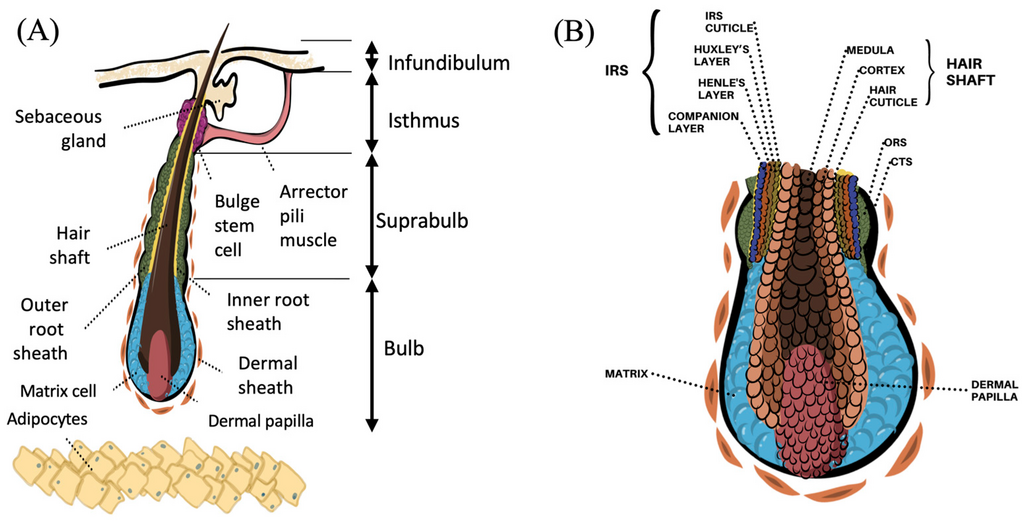
Blood vessels nourish the cells in the hair bulb, delivering the hormones that regulate hair growth and structure at different times of life.
As new cells emerge, the old, divided cells harden into hair through a process called keratinization.
Hair growth isn't a continuous process. Each follicle operates on a cycle with three distinct phases. At any given time, different hairs on your head are in different phases.
| Phase | What Happens | Typical Duration |
|---|---|---|
| Anagen | The active growth phase. Cells in the hair bulb divide rapidly, forming new hair. | 2-7 years |
| Catagen | A short transitional phase. Hair growth stops and the follicle shrinks. | 2-3 weeks |
| Telogen | The resting phase. The old hair is released and sheds, and the follicle remains inactive. | Around 3 months |
After the telogen phase, the cycle begins again as the follicle re-enters the anagen phase to produce a new hair. Because each follicle is on its own independent schedule, you shed hair gradually every day rather than all at once.
Now, let's test your understanding of hair's structure and growth cycle.
What is the primary protein that makes up a hair strand?
Which layer of the hair shaft is responsible for giving hair its natural color?
Understanding the basic biology of your hair—from its layered structure to its cyclical growth—is the first step toward knowing how to care for it properly.