The Science of Free Fall
Introduction to Free Fall
The Idea of Free Fall
What happens when you drop something? It falls. This simple observation is the start of a deep idea in physics: free fall. An object is in free fall when the only force acting on it is gravity. We ignore other forces like air resistance for now to keep things simple. This isn't just about objects dropped from rest. A ball thrown upwards is also in free fall as soon as it leaves your hand, even while it's still moving up.
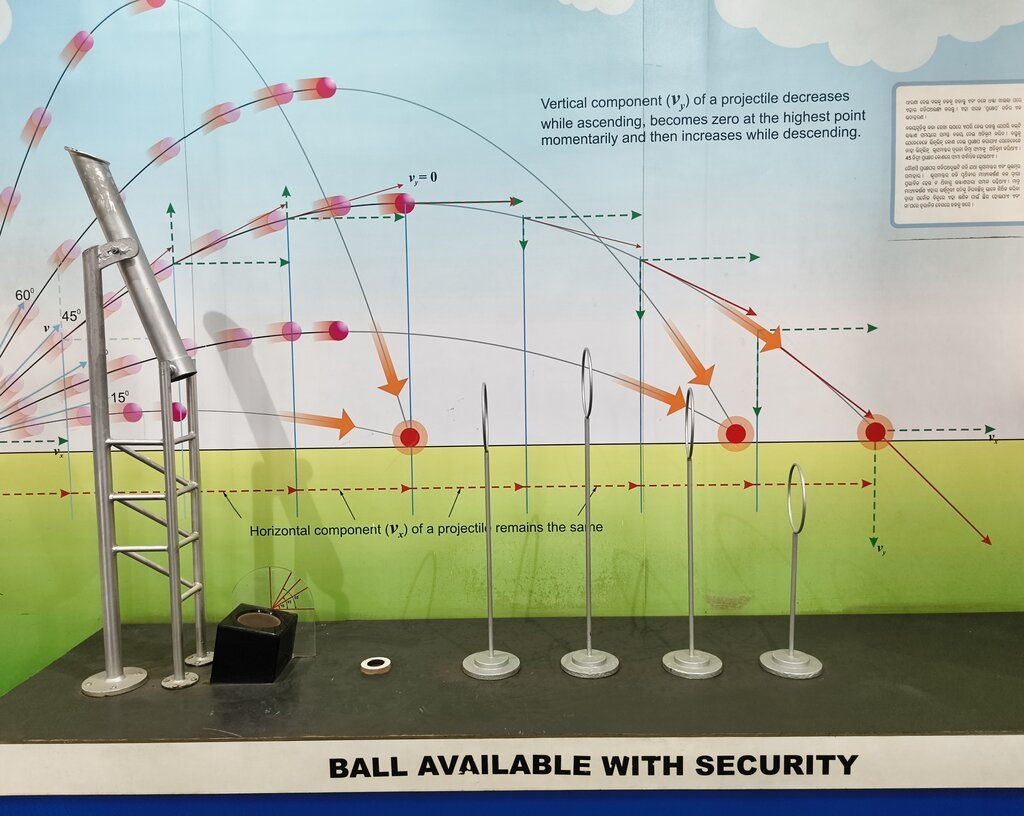
Under gravity's influence, all objects accelerate downwards at the same rate. This constant acceleration is called the acceleration due to gravity, and it's represented by the symbol . Near the Earth's surface, its value is remarkably consistent.
The acceleration due to gravity, , is approximately () near Earth's surface.
This means for every second an object is in free fall, its downward velocity increases by 9.8 meters per second. If you drop a rock from a cliff, after one second it's moving at . After two seconds, it's moving at , and so on, until it hits the ground.
Galileo's Insight
For a long time, people thought heavier objects fall faster than lighter ones. It seems intuitive, right? A bowling ball should hit the ground before a feather. But the Italian scientist Galileo Galilei challenged this idea in the 17th century. The famous story has him dropping two spheres of different masses from the Leaning Tower of Pisa to show they land at the same time. While this story might be a legend, Galileo did perform careful experiments with balls rolling down inclined planes, which slowed the motion and allowed for precise measurements.
His conclusion was revolutionary: In the absence of air resistance, an object's mass has no effect on its acceleration in free fall. A cannonball and a pebble dropped from the same height in a vacuum would land simultaneously. The reason a feather falls slower in real life is purely due to air resistance, a force we are ignoring in our definition of free fall.
The Math of the Fall
Since free fall involves constant acceleration, we can use the kinematic equations of motion to describe it. We just need to make a few adjustments. We'll set up a coordinate system where the upward direction is positive, which means the acceleration due to gravity, , is a negative value, . We'll also use for vertical position instead of .
Here are the kinematic equations for free fall:
This equation tells you the final vertical velocity () of an object after a certain time (), given its initial vertical velocity ().
This helps find the final vertical position () of an object starting from an initial position ().
And this one relates final velocity to displacement (), without needing to know the time.
Remember, is positive if the object is initially moving up and negative if it's moving down. If an object is simply dropped, its initial velocity is zero.
Which of the following scenarios correctly describes an object in free fall?
According to Galileo's experiments, if a 10 kg cannonball and a 1 kg rock are dropped from the same height in a vacuum, which statement is true?
These concepts form the foundation for understanding how objects move under gravity's pull.