The Science of Flight
Lift Generation Principles
The Shape of Lift
You already know that lift is the force opposing weight, allowing an aircraft to rise. But how is this force actually generated? It all starts with the shape of the wing, specifically its cross-section, known as an airfoils. An airfoil is engineered to manipulate the air flowing past it, creating a pressure difference that generates an upward force.
This specific shape, with its curved upper surface and flatter bottom, is the foundation of lift. When air flows over this shape, the magic begins. The way the wing is tilted into the airflow also plays a crucial role.
Angle and Pressure
The angle between the airfoil's chord line and the oncoming air is called the angle of attack (AoA). By increasing the angle of attack, a pilot can increase the amount of lift generated, up to a point. This works in conjunction with a fundamental principle of fluid dynamics.
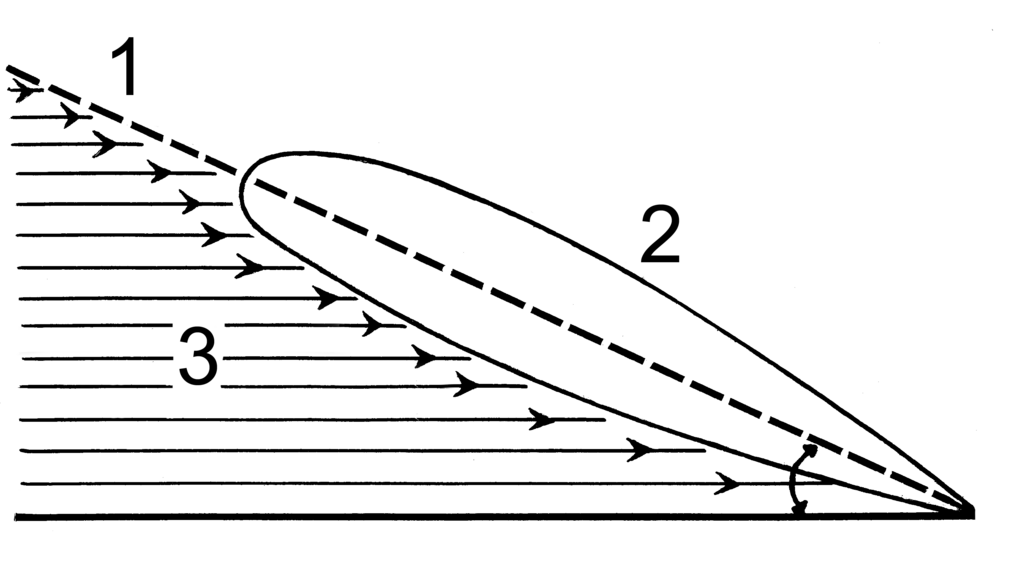
As air flows over the curved upper surface of the airfoil, it has to travel a longer distance than the air flowing along the flatter bottom surface. To meet up at the trailing edge at the same time, the air on top must speed up. According to , an increase in the speed of a fluid occurs simultaneously with a decrease in pressure. This creates a pressure differential: lower pressure above the wing and higher pressure below it. The high pressure pushes up more than the low pressure pushes down, resulting in a net upward force we call lift.
But that's not the whole story. The airfoil also physically pushes air downwards. Due to a phenomenon called the Coandă effect, the airflow tends to stick to the curved surface of the wing, following its contour. This deflects a large mass of air downwards. In line with Newton's Third Law (for every action, there is an equal and opposite reaction), pushing air down creates an equal and opposite upward force on the wing. Both the pressure differential and this downward deflection of air contribute to lift.
The Lift Equation
We can quantify lift with a fundamental formula. The amount of lift generated depends on four key variables: the density of the air, the velocity of the aircraft (airspeed), the surface area of the wing, and a special factor called the coefficient of lift.
The coefficient of lift, , is particularly important because it's the variable a pilot can most directly influence by changing the angle of attack. As the AoA increases, increases linearly. However, this relationship only holds up to a certain point.
If the angle of attack becomes too high, the smooth flow of air over the top surface of the wing breaks away. This is called flow separation. The thin layer of air right next to the wing's surface, known as the boundary layer, becomes turbulent and detaches. When this happens, the pressure differential is drastically reduced, and lift decreases sharply. This condition is known as a stall. It's important to remember that a stall is an aerodynamic effect related to the angle of attack, not the aircraft's speed.
Understanding these principles—airfoil shape, angle of attack, pressure differentials, and the limits of the lift curve—is the key to grasping how controlled, sustained flight is possible.
Time to check your understanding of these core concepts.
What is the cross-sectional shape of a wing, specifically designed to generate lift, called?
According to Bernoulli's principle, how does the shape of an airfoil generate lift?
With these principles in mind, we can begin to explore the other forces and systems that work together to make an aircraft fly.