The Science of Fictional Flight
Principles of Flight
The Four Forces of Flight
Whether it's a massive jumbo jet or a tiny hummingbird, anything that flies is under the influence of four fundamental forces. Flight is a constant balancing act between these four pressures. When they are in harmony, an aircraft can cruise smoothly through the sky. When they are intentionally unbalanced, the aircraft can climb, descend, or change speed.
Let's break down each of these forces.
Gravity and Lift
Gravity is the relentless force pulling an aircraft down toward the center of the Earth. It's also referred to as weight. To achieve flight, an opposing force must overcome gravity. That force is lift.
Lift is an upward aerodynamic force generated primarily by the wings. The curved shape of a wing, called an airfoil, is key. As the wing moves through the air, its shape forces the air flowing over the top to travel faster than the air flowing underneath. According to Bernoulli's principle, faster-moving air has lower pressure. This pressure difference, with higher pressure below the wing and lower pressure above, creates a net upward force: lift.
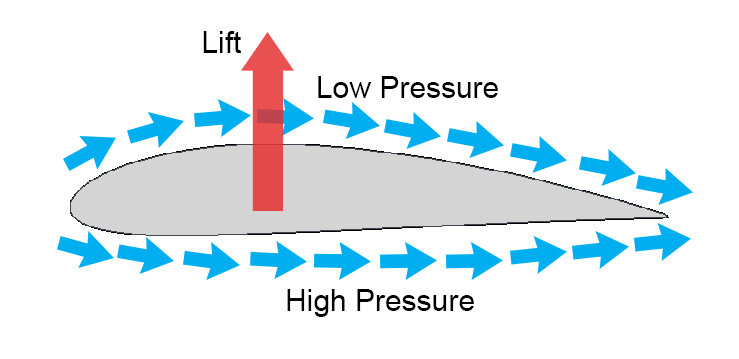
When lift is equal to gravity, the aircraft maintains its altitude. If lift becomes greater than gravity, the aircraft climbs.
Thrust and Drag
Thrust is the force that propels an aircraft forward through the air. It's generated by engines, whether they are propellers, jets, or rockets. Thrust is necessary to overcome the opposing force of drag.
Drag is the force of air resistance that works against an aircraft's motion. Think of it as aerodynamic friction. It's caused by the shape of the aircraft and the stickiness of the air itself. The faster an aircraft moves, the greater the drag it experiences.
With any flying machine, even our paper airplane, drag is one of the four main aerodynamic forces.
For an aircraft to maintain a constant speed, thrust must be equal to drag. To accelerate, thrust must be greater than drag.
Forces in Action
The pilot controls the aircraft by manipulating these four forces. By changing engine power, the pilot adjusts thrust. By changing the angle of the wings and control surfaces like flaps and ailerons, the pilot adjusts lift and drag.
Here’s how the balance of forces dictates flight:
| Flight Condition | Force Relationship |
|---|---|
| Straight, level flight | Lift = Gravity, Thrust = Drag |
| Climbing | Lift > Gravity, Thrust > Drag |
| Descending | Lift < Gravity, Thrust < Drag |
| Accelerating | Thrust > Drag |
| Decelerating | Thrust < Drag |
Mastering flight is all about understanding and managing the continuous interplay of lift, gravity, thrust, and drag.
Which set correctly identifies the four fundamental forces of flight?
An aircraft will accelerate forward when its thrust is greater than its ____.