The Science of Falling Apples
Introduction to Gravity
The Invisible Pull
Everything with mass, from a tiny grain of sand to the largest star, pulls on everything else. This invisible force of attraction is called gravity. It's the reason a dropped pen falls to the floor instead of floating away. It’s also what keeps the Moon circling the Earth and the Earth orbiting the Sun.
gravity
noun
A natural force that causes physical objects to be attracted to one another. The strength of this attraction depends on the mass of the objects and the distance between them.
For thousands of years, people saw things fall, but they didn't have a good explanation for why. The ancient Greek philosopher Aristotle suggested that objects fall because they want to return to their natural place. He also thought that heavier objects fall faster than lighter ones, a belief that went unchallenged for nearly 2,000 years.
Galileo's Breakthrough
In the 16th century, an Italian scientist named Galileo Galilei started to question the old ideas. Legend has it that he dropped two balls of different masses from the top of the Leaning Tower of Pisa. He observed that they hit the ground at almost the same time. While this story might be a myth, Galileo did perform careful experiments by rolling balls down ramps, which allowed him to study falling objects with great precision.
Galileo concluded that, if you ignore air resistance, all objects fall at the same rate, regardless of their mass.
This was a huge shift in thinking. It meant that the speed of a falling object didn't depend on how heavy it was, but on something else. Galileo had shown what happens when things fall, but the question of why they fall remained a mystery.
Newton's Universal Idea
The next great leap came from Isaac Newton in the late 17th century. The story goes that Newton was sitting under a tree when an apple fell on his head. This simple event sparked a profound thought: the same force that pulled the apple to the ground might also be the force that keeps the Moon in its orbit around the Earth.
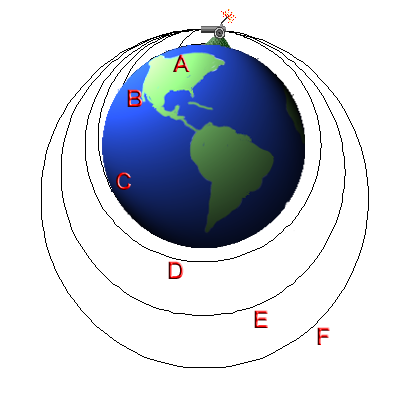
This was a revolutionary idea. Before Newton, people believed that the laws governing the heavens were completely different from the laws on Earth. Newton proposed that the force of gravity is universal—it applies everywhere and to everything with mass.
This became known as the Law of Universal Gravitation. It states that every object in the universe attracts every other object. The strength of this attraction depends on two things: the mass of the objects and the distance between them.
The more massive the objects, the stronger their gravitational pull. This is why you feel Earth's gravity so strongly—it has a tremendous amount of mass. The pull between you and your desk is incredibly tiny because your masses are so small.
At the same time, the farther apart the objects are, the weaker their pull. This is why we aren't pulled in by the Sun's immense gravity—it's very far away. Newton's simple law explained the motions of planets, comets, and tides, all with a single, elegant idea.
According to modern understanding, what is gravity?
Which historical figure famously proposed that the speed of a falling object does not depend on its mass, challenging a nearly 2,000-year-old belief?