The Science of Electric Lights
Introduction to Light and Electromagnetic Spectrum
Light as a Wave
Light is a form of energy that travels in waves, much like ripples spreading across a pond. These aren't water waves, however; they're electromagnetic waves. This means they are made of vibrating electric and magnetic fields that travel through space. Even empty space!
Every wave has two key properties: wavelength and frequency. Wavelength (represented by the Greek letter lambda, ) is the distance between two consecutive peaks of the wave. Frequency (represented by nu, ) is the number of waves that pass a point in a given amount of time.
These two properties are inversely related. The longer the wavelength, the lower the frequency, and vice versa. They are connected by a simple equation involving the speed of light (), which is a constant.
Think of it like pushing a rope up and down to create a wave. If you move your hand slowly (low frequency), you create long, lazy waves (long wavelength). If you move your hand quickly (high frequency), you create short, choppy waves (short wavelength).
The Electromagnetic Spectrum
The light we see with our eyes is just a tiny slice of a much broader range of light called the electromagnetic spectrum. This spectrum includes all types of electromagnetic radiation, arranged by wavelength and frequency.
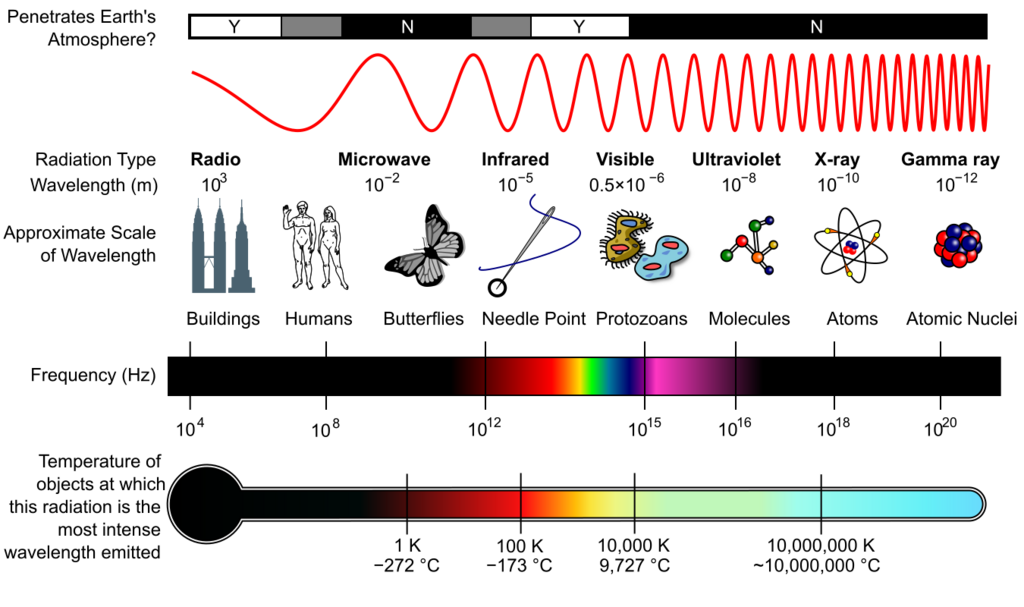
On one end of the spectrum are radio waves, which have very long wavelengths—some can be as long as a building. On the other end are gamma rays, with incredibly short wavelengths, smaller than an atom's nucleus. In between, we find microwaves, infrared radiation, the visible light we see, ultraviolet (UV) light, and X-rays.
Each type of radiation has different properties and uses.
| Radiation Type | Wavelength | Common Use |
|---|---|---|
| Radio Waves | > 1 meter | Broadcasting radio and TV |
| Microwaves | 1 mm - 1 m | Cooking food, WiFi |
| Infrared | 700 nm - 1 mm | Night vision, heat lamps |
| Visible Light | 400 - 700 nm | Human vision |
| Ultraviolet | 10 - 400 nm | Sterilization, causing sunburns |
| X-rays | 0.01 - 10 nm | Medical imaging |
| Gamma Rays | < 0.01 nm | Cancer treatment |
Visible Light and Color
The visible spectrum is the narrow band of wavelengths that our eyes can detect. We perceive different wavelengths within this band as different colors. The longest wavelengths appear red, and the shortest appear violet. In between, we see all the other colors of the rainbow.
You can remember the order of the colors with the acronym ROY G. BIV: Red, Orange, Yellow, Green, Blue, Indigo, and Violet.
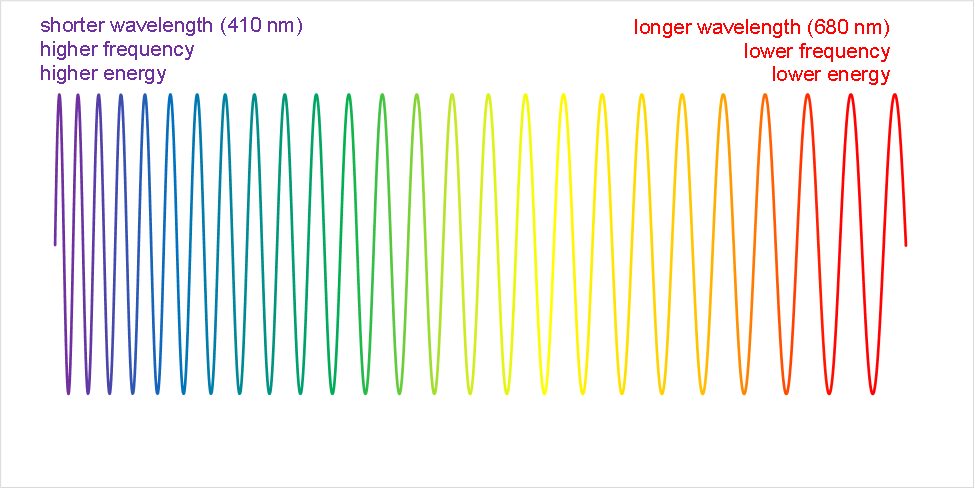
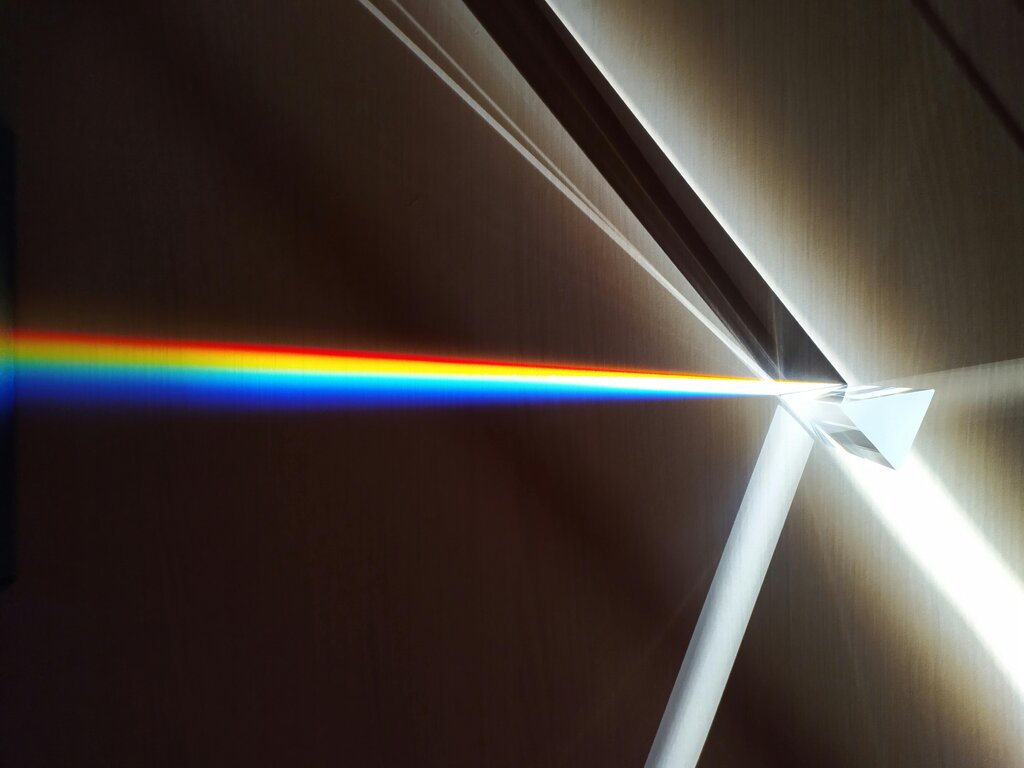
White light, like sunlight, isn't a single color. It's actually a mixture of all the colors in the visible spectrum. You can see this for yourself by passing a beam of sunlight through a prism. The prism bends the light, separating it into its component colors, just like a rainbow.
How Light Interacts with Matter
When light hits an object, it can do one of three things: reflect, refract, or be absorbed. Most of the time, it's a combination of these interactions.
Reflection happens when light bounces off a surface. A smooth, shiny surface like a mirror reflects light in a predictable way, creating an image. A rough surface reflects light in many directions, which is called scattering.
Refraction is the bending of light as it passes from one substance to another, like from air to water. This is why a straw in a glass of water looks like it's broken at the surface. The light traveling from the straw to your eye bends as it leaves the water.
Absorption occurs when an object takes in light energy. The color of an object depends on which wavelengths of light it absorbs and which it reflects. A red apple looks red because it absorbs all colors except red, which it reflects back to your eyes. A black object absorbs all visible light, while a white object reflects all of it.
Understanding these fundamental properties of light is the first step toward understanding how we can create and control it with technology.
Light travels as electromagnetic waves. What are these waves composed of?
If a light wave has a very long wavelength, what must be true about its frequency?