The Schrödinger Equation Explained
Quantum Mechanics Basics
A Weird New World
Classical physics, the kind Isaac Newton described, does a great job explaining the world we see. If you throw a ball, you can calculate its path perfectly. But when you shrink down to the size of atoms and electrons, those familiar rules break down. This is the realm of quantum mechanics, a place where particles behave in ways that seem to defy common sense.
At the quantum level, reality is less like a predictable machine and more like a game of probability.
Two Things at Once
One of the strangest ideas in quantum mechanics is that tiny particles, like electrons, can act as both particles and waves. This is called wave-particle duality. It's not that they switch back and forth; they are somehow both at the same time, and what we see depends on how we look.
A famous experiment illustrates this perfectly. If you shoot a stream of tiny particles, like electrons, at a screen with two narrow slits, you might expect to see two corresponding bands on the detector behind it, just like shooting paintballs through two openings. But that’s not what happens. Instead, an interference pattern appears—a series of many bands—which is the classic signature of waves interfering with each other.
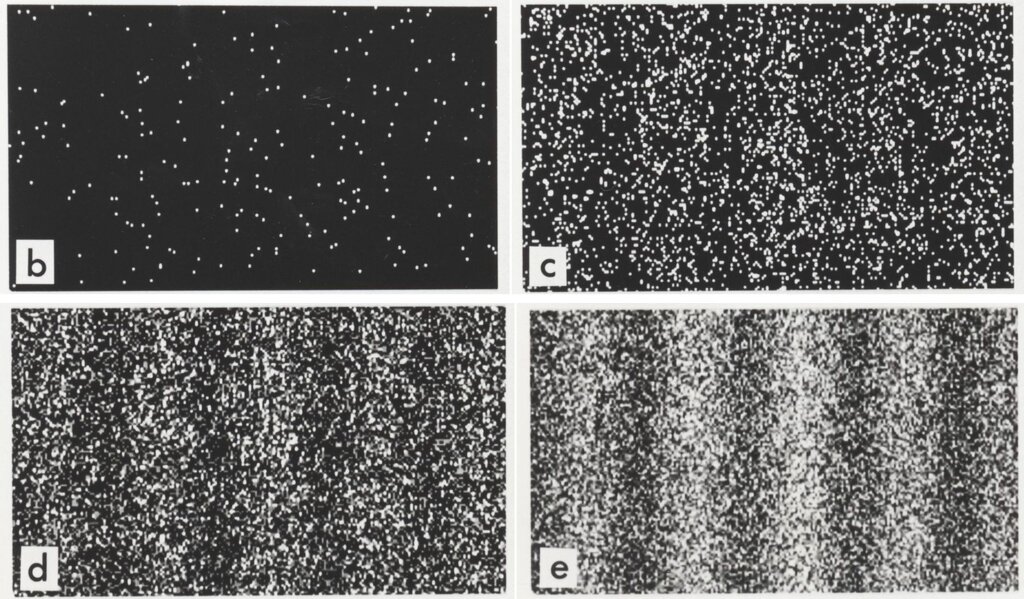
The weird part is that even if you send electrons through one at a time, they still create this pattern, as if each electron passes through both slits simultaneously as a wave and interferes with itself. However, if you place a detector at the slits to see which one the electron goes through, the interference pattern vanishes. The act of measuring forces the electron to “choose” a path and act like a particle again. It's as if the universe behaves differently when we're watching.
The Rules of Uncertainty
This strange behavior leads to another core concept: the Heisenberg Uncertainty Principle. It states that there's a fundamental limit to how well you can know certain pairs of properties of a particle at the same time. The most famous pair is position and momentum.
The more precisely you measure a particle's position, the less precisely you can know its momentum (how fast and in what direction it's moving), and vice versa. It’s not about having clumsy measuring tools; it's a built-in feature of reality. Imagine trying to find a single dust mote in a dark room by waving your hand around. The moment you touch it and know its position, you've also pushed it, changing its momentum in an unpredictable way.
To describe this uncertain state, physicists use a mathematical tool called a wave function, often represented by the Greek letter Psi (). The wave function doesn't tell you where a particle is; instead, it describes a wave of probabilities. The height of the wave at any point corresponds to the likelihood of finding the particle there if you were to measure it. Before a measurement, the particle exists in a superposition of all possible states at once.
The wave function represents all the possibilities. A measurement collapses the function into a single, definite reality.
The Language of Quantum
Describing this strange world requires a special kind of mathematics, different from what's used in classical physics. Three key tools are essential for understanding quantum mechanics.
Complex Numbers Wave functions are described using complex numbers. A complex number has a real part and an “imaginary” part (which is just a multiple of , the square root of -1). They are perfect for describing waves and oscillations, as they can represent both the amplitude (height) and phase (position in the cycle) of a wave in a single number.
In this formula, is the real part and is the imaginary part. This mathematical structure is necessary to capture the full behavior of quantum waves.
Linear Algebra Linear algebra is the mathematics of vectors and vector spaces. In quantum mechanics, the state of a system—its wave function—is treated as a vector in a high-dimensional space. This allows physicists to handle the superposition of multiple states at once and calculate how those states combine and evolve. It provides a powerful framework for organizing the probabilities and transformations that are central to quantum theory.
Differential Equations Since quantum mechanics is all about how things change over time, it relies heavily on differential equations. These are equations that describe the rate of change of a quantity. In the quantum world, they are used to model how the wave function of a particle evolves over time. By solving these equations, physicists can predict the future probabilities of a quantum system's state.
These mathematical tools form the bedrock of quantum mechanics, giving us a precise language to describe an otherwise baffling reality.
Now that we have the basic concepts and mathematical language in place, we can move on to the central equation that governs how these quantum systems behave.