The Rise and Fall of the Khmer Empire
Socio-Political Structures
The God-King and His Court
At the pinnacle of the Khmer Empire stood the king, a figure of absolute and centralized authority. This wasn't just a political role; it was a divine one. The king was considered a devarāja, or god-king, a living manifestation of a deity on Earth, usually Shiva or Vishnu. This belief system created an unbreakable link between the state and the divine, making the king's word both law and sacred decree.
His power radiated outward from the capital, which was seen as a microcosm of the Hindu cosmos. The great temples, like Angkor Wat, were not just places of worship. They were political and administrative centers, reinforcing the king's divine status and his connection to the gods. All land and resources ultimately belonged to him, managed through a complex network of officials.
The concept of the devarāja meant that to challenge the king was to challenge the gods themselves. This divine authority was the ultimate tool for maintaining order and loyalty across a vast empire.
Supporting the king was an elaborate hierarchy of nobility and officials. This bureaucracy was essential for governing the empire's territories, collecting taxes, and mobilizing the massive labor forces needed for construction projects. The highest positions were often held by members of the royal family and powerful aristocratic clans who pledged their loyalty to the king.
These officials managed everything from provincial administration to the royal household. Their roles were structured in a clear hierarchy, ensuring commands flowed smoothly from the king down to the local level.
| Rank | Title/Role | Key Responsibilities |
|---|---|---|
| 1 | King (Devarāja) | Supreme political and religious leader. |
| 2 | Royal Family & High Priests | Advised the king, performed key rituals, held top posts. |
| 3 | Ministers (Mantrins) | Oversaw major state departments like justice, treasury, and military. |
| 4 | Provincial Governors | Administered territories, collected taxes, and enforced royal edicts. |
| 5 | Local Officials & Village Chiefs | Managed daily life, resolved local disputes, and organized labor. |
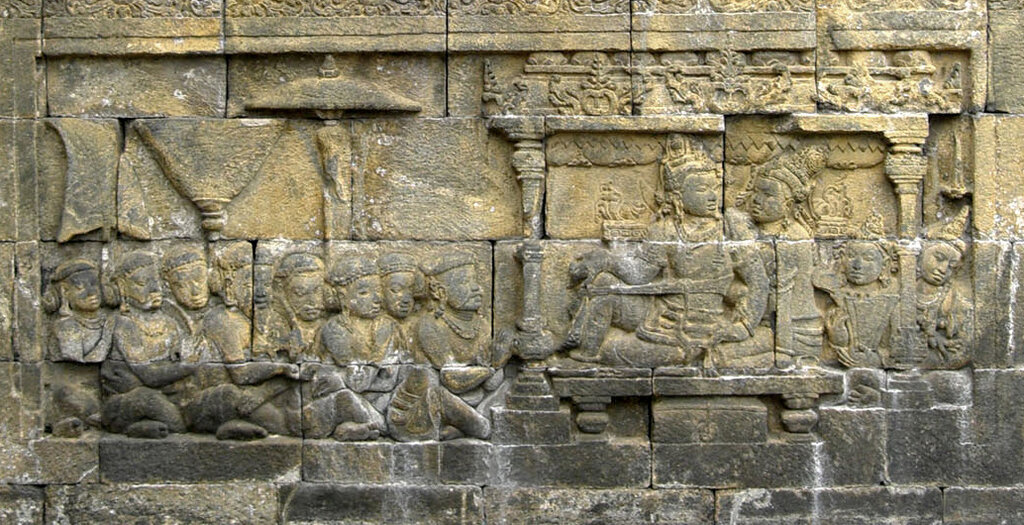
Religion as Statecraft
Religion was not separate from politics in the Khmer Empire; it was the very language of power. Initially, Hinduism provided the ideological foundation for the state. The cult of the devarāja was fundamentally Hindu, linking the king to deities like Shiva and legitimizing his rule. State temples were constructed as earthly homes for the gods and symbolic centers of the king's power.
These massive temple-mountains were more than monuments. They were economic engines, controlling vast agricultural lands and the people who worked them. The priesthood, which oversaw these temple complexes, held immense influence, acting as spiritual advisors to the king and as key administrators of the state's wealth.
Angkor Wat represents the fusion of religion, art, and politics in the Khmer Empire.
Later in the empire's history, particularly from the 12th century onward, Mahayana Buddhism began to gain prominence. King Jayavarman VII, one of the most powerful Khmer rulers, championed Buddhism. He repositioned the king's divine role as that of a bodhisattva, an enlightened being who delays nirvana to help humanity.
This shift changed the focus from personal deification to compassionate rule. The state's resources were directed towards building not just temples but also hospitals, rest houses, and other public works. While the structure of centralized authority remained, the religious justification for that power evolved, reflecting a new emphasis on social welfare.
Law and Order
The Khmer legal system was heavily influenced by legal traditions from India. The core principles were derived from texts known as the Dharmaśāstras, which are Hindu treatises on dharma, or moral and religious duty. These texts provided a comprehensive framework for law, justice, and social conduct.
Khmer rulers and legal scholars adapted these principles to fit their own society. Inscriptions found on temple walls reveal a system where the king was the ultimate judge, but a council of ministers and judges handled most cases. The laws governed everything from property rights and contracts to criminal offenses and family matters.
The legal code reinforced the existing social hierarchy. Punishments were often determined by a person's social status. An offense committed by a commoner against a noble would carry a much harsher penalty than the reverse. This system was designed to maintain social order and reinforce the authority of the ruling class.
Taxation and resource management were also regulated by these legal codes. The state had a right to a portion of all agricultural output, and officials were responsible for collecting this revenue to fund the court, the military, and public works. The legal framework was thus a critical tool for both administering justice and managing the empire's economy.
Now, let's test your understanding of the Khmer Empire's socio-political structure.
What does the term 'devarāja' signify in the context of the Khmer Empire?
How did the role of the Khmer king change with the rise of Mahayana Buddhism under Jayavarman VII?
The intricate blend of divine authority, a structured bureaucracy, and an adaptable legal system allowed the Khmer Empire to organize its society and govern effectively for centuries.