The Rise and Fall of the Holy Roman Empire
Origins and Formation
From Rome to Charlemagne
After the Western Roman Empire crumbled in the 5th century, Europe became a patchwork of smaller, competing kingdoms. The grand, unifying structure of Rome was gone, replaced by a constant struggle for power. Roads fell into disrepair, trade dwindled, and a sense of shared identity faded.
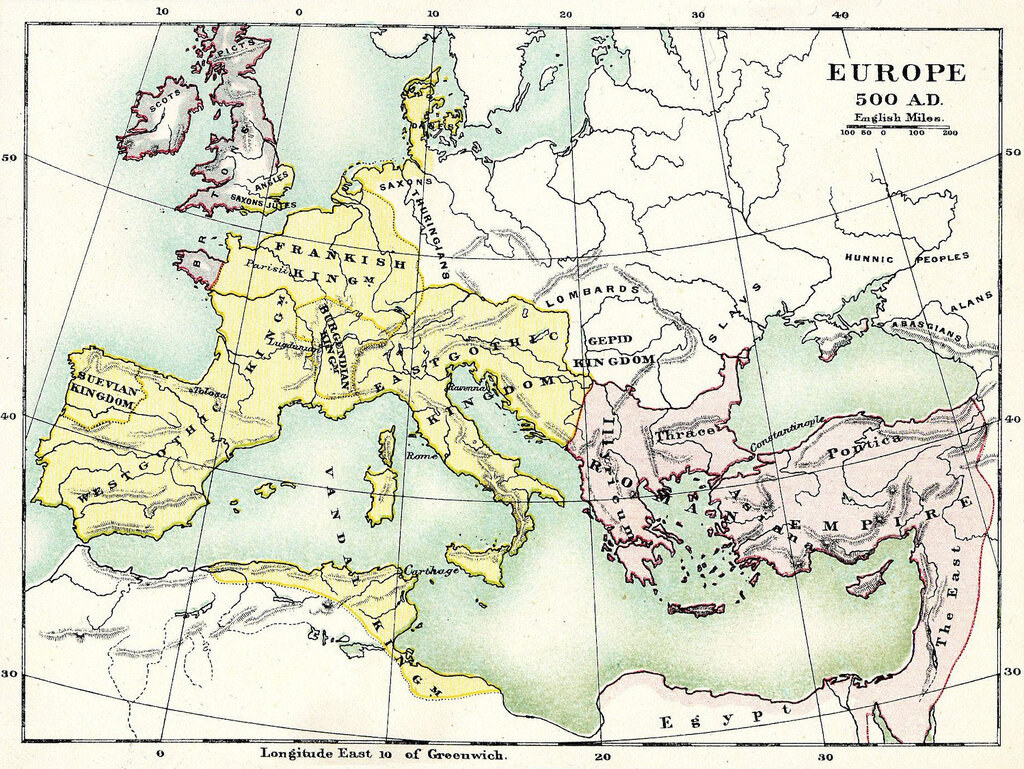
Out of this chaos, one Germanic tribe, the Franks, began to build a powerful kingdom in the region of modern-day France and Germany. Their most influential ruling family was the Carolingian dynasty. The Carolingians were shrewd leaders and skilled warriors who gradually expanded their territory and influence.
The greatest of them all was Charles the Great, or Charlemagne. He was a brilliant military strategist and a capable administrator who spent much of his reign on the battlefield, uniting a vast territory under his control. By the late 700s, his Frankish empire was the dominant power in Western Europe.
An Emperor Is Crowned
Something remarkable happened on Christmas Day in the year 800. While Charlemagne knelt in prayer at St. Peter's Basilica in Rome, Pope Leo III placed a crown on his head and declared him Imperator Romanorum, or Emperor of the Romans. This was a stunning move. The title of Roman Emperor hadn't been used in the West for over 300 years.
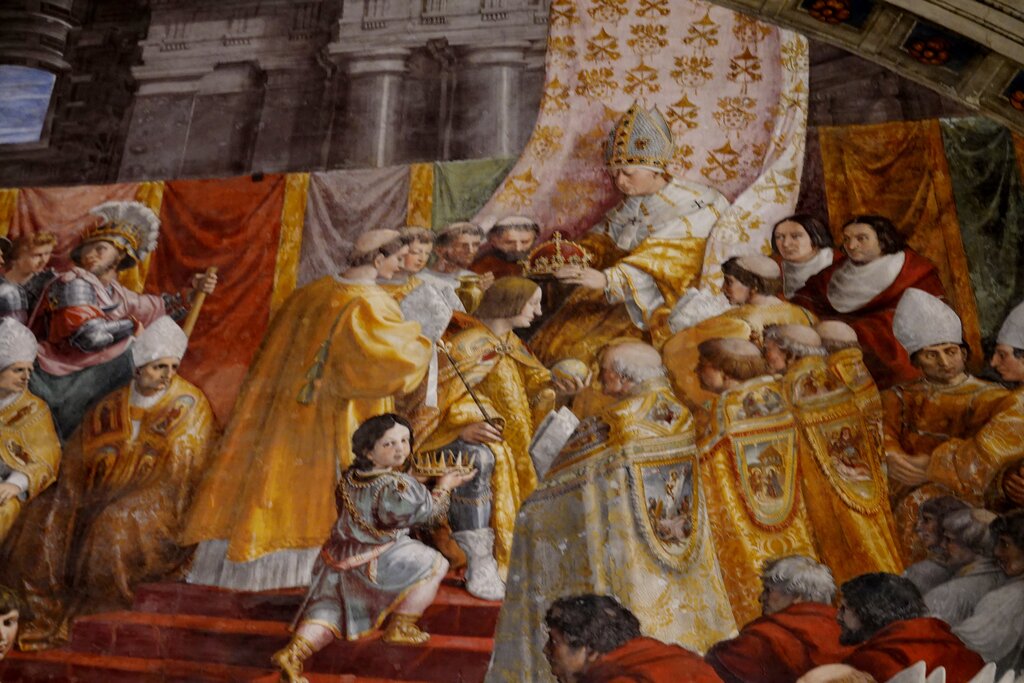
This single act was more than just a coronation. It was the symbolic birth of a new political entity, one that consciously blended three distinct traditions.
First, it was Roman. The title revived the idea of a universal, Christian empire in the West, drawing on the immense prestige and legacy of ancient Rome. It was an attempt to restore order and unity to Europe.
Second, it was Christian. The Pope's involvement was crucial. It established a powerful link between the secular power of the emperor and the spiritual authority of the Church. The emperor's right to rule was now seen as divinely sanctioned.
Finally, it was Germanic. Charlemagne was a Frankish king, not a Roman aristocrat. His power came from his military strength and the loyalty of his Germanic warriors. His empire was a new creation, led by the people who had inherited the lands of the old one.
This new empire wasn't a simple copy of the past. It was a unique fusion: Roman ideals, Christian authority, and Germanic power.
An Empire Divided
Charlemagne's empire was held together by his personal strength and charisma. After his death in 814, his heirs struggled to maintain control. His son, Louis the Pious, faced constant rebellions from his own sons, who were eager to rule their own kingdoms.
The infighting came to a head after Louis's death. In 843, his three surviving sons met in the city of Verdun to formally divide the vast Carolingian Empire among themselves.
After Charlemagne's death, his empire was divided up by his heirs into 3 sections in the Treaty of Verdun. This would eventually lead to the development of France and Germany.
The Treaty of Verdun split the empire into three parts:
- West Francia, which would eventually become the Kingdom of France.
- East Francia, which would form the core of the future Kingdom of Germany and the Holy Roman Empire.
- Middle Francia, a long, awkward strip of territory that ran from the North Sea down to Italy. This kingdom lacked geographic or cultural unity and soon fragmented.
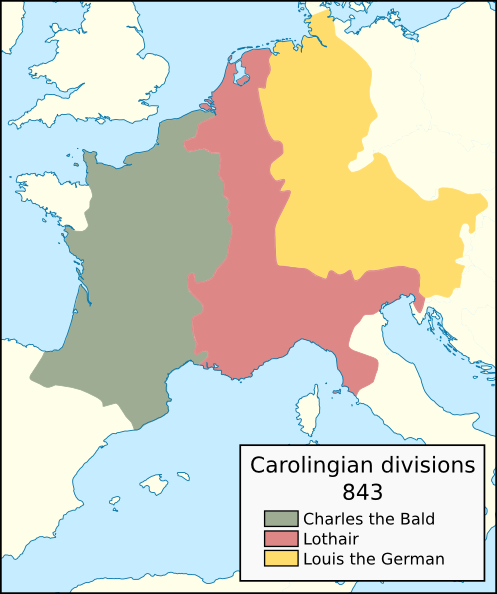
This division was a pivotal moment. The dream of a single, unified Christian empire in the West was shattered, but the pieces it left behind would shape the map of Europe for centuries. It was from the eastern kingdom, East Francia, that the Holy Roman Empire would eventually emerge, carrying forward the complicated legacy first established on that Christmas Day in 800.
What pivotal event occurred on Christmas Day, 800 AD, in Rome?
Charlemagne's newly established empire was a conscious blending of three distinct traditions. Which of the following lists them correctly?